

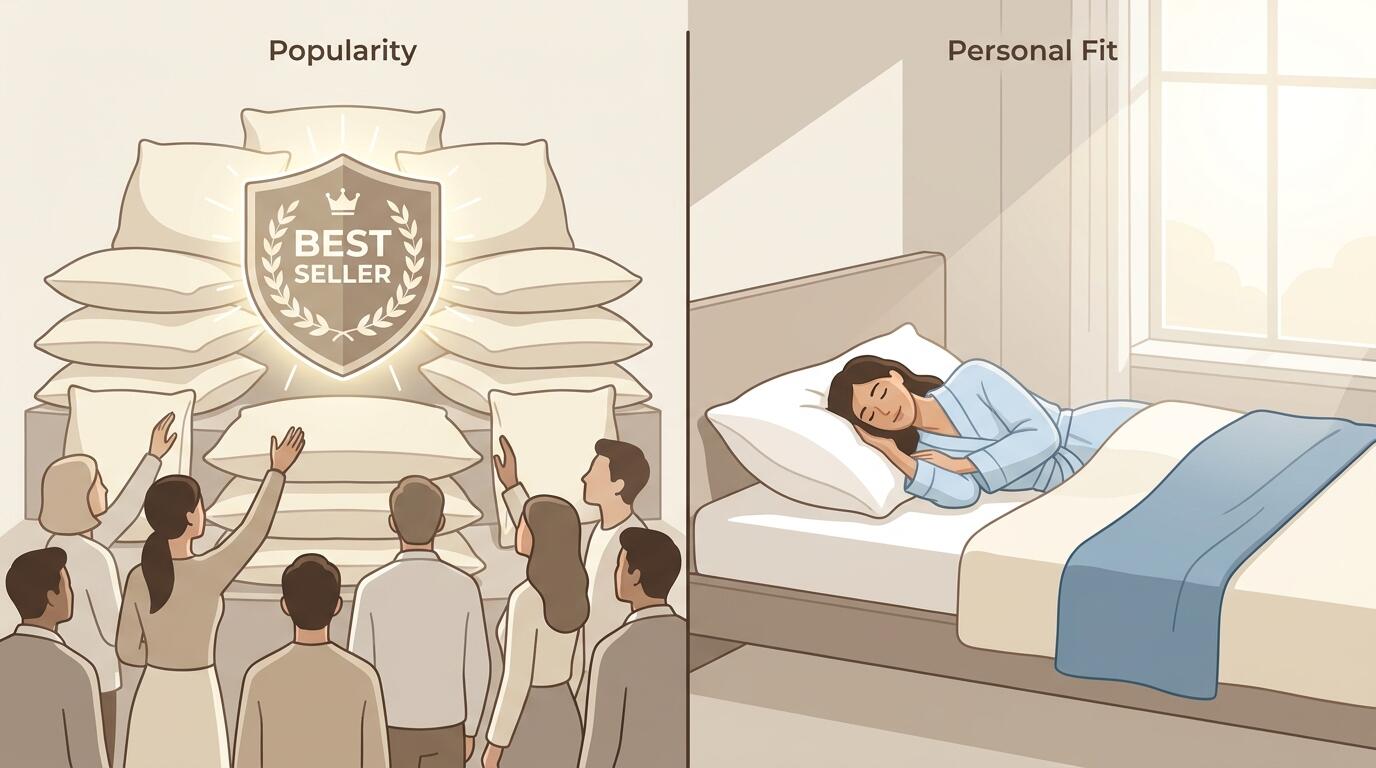
ALT: Best seller pillow rankings vs. personalized sleep comfort — why popularity doesn't guarantee the right fit
Why Popularity Doesn't Make a Pillow the Right Choice for Your Sleep
Key Conclusion: Best-seller pillow rankings reflect what sells broadly — not what works for your body, sleep position, or specific comfort needs. This guide breaks down the hidden factors that make a pillow genuinely right for you: from fill material and loft height to neck alignment and temperature regulation. Understanding these variables is what separates a good night's sleep from another restless one, and it's the foundation of how we approach product curation at SleepBetterMD.
Every week, we hear from shoppers who bought the highest-rated pillow on a major retail platform — the one with tens of thousands of reviews and a shiny "Best Seller" badge — only to wake up with a stiff neck, hot flashes, or the same dull ache they were trying to escape. The items on this list were selected based on patterns we consistently see in how people choose pillows versus what actually serves their sleep. Each factor represents a real gap between mass-market popularity and personal fit. Use this guide as a diagnostic tool: read through each point and ask yourself whether it applies to your situation.
The Real Reasons Best-Seller Badges Can Mislead Pillow Shoppers
Rankings Are Built on Volume, Not Fit
A best-seller ranking is a popularity metric — it tells you that many people purchased a product, not that those people slept better because of it. Retail algorithms favor products with high sales velocity, competitive pricing, and strong click-through rates. None of those signals are correlated with ergonomic suitability or material compatibility for any individual buyer.
In our experience sourcing and reviewing pillows from more than 20 Asian manufacturers, a pattern we consistently see is that mass-market bestsellers are often engineered to appeal to the broadest possible audience — which typically means a medium loft, a moderate firmness, and a fill that photographs well. This is a reasonable commercial strategy, but it produces a pillow that is average by design. For the many people with specific sleep challenges — chronic neck tension, shoulder impingement, temperature sensitivity, or allergy concerns — "average by design" is rarely good enough.
Best for: Anyone beginning to question why a highly rated product didn't work for them.
Watch out: High review counts can actually obscure individual fit problems. A pillow with 50,000 reviews may still have thousands of one-star ratings buried beneath the aggregate score — often from people with the same sleep profile as you.
Sleep Position Is the Single Most Important Variable
The right pillow for a side sleeper is almost certainly wrong for a stomach sleeper, and vice versa. Sleep position determines the ideal loft (height), firmness, and contouring behavior of a pillow. According to sleep medicine research published by academic sleep science programs, spinal alignment during sleep is directly linked to cervical support — and getting that wrong consistently contributes to morning discomfort and disrupted sleep cycles.
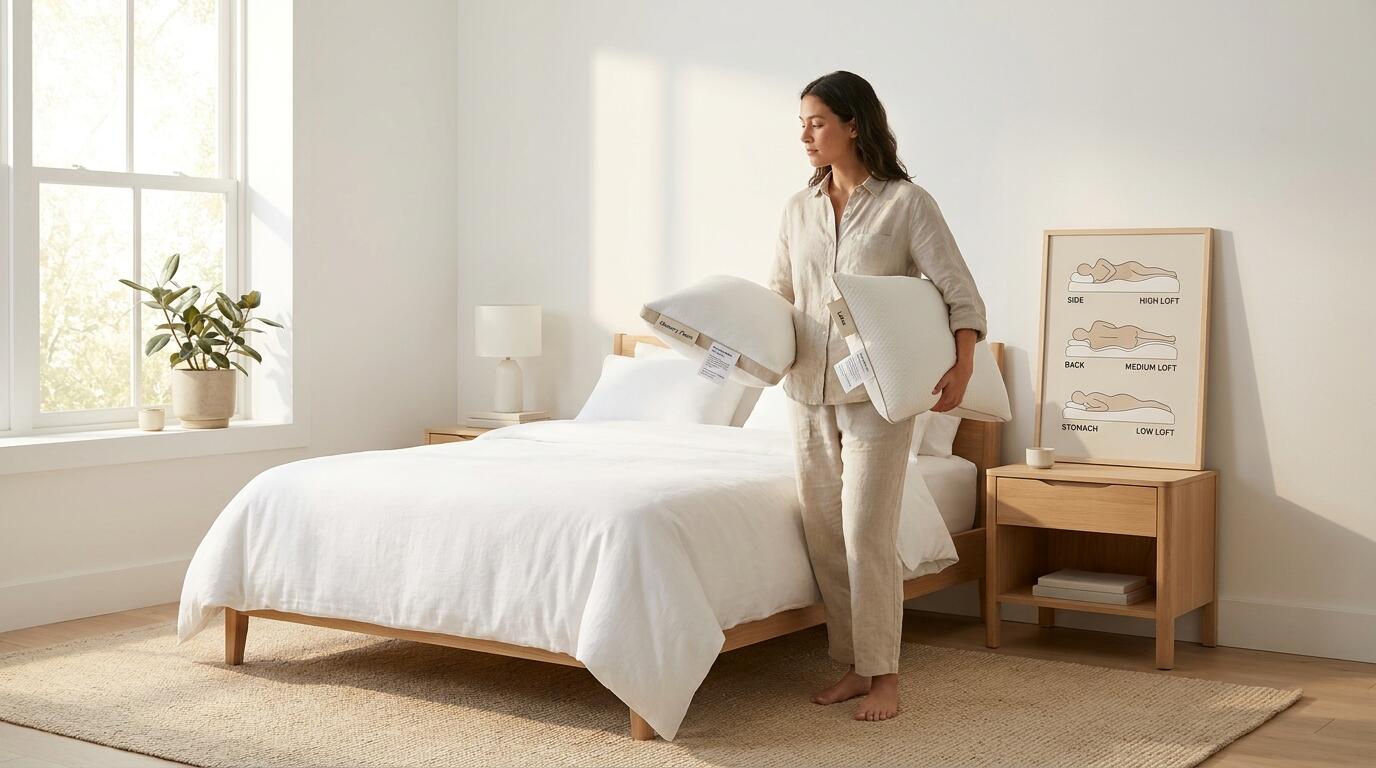
- Side sleepers generally need a higher loft to fill the gap between their shoulder and head, keeping the spine neutral.
- Back sleepers do best with a medium loft that cradles the head without pushing the chin toward the chest.
- Stomach sleepers need a low, soft pillow — or sometimes no pillow at all — to avoid hyperextending the neck.
A bestselling pillow is almost never optimized for one specific position. It splits the difference. If you are a committed side sleeper with broad shoulders, that compromise is working against you every night.
Best for: Shoppers who have never considered their sleep position when buying a pillow.
Watch out: Many people shift positions during the night. If you're a true combination sleeper, you'll want a pillow with adaptable fill — such as shredded latex or adjustable memory foam — rather than a fixed-loft design.
Fill Material Determines Far More Than Comfort
The fill inside a pillow governs how it responds to heat, how it holds its shape, how it compresses under weight, and how long it remains supportive. These are not minor details. Yet bestseller rankings rarely surface material differences — two pillows can sit next to each other in a top-ten list with entirely different fills, and the ranking tells you nothing about which one is right for your body chemistry or sleep environment.
At SleepBetterMD, our approach is built on what we call radical material transparency: every product in our collection comes with a clear breakdown of what's inside it and why that matters. The most common pillow fills — memory foam, latex, down, down alternative, buckwheat, and various polyester blends — each have distinct trade-offs:
- Memory foam conforms closely to head shape but retains heat and may off-gas initially.
- Latex is responsive and durable, naturally resistant to dust mites, and sleeps cooler than memory foam.
- Down is luxuriously soft and compressible but can trigger allergies and lacks firm support.
- Buckwheat is firm, adjustable, and excellent for heat dissipation, but noticeably heavy and audible when you move.
- Polyester fiber is affordable and hypoallergenic but compresses quickly and loses loft over time.
A bestseller badge tells you nothing about which of these fills you're getting or whether it suits your needs. For a deeper look at how material differences should drive your purchasing decisions, the SleepBetterMD guide to comparing sleep products by material, function, and long-term value offers a structured framework.
Best for: Anyone who has replaced multiple pillows without improvement and suspects the fill material may be the issue.
Watch out: Fill descriptions on product pages can be vague or technically accurate but practically misleading — "premium fiber fill" and "high-density memory foam" can describe dramatically different products with very different performance lives.
Loft Height Is Personal, Not Universal
Loft — the height of a pillow when lying flat — is one of the most underappreciated variables in pillow selection. Yet most product listings either omit it entirely or list a single measurement that may compress significantly under the weight of an average head.
The ideal loft for any given person is determined by their shoulder width, mattress firmness, and sleep position. A firmer mattress pushes your body up, reducing the gap your pillow needs to fill; a softer mattress lets you sink in, requiring less loft. Broadly speaking:
- Petite frames with narrower shoulders typically need a lower loft.
- Larger frames with broader shoulders typically benefit from a higher loft.
- The mattress surface changes this calculation significantly.
A bestselling pillow with a fixed medium loft may be perfect for someone in the middle of this distribution — but it's a rough fit for anyone on either end. We consistently hear from customers who slept on a "bestselling" pillow for months before realizing they'd been fighting the wrong loft the entire time.
Best for: Shoppers who wake up with neck stiffness that resolves within an hour or two — often a sign that their pillow loft is misaligned with their body type and mattress combination.
Watch out: Pillow loft can change substantially over time as fill compresses. A pillow that felt right when new may be effectively too flat after several months of use.
Temperature Regulation Is a Hidden Dealbreaker
A popular pillow that sleeps hot can undermine your sleep quality even if everything else about it is correct. Core body temperature drops naturally as you move into deeper sleep stages, and a pillow that traps heat near your head can interrupt that process and push you toward lighter, less restorative sleep.
According to research from sleep physiology institutions, ambient and surface temperatures around the head significantly influence sleep onset and sleep continuity. Despite this, temperature performance rarely shows up in bestseller rankings — reviews mention it, but platforms don't filter or rank on it, and the metric is invisible in a product's overall star rating unless you read carefully through hundreds of comments.
Materials like latex, buckwheat, and certain breathable textile covers actively support heat dissipation. Dense memory foam, in its standard form, tends to retain heat. If you frequently wake feeling warm, or if you live in a humid climate, this variable deserves serious weight in your buying decision — far more weight than any sales ranking gives it. If temperature regulation is a concern that extends beyond your pillow to your full sleep environment, the guide on bedding materials for hot, cold, and combination sleepers addresses it comprehensively.
Best for: People who describe themselves as "hot sleepers" or who frequently push pillows aside during the night.
Watch out: "Cooling" claims on product labels vary enormously in substance. Genuine cooling performance comes from fill density and cover breathability — not from marketing language alone.
Allergies and Sensitivities Are Invisible to Rankings
Bestseller lists are built from aggregate popularity. They cannot tell you whether a pillow's fill, cover fabric, or chemical treatment will irritate your skin, trigger your allergies, or aggravate your respiratory sensitivities. Yet a meaningful proportion of poor sleep experiences are linked to exactly these factors.
Natural down is a common allergen. Synthetic fills treated with chemical softeners or flame retardants can cause sensitivity reactions in some users. Pillow covers made with certain dyes or finishes may irritate skin that comes into contact with them for hours each night. None of this appears in a star rating unless an affected user happened to leave a detailed review — and even then, it's buried.
This is one reason material transparency is not just a marketing value at SleepBetterMD — it is a functional requirement for shoppers with sensitivities. Knowing the exact fill content, the cover fabric composition, and whether a product carries relevant certifications (such as OEKO-TEX Standard 100, which tests for harmful substances in textiles) allows you to make a genuinely informed decision. For more on what material transparency actually means in practice, the SleepBetterMD guide on material transparency when buying sleep products is a practical starting point.
Best for: Anyone with known allergies, asthma, eczema, or skin sensitivities who has never specifically checked pillow materials before purchasing.
Watch out: "Hypoallergenic" is a widely used term with no universal regulatory definition. Always check for a third-party certification rather than relying on a label claim.
Price Point Skews Rankings Toward the Middle
Bestseller lists on major platforms are disproportionately populated by mid-range products — not because mid-range pillows are inherently superior, but because they hit the price point most people are willing to click on impulsively. Very affordable pillows and premium pillows both appear less frequently in bestseller charts for purely commercial reasons unrelated to performance.
The practical consequence: the pillow that is genuinely right for you may be priced above or below the bestseller cluster. A high-quality latex pillow sourced from a reputable Asian manufacturer may cost more per unit than a mass-market synthetic pillow — but it may also last significantly longer and perform better across the variables that actually matter for your sleep. Conversely, a well-designed basic pillow from a transparent supplier might be a better value than a bestseller with inflated brand pricing.
Best for: Budget-conscious shoppers who assume the most popular option is also the best value.
Watch out: Longevity matters enormously in pillow value calculations. A pillow that costs more upfront but maintains its loft and support for years often represents better value than replacing a cheaper pillow every twelve months.
The Platform's Incentives Are Not Aligned with Your Sleep
Major retail platforms profit when products sell — not when shoppers sleep well. Bestseller rankings, sponsored placements, and "Customers also bought" algorithms are all optimized for engagement and purchase velocity, not for matching products to individual needs. This is not a criticism of the platforms; it is simply a description of how their business models work. But it matters for you as a buyer.
A pattern we consistently see is that shoppers who approach pillow buying the way they approach any other commodity purchase — scanning a top-ten list, checking the star rating, clicking the bestseller — end up cycling through multiple pillows without ever addressing the root cause of their sleep discomfort. The right framework is not "what's popular" but "what addresses my specific problem." This is the exact logic behind problem-first product navigation — a curation approach that starts with your sleep challenge and works backward to the product features that address it. If the sheer volume of options on mass-market platforms feels overwhelming, the piece on navigating the problem with 50,000 pillow options offers a structured alternative approach.
Best for: Anyone who feels paralyzed by choice or frustrated by repeated failed pillow purchases.
Watch out: Even curated product collections can reflect supplier preferences or inventory incentives. Look for retailers who are explicit about their selection criteria and material sourcing — transparency in the curation process is as important as transparency in the product itself.
Quick Comparison at a Glance
| Factor | Best For | Key Strength | Limitation |
|---|---|---|---|
| Sales volume rankings | Understanding broad market trends | Easy to access; signals general acceptance | No relationship to individual fit or sleep quality |
| Sleep position matching | Side, back, and stomach sleepers | Most direct predictor of spinal alignment | Combination sleepers need more flexible fill |
| Fill material selection | Allergy sufferers, hot sleepers, durability seekers | Addresses multiple performance variables at once | Requires more research and often higher upfront cost |
| Loft height calibration | People with neck or shoulder discomfort | Directly corrects the most common source of morning stiffness | Changes with mattress firmness and body frame; not a fixed number |
| Temperature regulation | Hot sleepers and humid-climate residents | Protects deeper sleep stages from heat disruption | "Cooling" claims are often unsubstantiated without certification |
| Allergy and sensitivity screening | Anyone with skin, respiratory, or chemical sensitivities | Prevents a preventable sleep disruptor | Requires reading past marketing language to actual material specs |
| Price-point context | Budget-conscious and value-focused shoppers | Corrects the assumption that popular equals best value | Premium options may require more initial research to justify |
| Platform incentive awareness | All shoppers | Shifts decision-making from passive scrolling to active problem-solving | Requires more deliberate effort than a quick bestseller search |
How to Choose the Right Pillow for Your Specific Sleep Needs
The most common misconception about pillow shopping is that it is a one-size-fits-most decision — that a highly rated product will work reasonably well for most people. In reality, pillow fit is closer to shoe fit: the right dimensions, structure, and material for one person can actively cause discomfort for another.
Here is a practical decision map based on common reader situations:
If you wake up with neck stiffness or upper back pain: Start with sleep position and loft. Identify whether your current pillow is pushing your head up too high or letting it drop too low. Side sleepers with broad shoulders almost always need more loft than a standard medium pillow provides.
If you frequently wake up feeling warm or unrested despite adequate hours: Temperature regulation should be your first filter. Look for latex, buckwheat, or breathable synthetic fills with high-thread-count cotton covers rather than microfiber.
If you have allergies or sensitivities: Material transparency is non-negotiable. Look for OEKO-TEX-certified products and avoid down or chemically treated synthetic fills without clear ingredient disclosure.
If you have gone through multiple pillows without improvement: The issue may be systemic rather than product-specific. Consider whether your mattress firmness, sleep environment temperature, or sleep position has changed — a different mattress can make a previously good pillow suddenly wrong.
If cost is a primary concern: Factor in replacement frequency. A well-constructed latex or natural fill pillow from a quality manufacturer may have a significantly longer service life than a budget synthetic, making the per-night cost competitive or lower.
The core principle: define the problem your pillow needs to solve before you evaluate any product. Sales rankings skip this step entirely.
ALT: Choosing the right pillow based on sleep position, fill material, and loft height rather than bestseller rankings
Questions & Answers
Q1: How do I figure out which pillow fill is actually right for me?
Start by identifying your primary sleep concern. Hot sleepers should prioritize breathable fills like latex or buckwheat. Side sleepers needing firm support typically do well with high-density latex or shredded foam. People with allergies should look for OEKO-TEX-certified synthetic fills or natural latex rather than down. According to sleep medicine research generally attributed to institutions including the American Academy of Sleep Medicine, sleep surface comfort directly influences sleep onset time and sleep quality — making fill selection a genuinely consequential decision, not a preference question.
Q2: Are "cooling" pillow labels a reliable indicator of temperature performance?
Cooling label claims are not reliable on their own. The term has no standardized regulatory definition, meaning a manufacturer can apply it to almost any product. Genuine cooling performance depends on fill density, cover fabric breathability, and airflow through the pillow structure. Look for specific material disclosures — open-cell latex, buckwheat hulls, or phase-change material covers are examples of fills and fabrics with documented heat dissipation properties. A pillow described only as "cooling" without material specifics is a marketing claim, not a performance guarantee.
Q3: How long should a quality pillow last, and how does that affect its real cost?
Pillow lifespan varies considerably by fill type. Polyester fiber pillows typically lose meaningful loft and support within one to two years of regular use. Memory foam pillows generally last longer but can degrade in resilience over time. Natural latex pillows are widely regarded as among the most durable fill options, with significantly longer functional lifespans under normal use conditions. When evaluating a pillow's value, dividing the purchase price by the expected number of months of use gives a more honest cost comparison than sticker price alone — a more expensive pillow that lasts substantially longer can be the more economical choice.
The Bottom Line
Best-seller badges measure commercial popularity, not personal fit. A pillow that dominates a retail ranking may be an excellent product for a broad market — but if your sleep position, body proportions, temperature sensitivity, or material sensitivities fall outside the average, that ranking tells you almost nothing useful. Three principles should guide every pillow decision:
- Define the problem first. Neck pain, heat disruption, allergies, and loft mismatch all require different solutions. Knowing which problem you're solving narrows the field far more effectively than any popularity metric.
- Demand material transparency. You spend roughly a third of your life in contact with your pillow. Knowing what it's made of — fill content, cover fabric, certifications, and sourcing — is a reasonable expectation, not an unreasonable request.
- Think in long-term value, not sticker price. The cheapest popular pillow may cost more per night of good sleep than a well-constructed alternative with a longer service life and better material fit.
The path to better sleep runs through self-knowledge and product transparency — not through a bestseller list. When you start with your specific sleep challenge and match it to verified product properties, the decision becomes clearer and the results more durable.
Ready to find a pillow that actually fits your sleep? Browse the curated collection at SleepBetterMD — every product is sourced from trusted Asian manufacturers with full material transparency and a problem-first navigation approach, so you can shop by sleep challenge rather than by popularity.
References
- American Academy of Sleep Medicine. "Sleep Health and Clinical Sleep Medicine Resources".
https://aasm.org - OEKO-TEX Association. "OEKO-TEX Standard 100 — Testing for Harmful Substances in Textiles".
https://www.oeko-tex.com - National Institutes of Health — National Center for Complementary and Integrative Health. "Sleep Disorders and Sleep Health Research".
https://www.nccih.nih.gov
Note: Standards and guidelines may be updated; please check the latest official documents or consult professional advisors.