

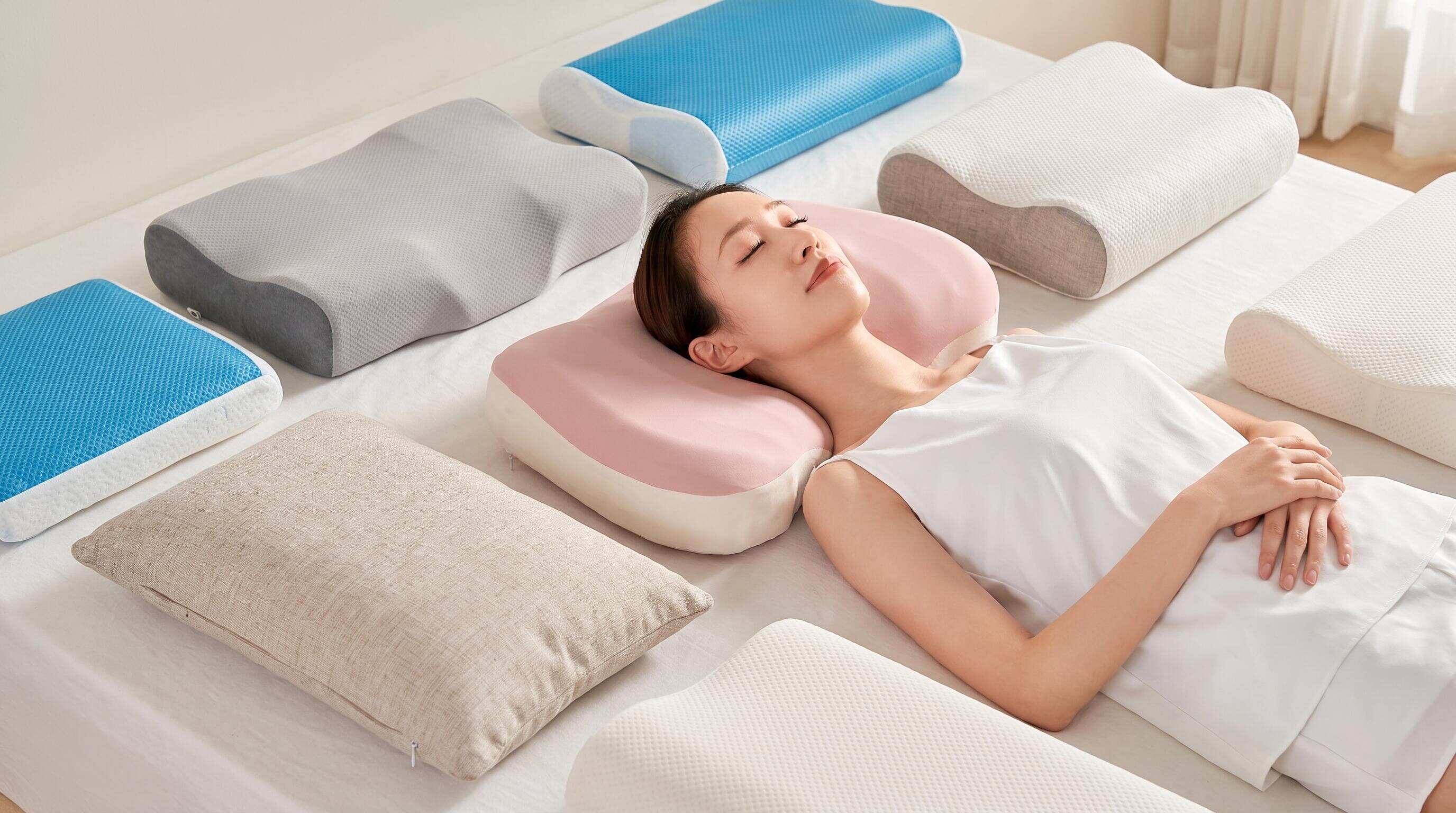
ALT: A selection of pillow types for comfortable and healthy sleep arranged on a bed
Finding the Right Pillow for a Comfortable, Healthy Night's Sleep
You wake up with a stiff neck — again. Or maybe you've been tossing and turning for months, blaming your mattress, your stress levels, your phone. But in our experience working closely with sleep-conscious shoppers, one of the most consistently overlooked culprits is the pillow. The right pillow supports your head, neck, and spine in alignment throughout the night; the wrong one quietly undoes your sleep quality one uncomfortable hour at a time.
This guide breaks down the most common pillow types available today — what each one is made of, who it genuinely suits, and where each falls short. The goal isn't to sell you on a single "best" pillow. It's to help you match a pillow to your actual sleep situation: your preferred position, your body, your specific discomforts, and your values around materials and sourcing.
The types covered here were selected based on a pattern we consistently see in the sleep product space: shoppers choose pillows on impulse, by price or brand recognition, without understanding the fundamental fill or construction differences that determine whether a pillow will actually help them sleep better. Each entry below addresses a real sleep need, with an honest look at trade-offs.
The Most Common Pillow Types — and Which Sleep Problems They Actually Solve
Memory Foam Pillows: Contouring Support for Pain-Prone Sleepers
Memory foam is a viscoelastic polyurethane material that responds to heat and pressure, conforming closely to the shape of your head and neck rather than simply compressing under weight. This contouring effect is the reason memory foam became one of the most widely recommended pillow fills for people dealing with neck pain, shoulder tension, or spinal alignment issues.
Solid memory foam pillows hold their shape through the night — there's no bunching, flattening, or mid-sleep need to punch and re-fluff. Shredded memory foam variants offer a similar contouring quality but with more adjustability, since you can add or remove fill to fine-tune loft (height). Both forms tend to run warm, which is a real consideration for hot sleepers.
The material transparency point matters here: not all memory foam is the same. Foam density, response time, and off-gassing levels vary significantly between manufacturers. At SleepBetterMD, we specifically source from manufacturers who disclose foam composition and certifications — because what you're sleeping on for eight hours a night deserves that level of honesty.
Best for: Side sleepers and back sleepers dealing with neck or shoulder pain; people who want a pillow that stays put and maintains consistent loft.
Watch out: Memory foam traps heat more readily than natural fills. If you sleep warm, look specifically for open-cell or ventilated foam constructions, or pair a memory foam pillow with breathable pillowcase materials.
Latex Pillows: Resilient, Responsive, and Naturally Cooler
A latex pillow is made from either natural rubber (derived from the Hevea brasiliensis tree) or synthetic latex, and it offers a distinctly different feel from memory foam — springy and responsive rather than slow-sinking and contouring. When you press into a latex pillow, it pushes back with gentle resistance, supporting the neck while allowing easy repositioning through the night.
Natural latex has several practical advantages. It is inherently resistant to dust mites and mold, making it a strong choice for allergy-prone sleepers. It also sleeps significantly cooler than conventional memory foam because of its open-cell structure and the pinholes typically incorporated into molded latex designs. Latex pillows tend to be among the more durable options — they hold their shape and resilience over time without developing the dead-spot compression common in lower-quality foam.
One important distinction: natural latex and synthetic latex are not equivalent. Natural latex sourced from certified rubber plantations carries a much cleaner material profile. Synthetic latex may include petrochemical additives that affect both feel and off-gassing. Knowing which you're buying matters — and it's a transparency issue that gets glossed over in mass-market retail.
Best for: Allergy-sensitive sleepers; people who run warm at night; those who want the support of foam with a more responsive, bouncier feel.
Watch out: Latex pillows are among the heavier pillow options and can feel too firm for stomach sleepers or lightweight individuals who prefer a softer, more plush surface. Natural latex is also a known allergen for a small subset of people — worth checking before committing.
Down and Feather Pillows: Soft, Moldable, and Luxuriously Light
Down is the soft, fine underplumage found beneath the outer feathers of geese and ducks. A down pillow is filled entirely or primarily with these clusters, producing an exceptionally light, lofty, and moldable feel. Feather pillows use the firmer quill-containing outer feathers, either alone or blended with down, resulting in a denser, more structured (and generally more affordable) option.
The appeal of down is its feel: nothing else quite replicates that soft, cloud-like compression that shapes itself to wherever your head lands. For stomach sleepers in particular — who need a low-loft, compressible pillow to avoid craning the neck — down is frequently the most comfortable natural option. Down pillows are also highly breathable and temperature-regulating because of the natural air-trapping structure of the clusters.
The trade-offs are real, though. Down requires regular fluffing and loses loft over time. It is also the pillow category most plagued by sourcing opacity — "duck down" can range from ethically harvested to live-plucked, and fill power (the measure of down quality and loft) varies enormously between products. According to the Sleep Foundation, fill power and shell thread count are both important quality indicators when evaluating down pillows. Transparency about sourcing and certification matters significantly in this category.
Best for: Stomach sleepers; those who love an ultra-soft, moldable feel; sleepers who run cold and want a naturally warm, cozy fill.
Watch out: Not suitable for people with feather or down allergies. Requires active maintenance (regular fluffing) to maintain loft. Sourcing ethics vary enormously — look for certified responsible sourcing disclosures before buying.
Down Alternative Pillows: Allergy-Friendly Softness Without the Animal Material
Down alternative pillows are filled with synthetic fibers — most commonly polyester, though microfiber and gel fiber constructions are increasingly common — engineered to approximate the soft, lofty feel of natural down. They are hypoallergenic by design, washable at home, and consistently more affordable than quality natural down.
For shoppers who want the moldable, medium-soft feel of down without animal-derived materials, down alternative is the go-to option. They're a practical choice for guest rooms, travel, or anyone building a sleep setup on a tighter budget without sacrificing softness. A pattern we see regularly: shoppers who start with down alternative for cost reasons often end up genuinely satisfied because modern microfiber fills have improved significantly in quality.
The limitation is longevity. Synthetic fills flatten and clump faster than either natural down or foam, and once they lose loft, they don't recover through fluffing the way down can. Budget-tier down alternative pillows in particular may need replacing more frequently.
Best for: Allergy-prone sleepers; people who prefer a soft, moldable feel but want a vegan or animal-free product; those who need a machine-washable option.
Watch out: Durability is the main concern. Lower-density synthetic fills can flatten within months under regular use. Prioritize products with higher fill weights and quality microfiber constructions for better longevity.
Buckwheat Pillows: Firm, Adjustable Support with a Distinct Feel
A buckwheat pillow is filled with the hulls of the buckwheat plant — the outer shells left after the grain is removed. These hulls are small, irregular, and rigid, packing together to form a firm, sculptable surface that holds its shape under the weight of your head. Buckwheat pillows have been used across East Asia for centuries and remain popular in Japan, Korea, and China for their supportive qualities.
The standout feature of a buckwheat pillow is adjustability: hulls can be added or removed through a zipper opening to dial in your preferred loft with precision. The pillow conforms to the shape of your neck and head, not through compression like foam, but through the collective shifting of thousands of individual hulls. This creates a firm, cradle-like support that many sleepers with neck pain find highly effective.
Buckwheat pillows also sleep cool — air circulates freely between the hulls — and they produce a soft rustling sound when you move, which some sleepers find soothing and others find disruptive. They are also heavy, significantly heavier than foam or fiber-fill options.
Best for: Back sleepers and side sleepers who want firm, adjustable support; heat-sensitive sleepers; those who want a minimally processed, natural fill.
Watch out: The rustling noise is a dealbreaker for some light sleepers. The firm feel is also very different from conventional Western-style pillows — it's worth trying if you've never used one before rather than assuming you'll love it.
Cooling Gel Pillows: Temperature Management for Hot Sleepers
Cooling gel pillows incorporate gel either as a layer or infused into foam to actively draw heat away from the body during sleep. They are designed specifically for hot sleepers — people who consistently wake up sweating, flip their pillow repeatedly searching for the cool side, or find their sleep disrupted by elevated body temperature.
Gel-infused memory foam is the most common construction: the gel particles are blended into the foam during manufacturing, moderating the temperature retention that standard foam is known for. Gel layers — either a solid gel cap applied to one side of the pillow or a separate layer within the fill — take a more direct approach, providing a cool-to-the-touch surface.
In our experience sourcing sleep products across Asian manufacturers, the effectiveness of cooling gel technology varies considerably between products. The cooling effect is often strongest in the initial minutes of contact and diminishes as the gel equilibrates to body temperature. For sustained cooling, the pillow cover material (look for phase-change material or highly breathable fabrics) makes as much of a difference as the gel itself.
Best for: Hot sleepers and night sweaters; anyone who consistently sleeps warm regardless of room temperature; people who already love memory foam's support but need a cooler alternative.
Watch out: The cooling effect is often temporary rather than sustained through the entire night. Paired with a breathable pillowcase in moisture-wicking or phase-change fabric, the performance improves significantly. Don't rely on gel alone if you're a serious hot sleeper.
Cervical (Contour) Pillows: Engineered Support for Specific Neck Needs
A cervical pillow — also called a contour pillow — is shaped with a distinct ergonomic profile: typically a lower central section for head placement and raised edges on either side to support the neck in different sleep positions. The design is intended to maintain the natural cervical curve of the spine during sleep, reducing the muscular strain that can cause waking neck pain and headaches.
Cervical pillows are most often made from memory foam, latex, or a combination, since these materials hold the shaped structure without collapsing. They are a step beyond "supportive" into actively corrective — and that specificity is both their strength and their limitation.
According to Good Housekeeping's expert-tested pillow evaluations, contour pillows perform best when the sleeper's body dimensions and preferred position match the pillow's geometry. A cervical pillow engineered for a side sleeper of average shoulder width will not perform the same way for someone with broader shoulders or for a back sleeper. Getting this wrong can actively worsen neck discomfort rather than improve it.
Best for: Back and side sleepers with diagnosed or chronic neck pain; those who wake regularly with tension headaches; sleepers who have already confirmed that pillow loft and support are contributing to their discomfort.
Watch out: The fit is highly specific. If the contour dimensions don't match your body and sleep position, the pillow works against you. Try to assess the pillow's loft measurements against your own shoulder-to-neck dimensions before buying.
Hybrid Pillows: Layered Fills for Complex Sleep Needs
A hybrid pillow combines two or more fill materials — most commonly a memory foam or latex core with an outer layer of down alternative or microfiber — to balance the competing properties of support and softness. The logic mirrors hybrid mattress design: use each material where it performs best, mitigating the weaknesses of either fill in isolation.
Hybrid pillows are particularly well-suited to combination sleepers — people who move between back and side positions through the night — since they need a pillow that provides structural support without sacrificing surface softness. The core holds loft and maintains alignment; the outer fill softens the feel and adds breathability.
The trade-off is complexity in both manufacturing and care. Hybrid constructions require more scrutiny around material quality at each layer. A well-built hybrid pillow from a manufacturer who discloses what goes into each layer is a genuinely excellent product. A poorly built one is an expensive disappointment.
Best for: Combination sleepers; people who need support but find solid foam too firm; those willing to invest in a pillow that addresses multiple sleep needs simultaneously.
Watch out: Not all hybrid pillows are equally well-constructed. Look carefully at what each layer is made of, how it's assembled, and whether the manufacturer provides transparency around materials. Layered constructions can mask lower-quality fills on the interior.
Quick Comparison at a Glance
| Pillow Type | Best For | Key Strength | Limitation |
|---|---|---|---|
| Memory Foam | Side and back sleepers with neck pain | Consistent contouring support, no flattening | Retains heat; off-gassing possible |
| Latex | Allergy-sensitive and warm sleepers | Responsive support, naturally cool, durable | Heavy; firm feel may not suit all; latex allergy risk |
| Down and Feather | Stomach sleepers, cold sleepers | Ultra-soft, moldable, lightweight | Needs fluffing; sourcing ethics vary |
| Down Alternative | Allergy-prone; budget-conscious | Hypoallergenic, washable, soft | Flattens faster than natural fills |
| Buckwheat | Back and side sleepers wanting firm support | Fully adjustable loft, sleeps cool | Heavy; rustling noise; very firm feel |
| Cooling Gel | Hot sleepers | Active heat dissipation, pairs with foam support | Cooling effect diminishes over time |
| Cervical/Contour | Chronic neck pain sufferers | Engineered spinal alignment support | Highly specific fit; wrong size worsens pain |
| Hybrid | Combination sleepers | Balances support and softness in one pillow | Quality varies; requires material transparency |
How to Choose the Right Pillow for Your Sleep Situation
The single most important variable in pillow selection is sleep position — and it's the one most people overlook when browsing options.
Side sleepers need a high-loft, firmer pillow to fill the gap between the head and the mattress, keeping the spine in a straight lateral line. Memory foam, latex, and buckwheat all work well here. A pillow that's too soft or too low causes the head to drop, creating the lateral neck strain that leads to morning stiffness.
Back sleepers need a medium-loft pillow that supports the natural cervical curve without pushing the head too far forward. Latex, medium-density memory foam, and cervical contour pillows are all strong candidates. The common mistake we see is back sleepers using pillows designed for side sleepers — the extra loft cranes the neck forward and compounds the problem.
Stomach sleepers — and sleep experts broadly agree this position puts the most strain on the cervical spine — need a very soft, compressible, low-loft pillow. Down and down alternative are the best natural fits. For stomach sleepers, the goal is minimal elevation, not maximal support.
Beyond position, consider these factors:
- Temperature sensitivity: If you routinely sleep warm, cooling gel, latex, or buckwheat should be prioritized over conventional memory foam.
- Allergies: Down alternative, latex (confirmed non-allergenic), and buckwheat are the safest choices for allergy-prone sleepers.
- Neck or pain concerns: Cervical contour or high-quality memory foam, sized correctly for your body, offers the most structured relief.
- Material values: If sourcing transparency and material honesty matter to you, look for manufacturers who disclose fill composition, certifications, and sourcing origin — not just brand names.
A common misconception worth correcting: a firmer pillow is not automatically a more supportive or healthier pillow. Firmness needs to match your sleep position and body weight. A very firm pillow that holds your head too high creates as many problems as one that offers no support at all.
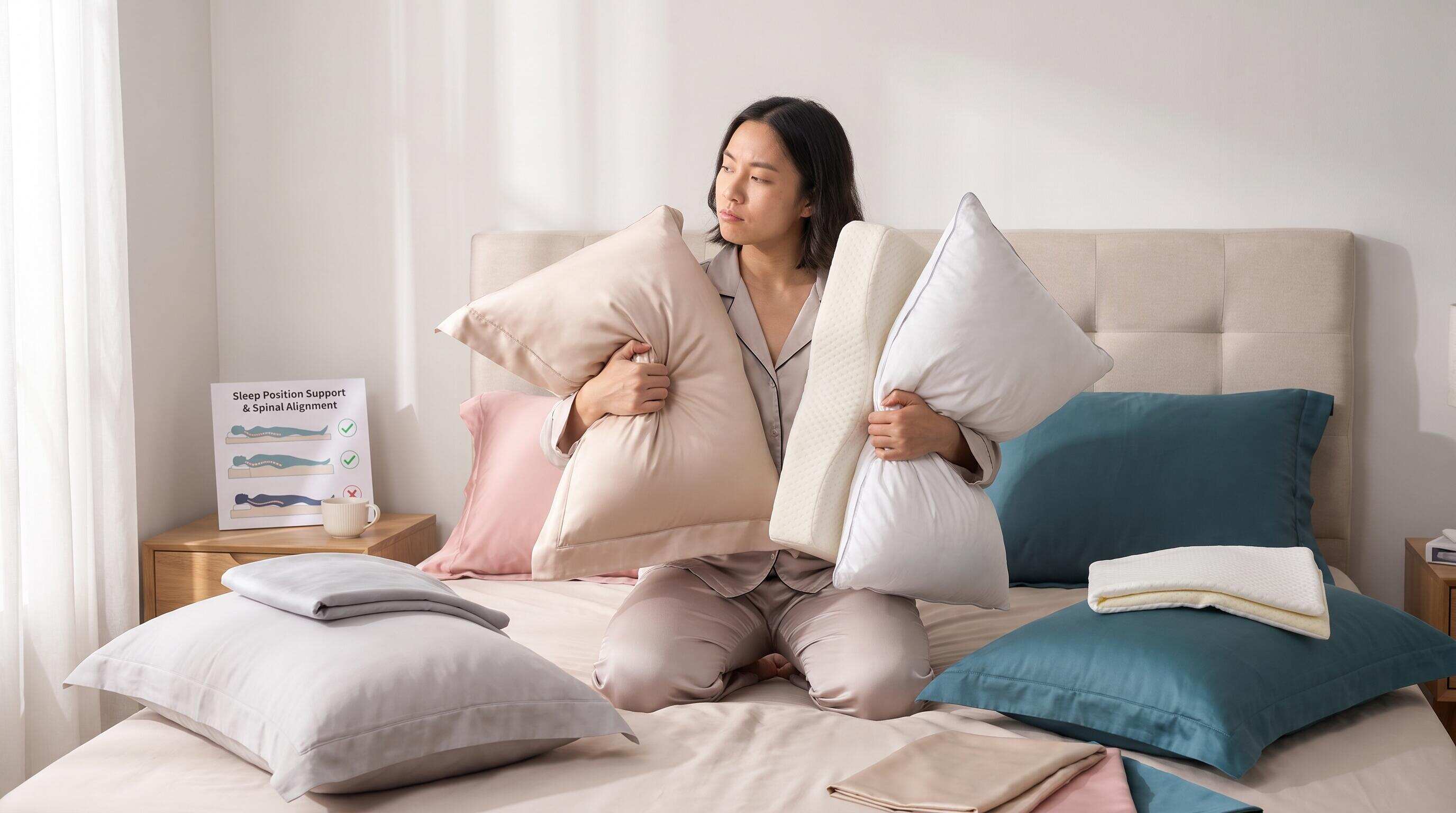
ALT: Person comparing different pillow types for sleep position support, comfort, and healthy spinal alignment
Questions & Answers
Q1: How does sleep position affect which pillow type is healthiest for me?
Sleep position is the primary determinant of ideal pillow loft and firmness. Side sleepers need a higher, firmer pillow to maintain lateral spinal alignment, while back sleepers benefit from medium loft that preserves the natural neck curve without pushing the head forward. Stomach sleepers require a very low, compressible pillow to minimize cervical strain. Matching pillow construction — whether memory foam, latex, or down — to your dominant sleep position is the foundational step toward choosing a pillow that genuinely supports healthy sleep.
Q2: Are natural fill pillows (down, latex, buckwheat) healthier than synthetic ones?
Natural fills are not automatically healthier, but they often offer specific advantages: natural latex resists dust mites and mold; buckwheat sleeps exceptionally cool; responsibly sourced down is highly breathable and temperature-regulating. The health-relevance depends on your individual needs. For allergy-prone sleepers, hypoallergenic synthetic fills or latex may be safer than down. For those prioritizing off-gassing concerns, certified natural latex or buckwheat may feel more comfortable than petroleum-based foams. Material transparency — knowing exactly what's in your pillow — matters as much as whether the fill is natural or synthetic.
Q3: How often should I replace my pillow for the best sleep quality?
Pillow lifespan varies significantly by fill type. Down alternative and standard polyester pillows typically need replacing every one to two years as synthetic fills compress and lose resilience. Quality down pillows, properly maintained with regular fluffing, can last considerably longer. Natural latex pillows are among the most durable, retaining their shape and support for several years under normal use. A simple test: fold your pillow in half and release it — if it stays folded rather than springing back, it has lost the structural integrity needed for healthy sleep support and should be replaced.
Key Takeaways
Choosing the right pillow is not about finding a universally "best" option — it's about matching the right fill and construction to your specific sleep position, temperature preferences, and any existing discomforts.
Three points worth carrying forward:
First, sleep position is the foundation of pillow selection. Side, back, and stomach sleepers have genuinely different structural needs, and a pillow optimized for one position can actively worsen sleep quality for another.
Second, material transparency matters. What a pillow is filled with — and how honestly that information is presented — affects both sleep quality and long-term health considerations. Fill composition, sourcing origin, and relevant certifications are not marketing extras; they're meaningful product information.
Third, the most expensive or most popular pillow is not automatically the right one for you. A well-matched, mid-range pillow in the right fill for your sleep position will outperform a premium pillow that doesn't fit your needs.
Before buying, start with your sleep position. Then layer in your temperature sensitivity, any allergy considerations, and your values around material sourcing. That sequence leads to a genuinely better decision than browsing by price point or brand recognition alone.
Ready to wake up feeling genuinely rested? SleepBetterMD takes the guesswork out of building your perfect sleep setup — every pillow, sheet, and sleepwear piece is hand-picked from 20+ trusted Asian manufacturers and presented with full material transparency so you know exactly what you're sleeping on. Visit SleepBetterMD to explore curated sleep solutions matched to your specific sleep challenges, and start your journey toward better nights tonight.
Sources
- Sleep Foundation. "The Best Pillows of 2026: Expert Tested and Reviewed".
https://www.sleepfoundation.org/best-pillows - Good Housekeeping. "9 Best Pillows of 2026, Tested for All Sleep Positions".
https://www.goodhousekeeping.com/home-products/pillow-reviews/a71462340/best-pillow/ - National Institutes of Health (NIH) — National Library of Medicine. Research on sleep ergonomics, cervical support, and musculoskeletal health during sleep.
https://www.nlm.nih.gov/ - OEKO-TEX Association. OEKO-TEX STANDARD 100 — Testing for harmful substances in textiles and filling materials used in bedding products.
https://www.oeko-tex.com/
Note: Standards may be updated; please check the latest official documents or consult professional advisors.