

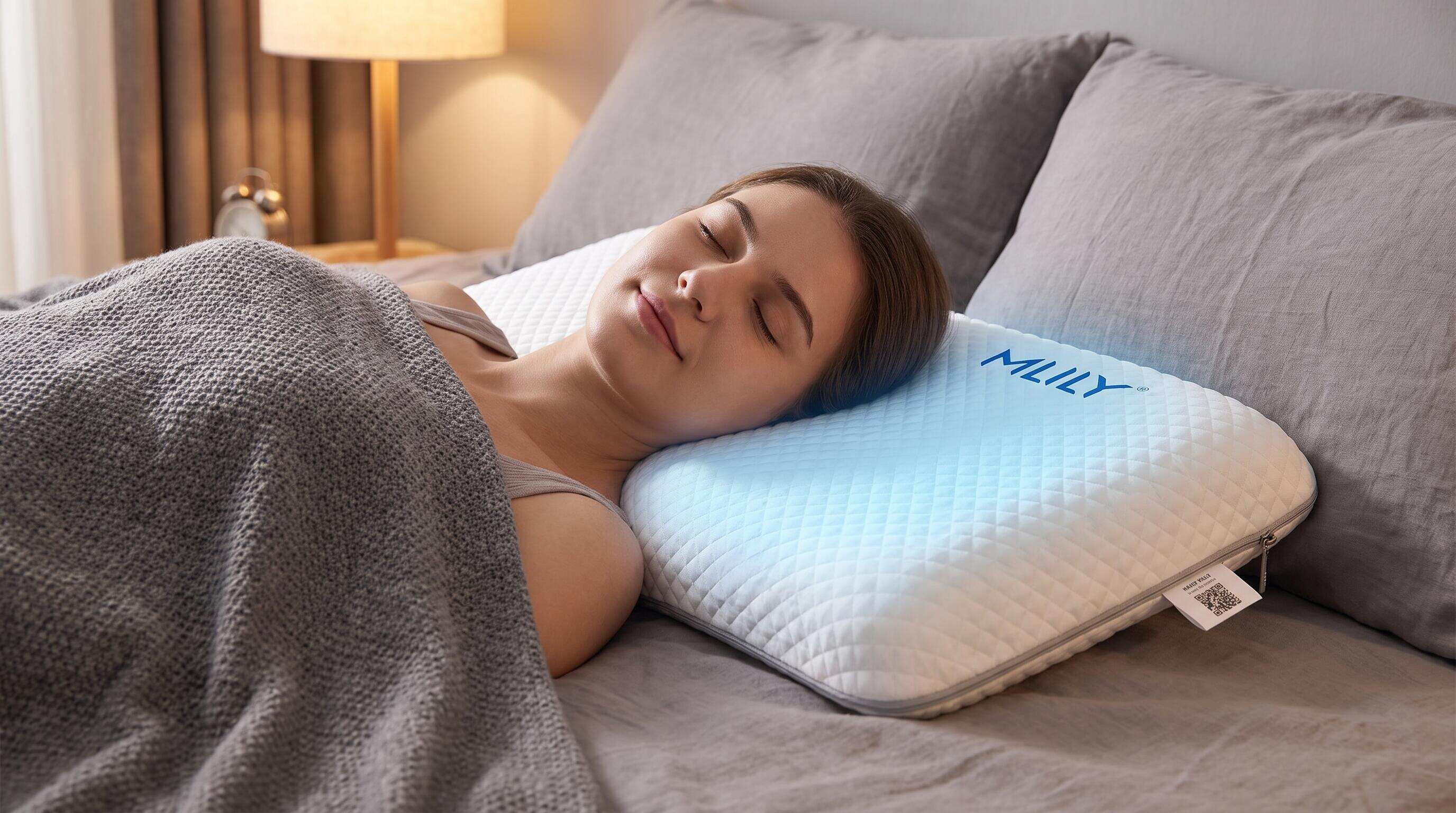
ALT: Person sleeping comfortably on a supportive pillow showing key features for improved sleep quality
What Actually Makes a Good Pillow — and Why Most People Get It Wrong
The single question worth asking before you buy another pillow is this: does it keep your head, neck, and spine in a neutral line while you sleep in your usual position? If the answer is yes, you have a good pillow. If the answer is unclear — because the label says nothing useful about loft, firmness, or materials — you are looking at the kind of generic product that dominates most bedding aisles and delivers mediocre results.
A genuinely good pillow does three things well: it supports your specific sleep position, it stays comfortable across the night without trapping heat or causing allergic reactions, and it is made from materials whose properties you can actually verify. At SleepBetterMD, a Hong Kong-based DTC sleep products retailer that curates pillows from more than 20 Asian manufacturers, these three criteria are the starting point for every product that reaches our shelves — not an afterthought. The sections below break down each factor in practical detail so you can make a genuinely informed decision, whether you shop with us or anywhere else.
Who This Guide Is For — and Where It Has Its Limits
This guide is most useful for:
- Adults who wake up with neck stiffness or shoulder tension and suspect their pillow is partly responsible
- Hot sleepers who find themselves flipping the pillow through the night looking for a cool surface
- People with skin sensitivity or allergies who want to understand what is inside their pillow before they rest their face on it
- Anyone who has bought two or three pillows in recent years and still has not found one that genuinely works
Where this guide is not a substitute:
- It does not replace an assessment by a physiotherapist or medical professional if you have a diagnosed cervical spine condition or chronic pain disorder
- It does not cover infant or toddler sleep surfaces, which have entirely different safety standards
- Material information here is general and educational; always read the specific product disclosures before purchasing
Why the "Right Pillow" Question Matters More Than Ever
For most of human history, pillows were a luxury that very few people gave much thought to. Today, the global pillow market is worth several billion dollars and growing — yet a striking number of sleepers still describe waking up tired, stiff, or with a nagging headache that disappears an hour into the morning. The correlation is not coincidental.
Research published by the National Institutes of Health highlights the biomechanical significance of pillow height — or "loft" — in determining cervical spine alignment during sleep. Misalignment, even mild and sustained across multiple hours, contributes to muscular tension that can disrupt sleep architecture and accumulate into daytime discomfort. Put plainly: a pillow that puts your neck at an awkward angle night after night is quietly working against your recovery. According to Harvard Health Publishing, the wrong pillow can contribute to neck pain, headaches, and even arm numbness, depending on how it positions the cervical spine.
The problem is compounded by the way most pillows are sold. Packaging tends to emphasize softness descriptors ("cloud-like," "ultra-plush") or vague certifications rather than communicating the information that actually matters for sleep quality: fill material and its properties, loft range, firmness level, and how the pillow responds to body heat. A pattern we consistently see at SleepBetterMD — working across dozens of pillow categories and manufacturers — is that shoppers who struggle most with pillow satisfaction are those who chose based on price alone or on aesthetic packaging rather than on fit with their sleep position and body type.
The good news is that once you know the four or five variables that determine pillow performance, the decision becomes much clearer.
The Core Features of a High-Quality Pillow
Three Questions to Ask Before You Buy
Step 1: Identify your primary sleep position
Your sleep position is the single most important variable in pillow selection, and it takes no more than a few honest minutes to confirm. Back sleepers generally need a medium loft pillow that keeps the head level with the spine without pushing the chin toward the chest. Side sleepers typically need a higher loft to bridge the gap between shoulder and ear. Stomach sleepers — a position that is inherently hard on the cervical spine — usually do best with the lowest possible loft, or sometimes no pillow at all under the head. If you switch positions through the night, look for a fill material that allows compression and redistribution, such as shredded memory foam or down-alternative microfibers.
Step 2: Match fill material to your most pressing sleep complaint
Once you know your position, the next variable is your dominant sleep problem. Sleeping hot? Prioritize fills with natural breathability (such as buckwheat, latex, or responsively aerated foam) over traditional solid memory foam, which retains heat. Sensitive skin or allergies? Look for hypoallergenic fills — natural latex and certain synthetics perform well here — and pay close attention to the cover fabric. Neck pain? A fill with meaningful shape retention (latex, firmer foam, or densely packed fiber) will hold its position through the night rather than compressing unevenly. At SleepBetterMD, we disclose fill composition percentages and sourcing information precisely because these details should drive your choice.
Step 3: Confirm the cover fabric and care requirements
The pillowcase you put on top handles most of your skin contact, but the pillow cover itself matters for breathability, durability, and allergen resistance. Natural cotton covers breathe well and tend to stay cooler. Bamboo-derived fabrics are increasingly popular for their soft texture and moisture-wicking properties. Synthetic covers are often more durable and easier to clean. Look for a removable, machine-washable cover whenever possible — a pillow you cannot keep clean will degrade in hygiene and performance faster than its fill material would otherwise dictate.
Comparing the Most Common Pillow Fill Materials
Choosing the right fill is where most of the practical nuance lives. The table below compares the fill types you are most likely to encounter, across the dimensions that matter most for sleep quality and long-term value.
| Comparison Dimension | Memory Foam (Solid) | Latex (Natural or Blended) | Down / Down-Alternative | Buckwheat |
|---|---|---|---|---|
| Spinal support | High; conforms closely | High; responsive rebound | Low to medium; compresses | High; fully adjustable |
| Temperature regulation | Tends to retain heat | Generally cooler than foam | Good airflow; varies by fill weight | Excellent; air circulates between hulls |
| Hypoallergenic suitability | Good (closed-cell, dust-mite resistant) | Good if certified; check latex allergy | Down: poor; alternatives: good | Generally good; check for dust sensitivity |
| Adjustability | Low; fixed shape | Low to medium | Medium; can be de-stuffed | High; hulls can be added or removed |
| Durability | Medium-high | High | Medium; clumps over time | Medium; hulls degrade slowly |
| Best for | Side and back sleepers with neck pain | Most position types; hot sleepers | Those prioritizing softness and lightness | Sleepers who want a fully customizable loft |
No fill material is universally best. The right choice depends on your position, temperature preference, and sensitivity profile — which is exactly why shopping by your sleep problem first, rather than by fill type or price bracket, tends to produce better outcomes.
Understanding Loft, Firmness, and Why They Are Not the Same Thing
Loft and firmness are often conflated, but they describe different properties. Loft is the height of the pillow when it is uncompressed — essentially its thickness. Firmness describes how much resistance the fill provides when weight is applied. A pillow can be high-loft and relatively soft (think a generously stuffed down pillow that compresses easily under your head), or medium-loft and firm (think a dense latex pillow that barely changes shape under pressure).
Both dimensions affect spinal alignment. A high-loft pillow that is too soft for a side sleeper may compress down to an insufficient height during the night, producing the same misalignment problem as a pillow that was too flat to begin with. A pillow that is too firm can hold the head at an exaggerated angle, creating tension in the opposite direction.
The practical implication: when evaluating a pillow, ask about both loft and firmness — ideally with some indication of how the fill responds under sustained pressure, not just how it feels when you first press it in the store or unbox it at home.
Material Transparency — Why It Should Be Non-Negotiable
One of the persistent frustrations in the bedding industry is the gap between what pillow labels claim and what they actually disclose. A label that reads "premium fiberfill" or "proprietary foam blend" tells you almost nothing about how the material will perform or what you are resting your face against for eight hours a night.
At SleepBetterMD, radical material transparency is a founding principle, not a marketing phrase. Every pillow in our range comes with full ingredient and material disclosure — fill composition (including percentages where relevant), cover fabric identity and construction, and any third-party certifications the manufacturer holds. We source across more than 20 Asian manufacturers specifically because working directly with makers allows us to verify these details at the production level rather than relying on importer summaries.
This matters practically because certain materials carry genuine health considerations. Natural latex, for instance, can trigger reactions in people with latex sensitivity — a fact that should be front and center in any responsible product listing. Some synthetic foams contain volatile organic compounds (VOCs) at levels that are low but non-zero; CertiPUR-US certification, for example, is a testing program that screens for specific chemical thresholds, and knowing whether a foam pillow carries that certification is useful information. We will not stock a product whose material composition we cannot verify and clearly communicate.
Longevity and Value: Getting the Most from Your Investment
A well-made pillow is not the cheapest item in the bedroom, and it should not be. But the calculation looks different when you consider cost-per-night rather than sticker price. A quality latex or foam pillow that maintains its support for several years often works out less expensive per night than a budget pillow replaced every twelve months — and delivers meaningfully better sleep in the interim.
The Sleep Foundation notes, as a general guideline, that most pillows benefit from replacement every one to two years, though higher-quality materials can extend that window considerably. Signs that a pillow has exceeded its useful life include visible flattening that does not recover, persistent odor despite washing, and recurring neck discomfort that improves after switching to a different pillow.
Caring for your pillow correctly also extends its lifespan. Most fiber-fill pillows can be machine-washed; solid foam and latex pillows generally cannot (spot cleaning only). Using a pillow protector underneath your pillowcase reduces sweat and oil accumulation in the fill, which is one of the more cost-effective maintenance habits available.
Advanced Considerations: Special Situations and Common Misconceptions
Combination sleepers need adjustability, not compromise. Many people assume that because they switch positions, they need a "universal" pillow — typically marketed as medium loft and medium firmness. In practice, a better solution is a pillow with adjustable fill, such as a shredded foam or buckwheat option that can be reshaped as you move. The goal is a pillow that adapts, not one that is merely average in all dimensions.
Firmness preference and support needs are not the same thing. A common misconception is that if you like the feel of a soft pillow, you should buy a soft pillow. Subjective feel at the point of sale, however, is a poor proxy for overnight performance. Many people genuinely prefer the sensation of sinking into a plush surface but sleep better on something with more structure. The test that matters is how you feel when you wake up, not how the pillow feels the moment your head touches it.
Pillow certifications are useful but not sufficient on their own. Certifications like OEKO-TEX Standard 100 (which tests for harmful substances in textiles) or CertiPUR-US (for foam) are meaningful quality signals — but they speak to chemical safety, not to ergonomic suitability. A certified pillow can still be the wrong loft or fill type for your sleep position. Use certifications as a floor, not a ceiling, for your evaluation.
The pillow and mattress work together. A firmer mattress allows less shoulder sink for a side sleeper, which changes the effective loft needed from the pillow. If you have recently changed your mattress, your previous pillow may no longer be the right fit even if it was working well before.
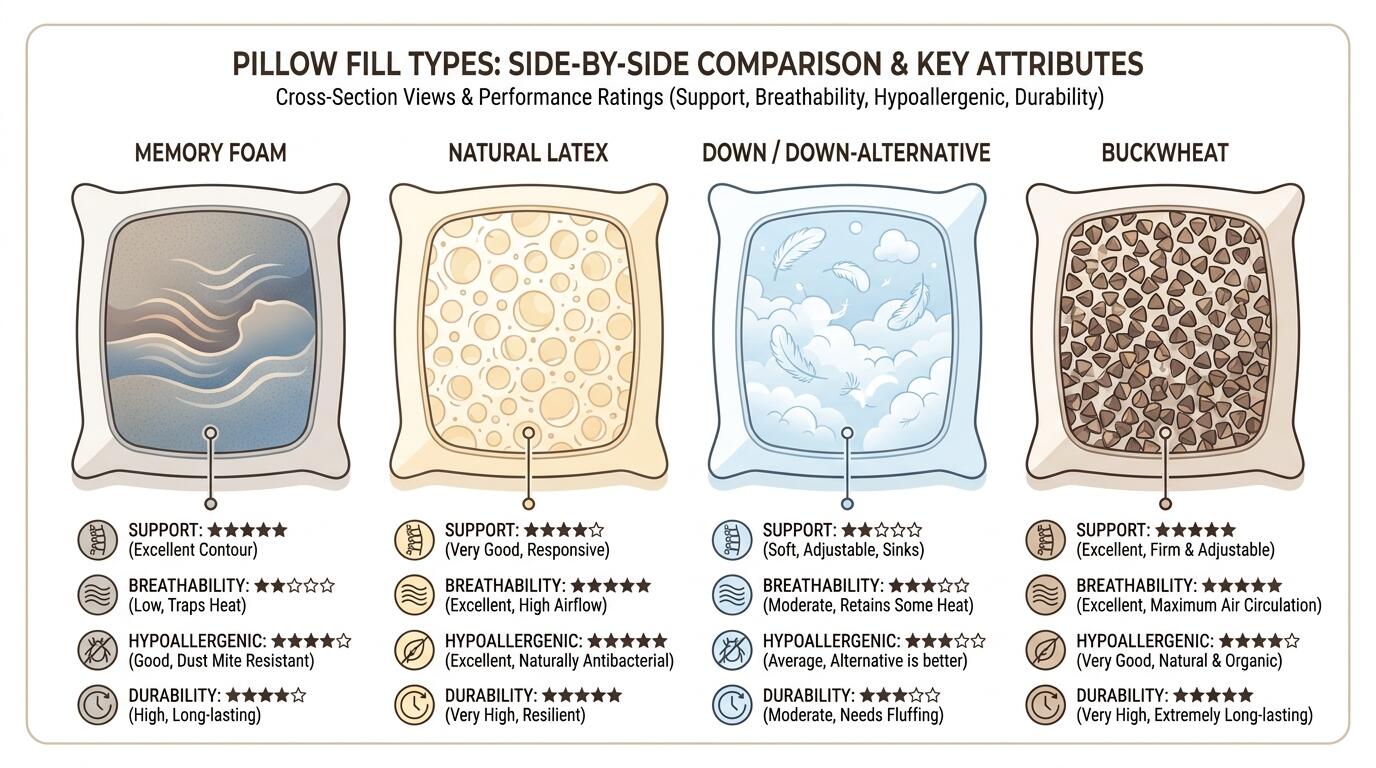
ALT: Comparison of memory foam, latex, down, and buckwheat pillow fills showing key features that affect sleep quality and spinal support
Frequently Asked Questions
Q1: How do I know if my pillow is the right loft for my sleep position?
A straightforward test: lie in your habitual sleep position with your current pillow and have someone photograph your profile, or use a mirror set up so you can check your own alignment. Your head should be level with your spine — not tilted upward or dropped downward. If your neck curves sharply in either direction, your loft is likely off. For side sleepers, the pillow should fill the full gap between your ear and the mattress. For back sleepers, there should be a gentle, neutral curve with no chin-to-chest compression.
Q2: Are natural fill pillows always better than synthetic ones?
Natural fills — such as down, latex, or buckwheat — are not universally superior to synthetic alternatives. Each has genuine trade-offs. Down is exceptionally soft and lightweight but compresses easily and can trigger allergies in sensitive users. Natural latex provides excellent support and breathability but is not suitable for those with latex sensitivity, and it carries a higher price point. High-quality synthetic fills — particularly down-alternative microfibers and foam blends — can match or exceed natural materials on specific performance dimensions like durability, allergen resistance, or consistent loft. The better question is which fill type best matches your sleep problem and sensitivity profile.
Q3: How often should a good pillow be replaced, and what affects its lifespan?
Most sleep and health authorities suggest replacing pillows roughly every one to two years, though this depends heavily on fill material and care habits. Latex and high-density foam pillows typically last longer than fiber-fill options, which tend to clump and lose loft faster. Using a pillow protector, following the manufacturer's washing instructions, and allowing the pillow to fully air out periodically all extend its useful life. The practical signal for replacement is not a fixed time interval but a change in your waking comfort — if neck stiffness returns or the pillow no longer recovers its shape, it is time to reassess.
The Bottom Line
A good pillow is one that aligns with how you actually sleep — not one chosen by feel in a store or by brand recognition on a shelf.
Key Takeaways:
- Sleep position is the primary filter: match loft and firmness to whether you sleep on your back, side, or stomach before considering any other variable.
- Fill material determines breathability, support retention, and allergen risk — know what is inside your pillow and why it suits your needs.
- Material transparency is not optional; a product whose composition you cannot verify is a product whose performance you cannot predict.
- Cost-per-night is a more useful metric than sticker price: a quality pillow that lasts and performs well is typically the better investment over time.
- Certifications like OEKO-TEX Standard 100 and CertiPUR-US signal chemical safety, but ergonomic fit still requires matching the pillow's physical properties to your body and sleep style.
If any of these takeaways surface a gap in what you currently know about your pillow, that is a useful starting point. The next step is to shop by your sleep problem — not by aesthetics or arbitrary price tiers — and to insist on products where the materials are clearly disclosed before you buy.
Ready to finally sleep the way you deserve? SleepBetterMD takes the guesswork out of building your perfect sleep environment — every pillow, sheet, and sleepwear piece is hand-picked from trusted Asian makers and presented with full material transparency, so you can shop by your actual sleep problem, not just by price or brand name. Visit the SleepBetterMD website to find your match and start waking up feeling the difference.
Sources & Citations
- National Institutes of Health (NIH) / PubMed Central. "Ergonomic Consideration in Pillow Height Determinants and Evaluation".
https://pmc.ncbi.nlm.nih.gov/articles/PMC8544534/ - Harvard Health Publishing, Harvard Medical School. "Is your pillow hurting your health?".
https://www.health.harvard.edu/pain/is-your-pillow-hurting-your-health - Sleep Foundation. "The Best Pillows of 2026: Expert Tested and Reviewed".
https://www.sleepfoundation.org/best-pillows - OEKO-TEX Association. OEKO-TEX Standard 100 — Testing for Harmful Substances in Textiles.
https://www.oeko-tex.com/ - CertiPUR-US Program. Certified Foam Standards for Chemical Safety and Performance.
https://www.certipur.us/
Note: Standards and guidelines may be updated; please check the latest official documents or consult professional advisors for the most current information.