

ALT: Noise-blocking earplugs with NRR rating label on a bedside table for better sleep
What Does NRR Actually Mean — And Can You Trust It?
The single question we hear most from noise-sensitive sleepers is: "I bought earplugs with a high NRR rating, so why can I still hear everything?" The honest answer is that NRR — Noise Reduction Rating — is a real and regulated measure, but it is widely misunderstood, frequently overstated by marketers, and almost always applied incorrectly by consumers. Understanding how the rating works, what it genuinely promises, and where it falls short is the difference between waking up rested and waking up frustrated.
Noise disruption is one of the most underreported barriers to quality sleep, and the problem is growing. Urban density, open-plan living, light-sleeping partners, early-morning delivery trucks — the sources of unwanted sound are multiplying. Earplugs are the most accessible intervention most people reach for, but the gap between what the NRR label implies and what real-world protection actually delivers is wide enough to explain millions of disappointed nights. This article closes that gap.
How the NRR System Came to Be — and Where It Stands Today
The Noise Reduction Rating (NRR) is a standardized numerical value assigned to hearing protection devices — including sleep earplugs — that represents the maximum theoretical noise attenuation (sound reduction) the device can provide under controlled laboratory conditions. The system was developed by the U.S. Environmental Protection Agency (EPA) and has been the governing framework for earplug labeling in the United States for decades, under regulations stemming from the Noise Control Act.
The NRR is expressed in decibels (dB), the unit used to measure sound intensity. A product labeled NRR 33, for instance, theoretically blocks up to 33 dB of noise. But "theoretically" carries enormous weight here, because the conditions under which that number is measured — a standardized laboratory setting with trained subjects achieving a near-perfect fit — are rarely replicated at home, in bed, at two in the morning.
The current testing standard, ANSI/ASA S3.19, requires manufacturers to measure attenuation across multiple frequency bands using trained subjects. The resulting NRR is calculated using a specific statistical formula. Historically, this method has been criticized by researchers and occupational health authorities for producing ratings that systematically overestimate real-world performance, sometimes by a factor of two or more.
Globally, the landscape is somewhat different. The European Union uses a system called SNR (Single Number Rating), governed by the EN 13819 standard family, which some researchers argue produces figures that more closely reflect typical use. Australia and New Zealand follow an equivalent framework. For sleep shoppers outside the United States, this means a product's noise-reduction number may be calculated using a different methodology entirely — a point worth understanding when comparing options across international retailers.
In the current regulatory environment, the EPA has periodically revisited the NRR framework with proposals to require more realistic "real-world" ratings on product packaging, acknowledging the gap between laboratory and consumer performance. As of the time of writing, the conversation between regulators, manufacturers, and occupational health communities is ongoing, making this an active area of consumer protection policy.
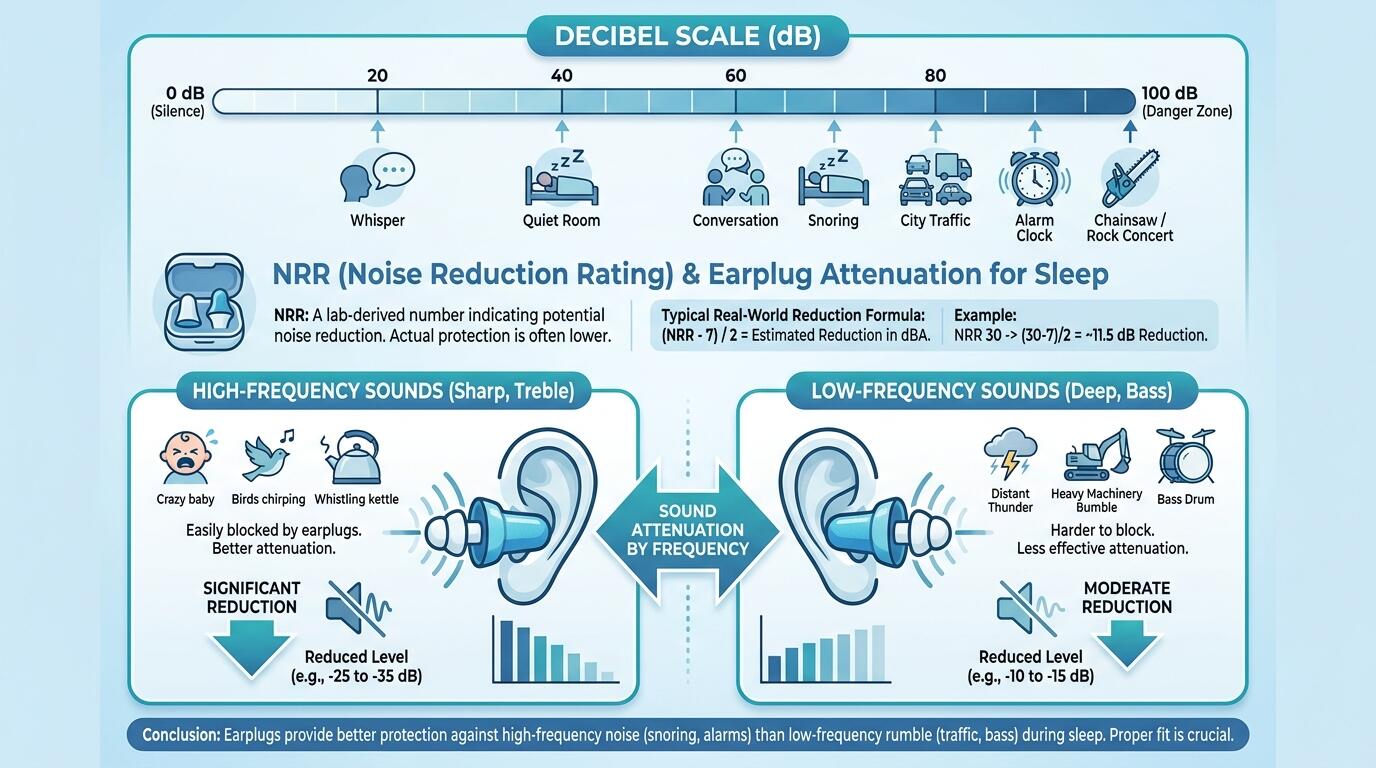
ALT: Infographic explaining NRR decibel ratings and how noise-blocking earplugs reduce sound frequency levels during sleep
The Mechanics Behind the Number: How Noise-Blocking Earplugs Actually Work
Understanding why NRR ratings do — and do not — translate directly into your bedroom requires a working knowledge of how earplugs interact with sound at a physical level.
Sound as a Physical Problem
Sound travels as pressure waves through the air, and earplugs work by interrupting those waves before they reach the eardrum. Every earplug, regardless of material or shape, relies on two fundamental principles: physical seal and acoustic absorption. A physical seal blocks the direct path of airborne sound into the ear canal, while acoustic absorption dissipates some of the wave energy that manages to pass through or around the plug itself.
The critical word is "seal." Sound will find the path of least resistance. If an earplug does not form a complete, gap-free seal against the walls of the ear canal, sound bypasses the plug through that gap. This is the single most common reason consumers feel let down by high-NRR products. The earplug's rated attenuation assumes a perfect seal — real-world fit rarely achieves this.
Material Differences and Their Acoustic Consequences
Foam earplugs, typically made from slow-recovery polyurethane or polyvinyl chloride foam, achieve their seal by expanding within the ear canal after compression. Their acoustic performance is generally strong across a broad frequency range, particularly at the high frequencies produced by voices, alarms, and traffic. Foam's porous cellular structure also absorbs energy rather than simply reflecting it. The trade-off is comfort over extended wear — firm foam can create pressure and soreness after several hours.
Silicone and moldable wax earplugs achieve their seal differently. They are pressed against the outer portion of the ear canal opening rather than inserted deeply. This makes them gentler for people with narrow or sensitive ear canals, but their seal quality is more variable and more dependent on application technique. Their attenuation tends to be lower than comparable foam products, particularly at lower frequencies — the rumble of a partner's snoring, for instance — where the soft seal is most prone to leakage.
Custom-molded earplugs, made from impressions of an individual's ear canal, theoretically provide the best possible seal and therefore the most faithful translation of laboratory NRR into real-world performance. They are substantially more expensive and require professional fitting, which places them outside the casual sleep-use market for most people.
Frequency Sensitivity and Why Low-Frequency Noise Is Harder to Block
Noise is not a single, uniform entity — it exists across a spectrum of frequencies, and earplugs do not perform equally across that spectrum. Most earplugs are significantly more effective at attenuating high-frequency sounds (the sharp consonants of speech, the screech of a car alarm) than low-frequency sounds (the bass thrum of HVAC systems, the rumble of traffic, the deeper register of snoring).
The NRR is a single composite number that averages attenuation performance across multiple frequency bands. This means a product rated NRR 30 might block high-frequency noise by 35–40 dB while only blocking low-frequency noise by 15–20 dB. If your primary sleep disruptor is bass-heavy noise, the NRR tells you less than you might expect. This is precisely why building a complete sleep setup for noise-sensitive sleepers often means layering multiple strategies — earplugs plus white noise, or acoustic curtains plus earplugs — rather than relying on one product alone.
The Fit Factor: Why Real-World Attenuation Diverges from the Label
According to the U.S. National Institute for Occupational Safety and Health (NIOSH), a widely cited practical guideline is to divide the NRR by two before estimating real-world protection — and this derating factor is specifically because typical, untrained users achieve significantly less attenuation than laboratory subjects. Even this adjusted figure assumes reasonably correct insertion or application technique.
For foam earplugs specifically, correct insertion involves rolling the plug tightly, pulling the ear upward and back to open the canal, and holding the plug in place for several seconds while it expands. The majority of people who reach for foam earplugs in the middle of the night, half-asleep, do not follow this sequence — and the resulting partial seal can cut their effective attenuation by more than half.
Comparing Earplug Types: Strengths, Trade-offs, and Best Fits
The earplug market presents several meaningfully different approaches to noise reduction for sleep. Understanding the honest trade-offs of each allows you to match the right tool to your specific noise environment and comfort needs, rather than defaulting to whichever option has the highest number on the package.
| Earplug Type | Strengths | Trade-offs | Best Fit |
|---|---|---|---|
| Foam (polyurethane) | High attenuation potential, broad frequency coverage, low cost | Can cause pressure/soreness over hours; fit requires technique | Heavy ambient noise, occasional use, budget-conscious shoppers |
| Moldable silicone/wax | Comfortable, no deep canal insertion, gentle for sensitive ears | Lower attenuation, especially low-frequency; more variable seal | Light noise disruption, long overnight wear, sensitive ear canals |
| Pre-molded reusable | Consistent size once right fit found, washable, durable | Fit depends on ear canal shape; many stock sizes may not match | Travelers, frequent users who have found their correct size |
| Custom-molded | Best seal consistency, professional-grade attenuation | High cost, requires professional impression, not widely accessible | Chronic noise sensitivity, audiologist-confirmed fit needed |
| Electronic/active | Can combine noise reduction with audio (white noise, music) | Expensive, battery-dependent, less effective for low-frequency | Tech-comfortable users who want flexibility and active masking |
One pattern we consistently observe when helping sleepers troubleshoot noise disruption is that the jump from foam to a higher-price option is often less impactful than correcting how the existing earplug is being inserted. Before upgrading products, technique is always worth revisiting — it costs nothing and frequently makes a measurable difference.
Material transparency matters here too. When evaluating any earplug for sleep use, it is worth checking whether the product discloses its primary material, whether it carries skin-safe or hypoallergenic certifications, and whether the manufacturer publishes attenuation data by frequency band rather than just a single composite NRR. These are the markers of a product you can genuinely evaluate rather than simply trust based on a number. This same principle — understanding what material transparency means when buying sleep products — is central to how we approach every product category at SleepBetterMD.
Where Earplug Science Is Heading — and What It Means for Your Sleep Setup
The noise-blocking earplug category is evolving in several meaningful directions, each with practical implications for sleep-focused consumers.
Real-world rating systems are gaining ground. NIOSH has developed an alternative metric called the NIOSH Derating Method, and there is growing industry and regulatory momentum toward requiring that consumer-facing packaging reflect more realistic attenuation expectations rather than idealized laboratory maxima. Shoppers can expect to see clearer, more honest labeling in the coming years as this conversation advances.
Hybrid and active noise-canceling sleep devices are maturing. Products that combine passive physical attenuation with active noise-canceling circuitry (the same technology found in premium headphones) are becoming more accessible at lower price points. These devices can address low-frequency noise — the historically weak point of passive foam — by generating inverse sound waves to cancel out bass-heavy disruption. This represents a genuine technological step for urban sleepers whose primary noise source is traffic or HVAC rumble.
Personalization is becoming more accessible. At-home ear impression kits, digital scanning tools, and direct-to-consumer custom earplug services are beginning to democratize a solution that previously required an audiologist's office. While the quality of outcomes still varies, the direction of travel is toward better real-world fit for more people.
For practical use today, the actionable takeaways from the science are straightforward. Use the NIOSH-recommended derating approach — divide the labeled NRR by two — as your working estimate of real-world protection. Match earplug type to your noise profile: foam for broadband noise, silicone for comfort and light disruption, and hybrid or electronic options for low-frequency bass noise. Always prioritize fit over label numbers. And if earplugs alone are insufficient, layer in complementary interventions such as white noise or acoustic room treatment rather than simply chasing a higher NRR. For a broader view of how earplugs fit within a complete sleep environment, comparing sleep products by material, function, and long-term value is a useful framework for making confident decisions.
Common Questions
Q1: How do I calculate realistic noise reduction from an NRR-rated earplug?
The standard practical guideline, endorsed by the U.S. National Institute for Occupational Safety and Health (NIOSH), is to divide the labeled NRR by two to estimate real-world attenuation. So an earplug labeled NRR 32 offers an estimated 16 dB of practical noise reduction in typical use. This accounts for the gap between laboratory fit conditions and how most people actually insert and wear earplugs during sleep.
Q2: Are high-NRR earplugs safe to wear every night for sleep?
For most healthy adults, wearing earplugs nightly is generally considered safe, provided the products are kept clean, replaced or cleaned on schedule, and inserted correctly to avoid compacting earwax. However, people with ear canal health concerns, recurring ear infections, or unusual anatomy should consult a healthcare provider before making earplugs a daily habit. Comfort and hygiene — not just attenuation — matter for long-term nightly use.
Q3: How long does it typically take to find the right earplugs for sleep, and does it cost much?
Finding the right option usually involves trying two or three types rather than committing to one immediately. Foam options are the most affordable starting point and give you quick feedback on how you tolerate deep-canal insertion. Moldable silicone is a natural next step if foam causes discomfort. Budget a few weeks of trial use per product to assess how your sleep responds across different noise conditions — the cost of exploring entry-level options is relatively low compared to the cumulative cost of chronic sleep disruption.
Wrapping Up
Understanding NRR ratings comes down to three core ideas. First, the NRR is a laboratory measure of maximum potential noise reduction — it assumes a perfect fit that most people do not achieve in real-world conditions. Second, the type of noise you are trying to block matters as much as the rating number itself: foam earplugs excel at high-frequency noise while struggling more with low-frequency bass, and no single composite number fully captures this nuance. Third, fit and technique consistently outweigh brand or price as the primary drivers of how much noise reduction you actually experience.
For noise-sensitive sleepers, the most productive path is not finding the highest number on the shelf — it is understanding the mechanism, matching the product type to your specific noise environment, applying correct technique, and layering complementary tools when earplugs alone are insufficient.
If you are building or refining your sleep environment and want products chosen with the same level of transparency and specificity this article has tried to bring to NRR ratings, the place to start is with a curated selection where the materials, construction, and intended use cases are clearly communicated.
Explore SleepBetterMD's curated collection of sleep accessories — hand-picked from trusted manufacturers with full material transparency, so you can find the right solution for your specific sleep needs. Visit SleepBetterMD to browse pillows, sleepwear, bedding, and sleep accessories chosen with the same clarity you now bring to reading an NRR label.
Sources & Citations
- U.S. Environmental Protection Agency (EPA). "Noise Control Act and Hearing Protector Labeling Regulations."
https://www.epa.gov - American National Standards Institute / Acoustical Society of America (ANSI/ASA). "ANSI/ASA S3.19 — Method for the Measurement of the Real-Ear Attenuation of Hearing Protectors."
https://www.ansi.org - International Organization for Standardization (ISO). "ISO 4869 Series — Acoustics: Hearing Protectors."
https://www.iso.org
Note: Standards may be updated; please check the latest official documents or consult professional advisors.