


ALT: Overwhelmed shopper facing too many pillow choices, seeking a smarter pillow buying guide
Why Having Too Many Pillow Choices Is Actually the Problem
You open a browser tab, type "best pillow," and suddenly you're staring at a wall of sponsored results, star ratings, and vague promises about "cloud-like comfort." Twenty minutes later you've got eleven tabs open, a running tally of competing fill materials, and absolutely no idea which pillow is actually right for you. Sound familiar?
This is the paradox at the center of modern pillow shopping: more options haven't made the process easier — they've made it harder. The core conclusion we keep coming back to, after working with shoppers across multiple continents and curating products from more than twenty Asian manufacturers, is that smarter pillow shopping isn't about finding the best pillow. It's about finding the right pillow for your specific sleep situation. And that requires a completely different starting point — one that begins with your problem, not with a product page.
In this article, we'll break down why the current pillow marketplace is broken, walk you through a practical three-step framework for cutting through the noise, and give you the honest comparisons and caveats you actually need before spending money on something you'll sleep on every night.
Who This Guide Is For — and When It Actually Applies
Applicable Scenarios:
- You're replacing a pillow that no longer feels comfortable but aren't sure why it stopped working
- You've had persistent neck tension, shoulder stiffness, or disrupted sleep and suspect your pillow might be contributing
- You're buying a pillow online and feel paralyzed by the number of options, conflicting reviews, and opaque material descriptions
Not Applicable/Cautions:
- If you have a diagnosed cervical spine condition or chronic pain disorder, start with a physiotherapist or sleep medicine specialist before buying any pillow — product guides can't substitute for clinical assessment
- If you're shopping for a child under three, pillow selection involves specific safety standards that fall outside the scope of general adult sleep guidance
The Pillow Market Has a Transparency Problem (and It Costs You Money)
The modern pillow market is, by any honest measure, oversaturated. Walk into any major e-commerce platform and the sheer volume of listings — many of which use nearly identical marketing language — makes meaningful comparison almost impossible. "Ergonomic," "orthopedic," "hotel quality," "breathable" — these words appear so frequently and so interchangeably that they've been drained of informational value.
What's less obvious is that this vagueness isn't accidental. According to the American Sleep Association, sleep quality is directly tied to sleep surface comfort, yet very few pillow brands make it easy for consumers to understand what's actually inside the product, how it was made, or how it will perform for a specific sleep position. When material disclosures are buried in fine print or omitted entirely, shoppers end up making decisions based on price point and star ratings — two metrics that correlate only loosely with actual sleep improvement.
The financial stakes are real. A pillow purchased without understanding your needs can turn into a wasteful cycle: buy, try for two weeks, notice it's wrong, repeat. Over time, this adds up to both money spent on products that don't work and the subtler cost of continued poor sleep — reduced focus, lower energy, irritability. Per guidance from the National Sleep Foundation, adults need between seven and nine hours of quality sleep per night, and pillow discomfort is one of the most commonly cited barriers to achieving it.
At SleepBetterMD, a pattern we consistently see is that shoppers who feel the most overwhelmed aren't the least informed — they're often the most informed. They've read the reviews, they understand fill power and loft, they know memory foam from latex. What they're missing isn't more information; it's a framework for applying that information to their specific situation. That's exactly what the next section provides.
A Smarter Three-Step Framework for Pillow Shopping
The Problem-First Approach to Narrowing Your Options
Identify Your Primary Sleep Complaint
Before you look at a single product, spend five minutes doing something most pillow guides skip entirely: diagnosing your actual sleep problem. The goal here is to move from "I need a new pillow" to "I wake up with neck stiffness because I sleep on my side and my current pillow has compressed beyond its usable height."
Write down two things: your dominant sleep position (back, side, stomach, or a combination), and your most consistent complaint (waking up stiff, overheating overnight, allergen sensitivity, or simply not feeling rested). This two-part profile will eliminate the majority of products on the market immediately — which is the whole point.
Step 1: Map Your Sleep Position to a Loft Range
Loft — the height of a pillow — is the single most mechanically important variable for spinal alignment, and it's directly determined by sleep position. Side sleepers generally need higher loft to bridge the gap between their head and shoulder. Back sleepers typically do better with medium loft that keeps the neck in a neutral curve. Stomach sleepers, if they use a pillow at all, tend to need very low loft to avoid straining the cervical spine. Spend about five minutes cross-referencing your dominant position against loft recommendations from a credible source — the pillow buying guide from The Company Store provides a clear breakdown of position-based loft guidance you can use as a starting reference.
Step 2: Match Your Complaint to a Fill Material
Once you know your loft range, your sleep complaint narrows the fill category. Sleeping hot? Look at materials with documented airflow properties — natural latex, buckwheat, or certain open-cell foams. Allergy concerns? Prioritize materials with verifiable hypoallergenic certifications, and read the actual material disclosure rather than taking "hypoallergenic" marketing language at face value. Prefer a moldable, adjustable feel? Shredded fills — whether foam, latex, or fiber — typically allow more personalization than solid-core options. This step takes roughly ten to fifteen minutes if you're reading actual product specs rather than just marketing summaries.
Step 3: Set a Value Threshold, Not Just a Price Cap
The third step is where most shoppers either overspend or under-invest. Rather than setting a ceiling ("I won't spend more than X"), set a value threshold: how long do you expect this pillow to remain effective, and what's the cost per night of sleep over that period? A pillow that lasts two years and solves your problem costs less per night than a cheap option you replace every six months. This framing also helps you resist upselling tactics — a premium price tag is only worth it if the specific features that drive the cost are features you actually need.
Comparing the Main Fill Categories Honestly
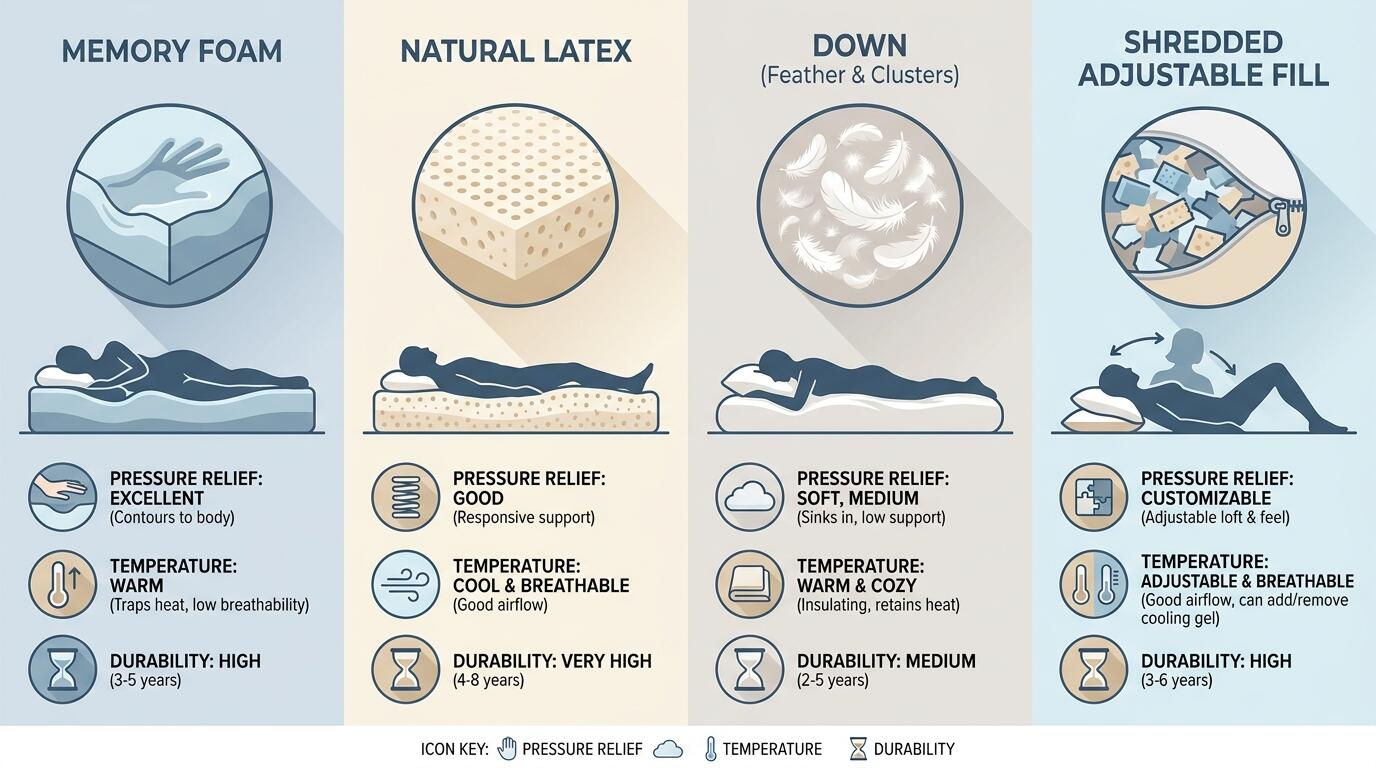
Pillow fill material is the variable that most affects both feel and performance, yet it's also the area where marketing language is least reliable. The table below compares the four most common fill categories across dimensions that actually matter to long-term sleep quality and value. Note that specific product performance will vary by manufacturer — use this as a category-level guide, not a substitute for reading individual product disclosures.
| Comparison Dimension | Memory Foam (Solid) | Natural Latex | Down / Down Alternative | Shredded / Adjustable Fill |
|---|---|---|---|---|
| Pressure relief | High — conforms closely to head and neck | High — responsive with slight bounce | Moderate — soft but less contouring | Variable — depends on fill density |
| Temperature regulation | Often retains heat unless specifically ventilated | Generally cooler than memory foam | Down breathes well; synthetics vary | Varies by fill material used |
| Adjustability | Low — fixed shape | Low — fixed shape | Low to moderate | High — fill can typically be added or removed |
| Durability | Medium to high depending on foam density | High — latex is inherently resilient | Lower — down compresses and clusters over time | Moderate — depends on outer shell quality |
| Best for | Back and side sleepers needing firm support | Sleepers wanting responsive support without synthetic materials | Soft-feel preference, cooler climates | Sleepers wanting to dial in loft precisely |
| Transparency considerations | Check foam certifications (e.g. OEKO-TEX) | Verify natural vs. synthetic latex ratio | Confirm fill power and source | Confirm fill composition, not just outer label |
What "Radical Material Transparency" Actually Means in Practice
Radical material transparency is the practice of fully disclosing what a sleep product is made of — fabric composition by percentage, fill material origin, chemical certifications, and manufacturing source — so that consumers can make genuinely informed decisions rather than trusting marketing language. It sounds like the baseline, but it's genuinely rare in the pillow industry.
When we use this phrase at SleepBetterMD, we mean it operationally: every product in our catalog comes with specific material disclosures sourced directly from the Asian manufacturers we work with. We don't accept "proprietary blend" as an answer, and we don't list certifications we can't verify. This approach emerged from a consistent pattern we observed — shoppers who felt burned by previous purchases almost always cited the same frustration: "I didn't know what I was actually buying."
The practical implication for you as a shopper, regardless of where you buy: treat any product page that doesn't disclose fill composition by material type as a yellow flag. You don't need a chemistry degree to evaluate this information — you just need it to exist. Look for the inner fill composition, the outer fabric content, and at minimum a reference to a recognized third-party certification standard such as OEKO-TEX Standard 100 (which tests for harmful substances in textiles) or CertiPUR-US (which applies to polyurethane foam). These certifications are publicly maintained and checkable, not just marketing badges.
Reviewing sources like Wirecutter's best bed pillows guide shows that even well-resourced editorial teams prioritize material quality and certification transparency as key evaluation criteria — it's not a niche concern, it's the baseline for any serious product assessment.
Advanced Considerations: Edge Cases, Misconceptions, and What Actually Matters Long-Term
Misconception: Higher price always means better materials. This is probably the most expensive myth in pillow shopping. Premium pricing often reflects brand positioning, retail markup, and marketing spend — not material quality. A pillow sourced directly from a specialized manufacturer with full material disclosure can outperform a luxury-branded equivalent at a fraction of the cost. The DTC (direct-to-consumer) model exists precisely to remove these layers of markup, and it's one reason curated DTC retailers focused on Asian manufacturing can offer high-quality materials at more honest prices.
Special situation: Combination sleepers. If you shift positions throughout the night — which, according to sleep researchers, the majority of adults do to some degree — a fixed-loft solid-core pillow will always be a compromise. Adjustable shredded-fill options are genuinely worth the added complexity here, because the ability to tune loft means you can approximate a neutral spine position across multiple positions rather than optimizing for only one.
Special situation: Pillow covers and encasements. The outer shell of a pillow affects feel, temperature, and allergen management as much as the fill — yet it's routinely ignored in buying guides. A high-quality fill inside a poorly constructed cover will underperform its potential. Prioritize covers with clearly disclosed fabric weights and weave types, particularly if temperature regulation or skin sensitivity is part of your sleep profile.
The "certifications replace transparency" misconception. Third-party certifications like OEKO-TEX Standard 100 are valuable and worth looking for — but they test for what isn't in the product (harmful substances), not for what is. A certified pillow can still be vague about its fill composition. Certifications and material disclosure are complementary, not interchangeable.
ALT: Side-by-side pillow fill comparison guide showing material transparency and sleep position recommendations for smarter buying decisions
Questions & Answers
Q1: How do I know which pillow fill material is actually right for my sleep position?
The most reliable starting point is to match loft to position first — side sleepers generally need more height than back sleepers, and stomach sleepers typically need the least. Fill material then layers onto that based on your secondary concerns: temperature regulation, firmness preference, or adjustability. A resource like this overview of common pillow-buying mistakes walks through how position and fill interact in plain, practical terms.
Q2: Are "orthopedic" or "ergonomic" pillow labels actually meaningful?
These terms are largely unregulated marketing descriptors in most markets, meaning any manufacturer can apply them without meeting a defined standard. They signal intent — the product was designed with spinal positioning in mind — but they don't guarantee it delivers. What matters more is whether the pillow's loft, firmness, and fill composition are appropriate for your specific sleep position and body geometry. Look for actual product specifications, not just label language.
Q3: How long should a quality pillow realistically last before it needs replacing?
Durability depends heavily on fill material and construction quality. Natural latex tends to be among the most long-lasting fill options. Down pillows typically require more frequent fluffing and eventual replacement as the fill clusters and compresses. Memory foam lifespan varies significantly by foam density. Rather than following a fixed replacement timeline, test your pillow: if it no longer returns to its original loft, or if your sleep complaints have returned after a period of improvement, those are functional indicators that it's time for a replacement regardless of age.
The Bottom Line
The pillow market's core problem is that volume has replaced value — thousands of nearly identical product listings with opaque descriptions have made shopping harder, not easier, and led to a cycle of frustrated repurchasing that's bad for both your sleep and your wallet.
The smarter path forward rests on three principles: start with your problem (not a product), prioritize material transparency over marketing language, and evaluate cost as a long-term value calculation rather than an upfront price comparison. These principles apply whether you're buying your first intentional pillow or replacing one that's stopped working.
The specifics matter: loft for your sleep position, fill material for your comfort priorities, certifications you can verify, and disclosures you can actually read. When those pieces align, the decision stops feeling overwhelming — because you've replaced a wall of options with a clear set of criteria.
Ready to put this framework into practice? SleepBetterMD hand-picks every pillow, sheet, and sleep accessory from trusted Asian makers — and lays out exactly what's inside, so you always know what you're sleeping on. Explore the full curated collection and find your perfect sleep match at SleepBetterMD.
Sources & Citations
- Wirecutter / The New York Times. "The 6 Best Bed Pillows of 2026".
https://www.nytimes.com/wirecutter/reviews/best-bed-pillows/ - The Company Store. "How To Choose a Pillow: A Buying Guide".
https://www.thecompanystore.com/pillow-buying-guide.html - YouTube / Sleep Education Content. "Don't make these 3 mistakes when buying a new pillow".
https://www.youtube.com/watch?v=4kxsCX-okVA - OEKO-TEX Association. OEKO-TEX Standard 100 — Independent Testing and Certification for Textile Products.
https://www.oeko-tex.com/ - National Sleep Foundation. Sleep Health and Sleep Duration Recommendations for Adults.
https://www.thensf.org/
Note: Standards and recommendations may be updated; please check the latest official documents or consult professional advisors.