

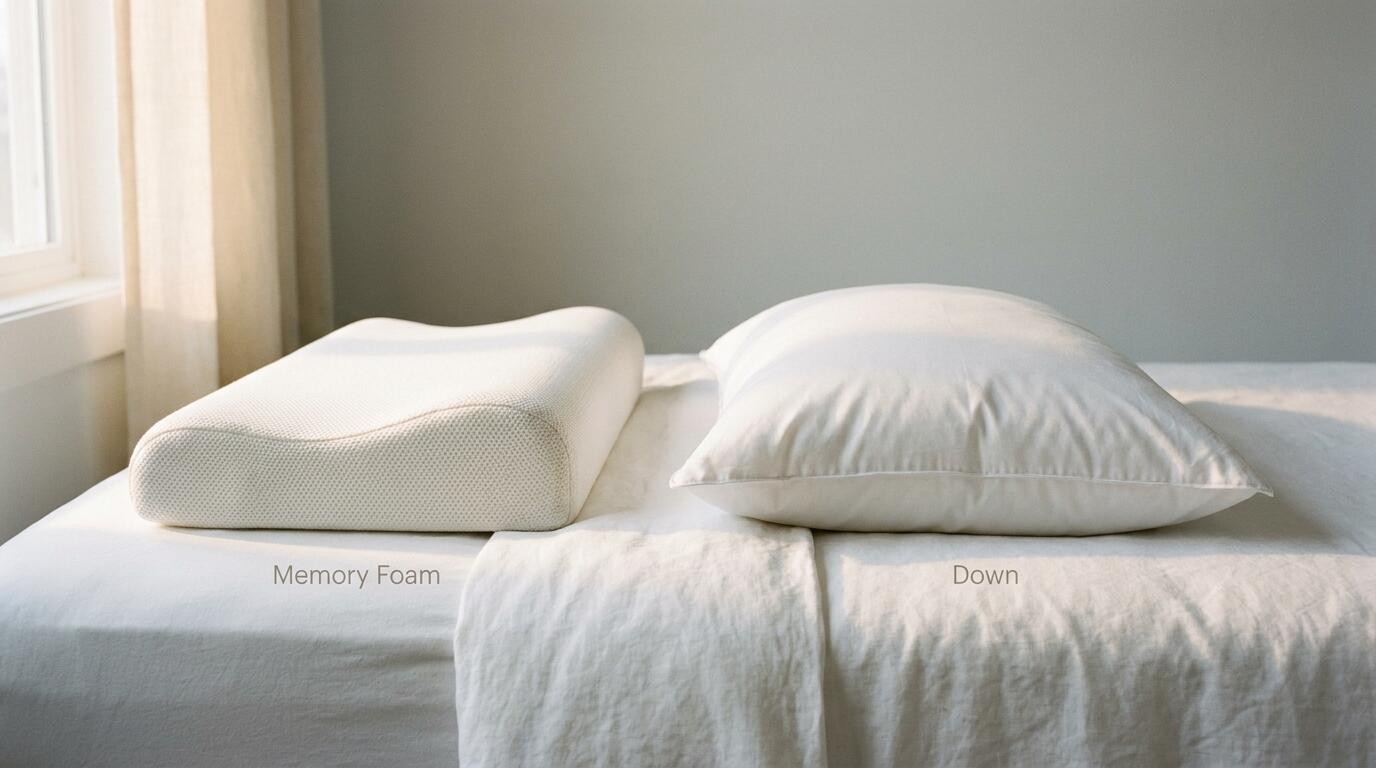
ALT: Memory foam vs. down pillow comparison for neck pain relief and better sleep in 2026
Memory Foam vs. Down Pillows: What Actually Helps Your Neck Pain?
Key Conclusion: Memory foam pillows generally outperform down pillows for neck pain relief because they maintain consistent cervical alignment throughout the night — they don't compress flat or shift position the way down fill can. That said, "better" depends heavily on your sleep position, body type, and whether heat retention is a problem for you. Down pillows remain a genuinely comfortable option for stomach sleepers or those who prefer a softer, more moldable feel. The right pillow is the one that keeps your spine neutral from head to tailbone, and both materials can succeed or fail at that depending on how they're made and how you sleep.
When your neck aches every morning, choosing between memory foam and down can feel like a gamble — both come wrapped in appealing marketing language, and neither is universally "best." This article breaks down the real differences between these two pillow types across the criteria that matter most for neck pain relief, so you can stop guessing and start sleeping well.
What Actually Matters When Judging a Pillow for Neck Pain Relief
Choosing a pillow for neck pain relief means evaluating it on more than just how it feels in the store. A pattern we consistently see in our work curating sleep products is that shoppers focus almost entirely on softness — and then wonder why their neck still hurts six months later. Here are the five dimensions that genuinely predict how well a pillow will support a sore neck.
Cervical alignment support is the single most important criterion. A pillow should keep your head, neck, and shoulders in a neutral line — not propped up too high, not sinking too low. Misalignment sustained for seven or eight hours causes the muscular strain most people wake up with.
Loft stability refers to how well a pillow maintains its height throughout the night. A pillow that starts at a good loft but compresses to half that by 3 a.m. is functionally failing you, even if it felt right when you first lay down.
Pressure distribution matters especially for side sleepers, whose shoulder and neck take the brunt of body weight. A pillow should spread that load evenly rather than creating point pressure on one area of the cervical spine.
Heat management is often underestimated in neck pain discussions, but temperature discomfort leads to tossing and turning — which means your head and neck are constantly shifting off the pillow's optimal support zone.
Adjustability and longevity round out the picture. A pillow that offers meaningful customization (removable fill, variable loft options) gives you more control over fit, and a pillow that holds its structure over time delivers better long-term value for your investment.
The Contenders
Memory Foam Pillows: Engineered Neck Support
Memory foam is a viscoelastic polyurethane material that responds to body heat and pressure, slowly contouring to the shape of your head and neck before returning to its original form once pressure is removed. Originally developed for aerospace applications and later adopted by the medical device industry, memory foam became widely used in consumer sleep products from the 1990s onward.
In the pillow category, memory foam comes in two main forms: solid (a single molded piece) and shredded (loose granules of foam inside a fabric shell). Solid memory foam pillows typically offer a fixed loft and firm, consistent support — excellent for maintaining cervical alignment but potentially too rigid for those who move frequently at night. Shredded memory foam pillows allow the fill to be redistributed or removed to dial in the right height, giving them more versatility.
From a materials transparency standpoint, it's worth paying attention to foam certifications. The CertiPUR-US standard, for instance, is an industry program in North America that tests polyurethane foam for harmful chemical emissions and heavy metals. If you're buying a memory foam pillow and can't find any information about what's in the foam, that's a red flag worth taking seriously.
On the downside, traditional memory foam retains body heat noticeably — a well-documented drawback that has led manufacturers to develop gel-infused and open-cell foam variants. These sleep cooler, though they may not conform quite as precisely as dense traditional foam.
Down Pillows: Classic Comfort With Real Trade-offs
Down is the soft underlayer of feathers found beneath the outer plumage of ducks and geese. A true down pillow is filled primarily with this material — sometimes mixed with a percentage of feather quills (labeled "down alternative" blends or simply "feather and down"). Higher fill power (a measure of down's loft and insulating quality per ounce) generally indicates a more premium, fluffier product, though fill power specifications vary by manufacturer and aren't always disclosed clearly.
Down pillows are beloved for their cloud-like softness, natural breathability, and excellent temperature regulation — down's hollow fiber structure allows air to circulate, which means down pillows tend to sleep cooler than conventional memory foam. They're also highly compressible and packable, which makes them popular in hospitality and travel contexts.
The core limitation for neck pain sufferers is loft instability. Down fill migrates under the weight of your head, often creating a "divot" effect where the center compresses while fill bunches at the edges. This means that even a well-chosen down pillow may stop providing adequate neck support within the first few hours of sleep — a pattern we observe repeatedly when helping customers troubleshoot morning neck stiffness.
Ethical sourcing is another dimension worth scrutinizing. The Responsible Down Standard (RDS), administered by Textile Exchange, verifies that down is sourced from birds not subjected to live-plucking or force-feeding. If a down pillow doesn't mention RDS or equivalent certification, you have no way of knowing how the fill was sourced — which matters both ethically and as a proxy for overall product quality transparency.
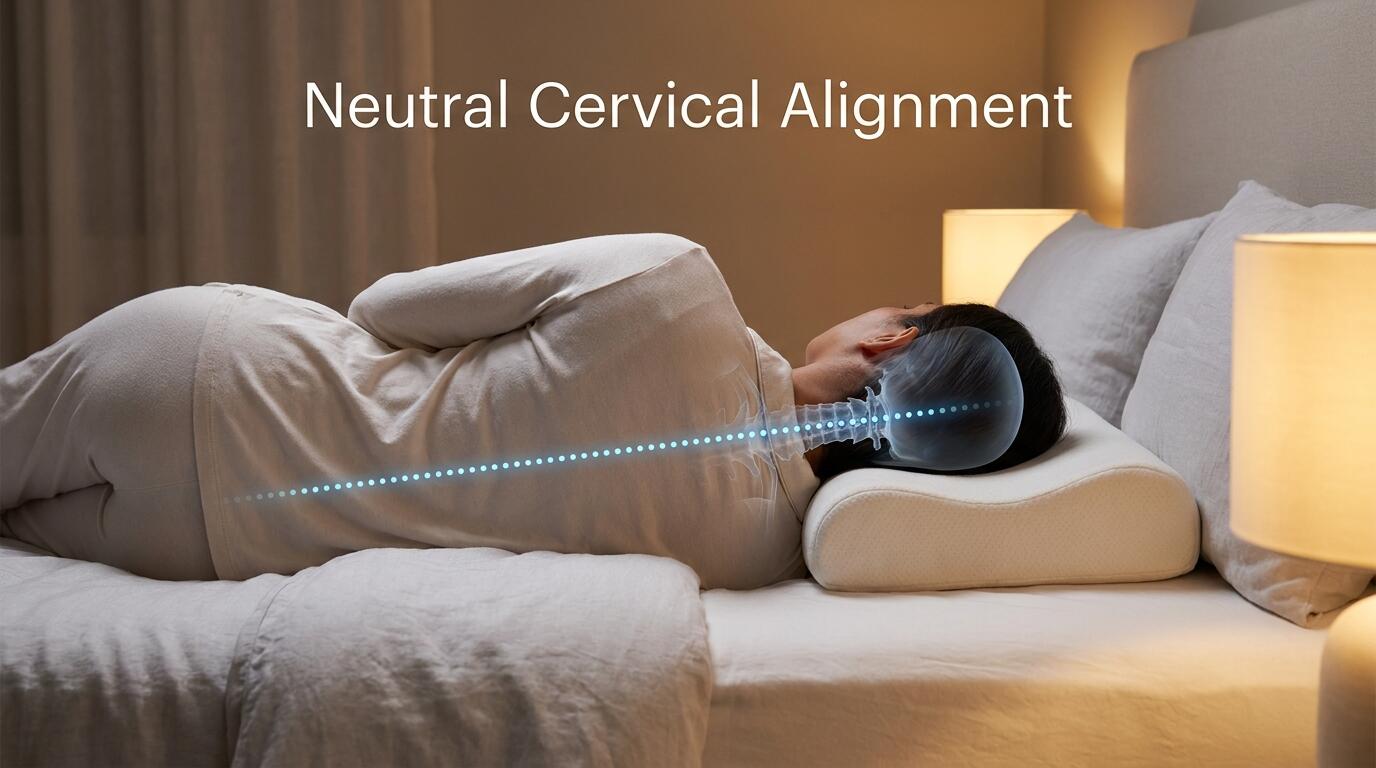
ALT: Side sleeper demonstrating proper neck alignment with a memory foam contour pillow for cervical support and neck pain relief
Head-to-Head Comparison: Memory Foam vs. Down for Neck Pain
| Criterion | Memory Foam | Down |
|---|---|---|
| Cervical alignment support | High — conforms to neck curve and holds position | Variable — fill migrates, reducing support over time |
| Loft stability throughout the night | High (solid foam); adjustable (shredded) | Low — compresses significantly under head weight |
| Pressure distribution | Good for side sleepers; may be too firm for stomach sleepers | Softer pressure distribution; better for stomach sleepers |
| Heat management | Warm; gel-infused or open-cell variants sleep cooler | Naturally breathable; typically cooler than standard foam |
| Adjustability | High with shredded fill; limited with solid foam | Moderate — can fluff, but fill redistributes unpredictably |
| Longevity and value | Long-lasting shape retention; good long-term ROI | Fill breaks down over time; needs regular replacement |
| Material transparency | Foam formulation varies; look for CertiPUR-US or equivalent | Fill quality and sourcing varies; look for RDS certification |
| Best sleep position match | Back and side sleepers | Stomach sleepers; versatile sleepers who move frequently |
The table above makes the performance gap fairly clear for neck pain specifically: memory foam holds a structural advantage in the categories that most directly affect cervical support. Because it doesn't shift or compress the way loose fill does, a well-chosen memory foam pillow is more likely to maintain the support you need from the moment you fall asleep to the moment you wake up.
That said, the heat management trade-off is real and shouldn't be dismissed. If you sleep hot and your partner already jokes about sleeping next to a radiator, a standard memory foam pillow may disrupt your sleep in a different way — by causing you to toss and turn, which undermines the very alignment benefits you were seeking. Gel-infused or open-cell foam variants address this significantly, and shredded foam pillows (which allow more airflow than solid blocks) are worth prioritizing if heat is a concern.
Down pillows genuinely outperform memory foam in breathability and in the kind of luxurious, cradling softness that some sleepers simply cannot substitute. For stomach sleepers in particular, the firm loft of most memory foam pillows can actually strain the neck by propping the head too high — a soft, low-loft down pillow can be a better fit. According to resources compiled by ergonomic and neurological health practitioners, including those reviewed at Empire Neuro's 2026 ergonomic pillow guide, pillow loft and sleep position compatibility are among the most frequently overlooked variables in neck pain management.
Which Should You Choose? Matching Pillow to Sleeper
The best pillow for neck pain is the one that keeps your spine in a neutral position for your specific body and sleep style. Here's how to match the options to your situation.
If you sleep on your back, memory foam is almost always the better choice. Back sleepers need a medium-loft pillow that fills the natural curve of the cervical spine without pushing the head too far forward. A contoured or shredded memory foam pillow does this reliably. Down compresses under head weight and typically won't maintain the right loft unless you're constantly refluffing.
If you sleep on your side, memory foam is again the stronger performer — but loft height matters enormously. Side sleepers need enough height to bridge the gap between the mattress and the ear without tilting the neck. Shredded memory foam, which you can customize by adding or removing fill, is particularly useful here. According to guidance from sleep health reviewers at CNET Health's 2026 pillow review, proper loft for side sleepers is one of the hardest specifications to get right with a standard down pillow.
If you sleep on your stomach, down is the more appropriate choice — or at minimum, a very soft, low-loft pillow. Stomach sleeping already strains the neck by rotating it to one side for hours, and a firm memory foam pillow exaggerates that strain. A thin, soft down pillow minimizes the angle. That said, stomach sleeping with chronic neck pain is a conversation worth having with a physiotherapist regardless of your pillow choice.
If you sleep hot, a down pillow or a gel-infused/open-cell memory foam pillow will serve you better than a dense standard foam option. Heat disrupts sleep continuity, and broken sleep means you're never staying in one position long enough for the pillow to do its job.
If budget and long-term value are a priority, memory foam generally wins. A quality memory foam pillow maintains its structure and support for considerably longer than down fill, which breaks down and clusters over time. From a cost-per-night standpoint, the upfront investment in a good memory foam pillow tends to offer better return over its lifespan.
Pros and cons at a glance:
Memory foam pros: consistent cervical support, durable shape retention, adjustable loft (shredded variants), suitable for back and side sleepers.
Memory foam cons: can retain heat, may feel too firm for some, heavier and less compressible than down.
Down pros: naturally breathable, soft and luxurious, better for stomach sleepers and combination sleepers, lighter weight.
Down cons: loft instability throughout the night, fill migrates and clusters, sourcing transparency concerns, shorter effective lifespan.
Common Questions
Q1: How do I know if my pillow is causing my neck pain?
A pillow is likely contributing to neck pain if the discomfort is worst in the morning and gradually eases as you move around during the day. This pattern suggests the issue is positional — your neck is holding a strained angle for hours while you sleep. Check whether your pillow has gone flat, whether your head feels tilted relative to your spine when you lie down, or whether you find yourself folding the pillow in half for height. These are signs of poor loft or inadequate support. Replacing the pillow and reassessing within two to three weeks is a reasonable first step. As reviewed in Mattress Clarity's 2026 neck pain pillow guide, loft and firmness suitability for sleep position are the two most common mismatch issues.
Q2: Is a more expensive down pillow better for neck support than a budget memory foam option?
Price alone is not a reliable predictor of neck support quality. A high-fill-power down pillow may feel exceptional initially but will still compress under your head within a few hours — regardless of its cost. A mid-range shredded memory foam pillow with adjustable loft will generally outperform an expensive down pillow specifically for cervical alignment, because it holds its position. When evaluating value, consider support longevity: memory foam that maintains its structure for several years often costs less per night of quality sleep than premium down that loses its loft within a year or two.
Q3: How long should I give a new pillow before deciding it works for my neck pain?
Most sleep experts suggest a break-in period of two to four weeks before drawing conclusions. Your body needs time to adjust to a new sleep surface and support level — particularly if you've been using an inadequate pillow for years. Memory foam in particular can feel firmer than expected at first and softens slightly as it adapts to your body heat and pressure. Keep track of how your neck feels each morning, and take note of any consistent improvement trend. If there's no change or things feel worse after a month, the loft, firmness, or material likely isn't right for your sleep position.
The Bottom Line
For most people dealing with neck pain, memory foam pillows deliver more reliable cervical support than down pillows — especially for back and side sleepers who need consistent loft throughout the night.
Key Takeaways:
- Memory foam maintains cervical alignment reliably because it doesn't compress or migrate the way down fill does.
- Down pillows excel in breathability and softness, making them a better fit for stomach sleepers or hot sleepers who prioritize temperature regulation.
- Shredded memory foam offers the best of both worlds for many sleepers: adjustable loft, decent airflow, and consistent support.
- Loft height must match your sleep position — too high or too low will cause strain regardless of the material.
- Material transparency matters: look for foam certifications (such as CertiPUR-US) and responsible sourcing labels (such as the Responsible Down Standard) when comparing products.
- Long-term value generally favors memory foam, which holds its shape and support for longer than down fill before needing replacement.
The next practical step is to identify your primary sleep position and heat sensitivity, then use those as your two non-negotiables when shortlisting pillow options.
Ready to stop guessing and find the pillow that actually fits your neck? SleepBetterMD handpicks every pillow and sleep product from trusted Asian manufacturers and tells you exactly what's inside — so you can shop by your actual sleep problem, not just clever packaging. Visit the SleepBetterMD website to explore pillows matched to your sleep style and start waking up without that familiar morning ache.
Sources & Citations
- Empire Neuro. "Best Ergonomic Pillows for Neck Pain in 2026".
https://empireneuro.org/best-ergonomic-pillows-2026/ - CNET Health. "Best Pillow for Neck Pain Sufferers in 2026".
https://www.cnet.com/health/sleep/best-pillow-for-neck-pain/ - Mattress Clarity. "Best Pillows for Neck Pain (2026)".
https://www.mattressclarity.com/bedding/pillows/best-pillows-neck-pain/
Note: Standards and product certifications may be updated; please check the latest official documents from relevant standards bodies or consult professional advisors for current guidance.