

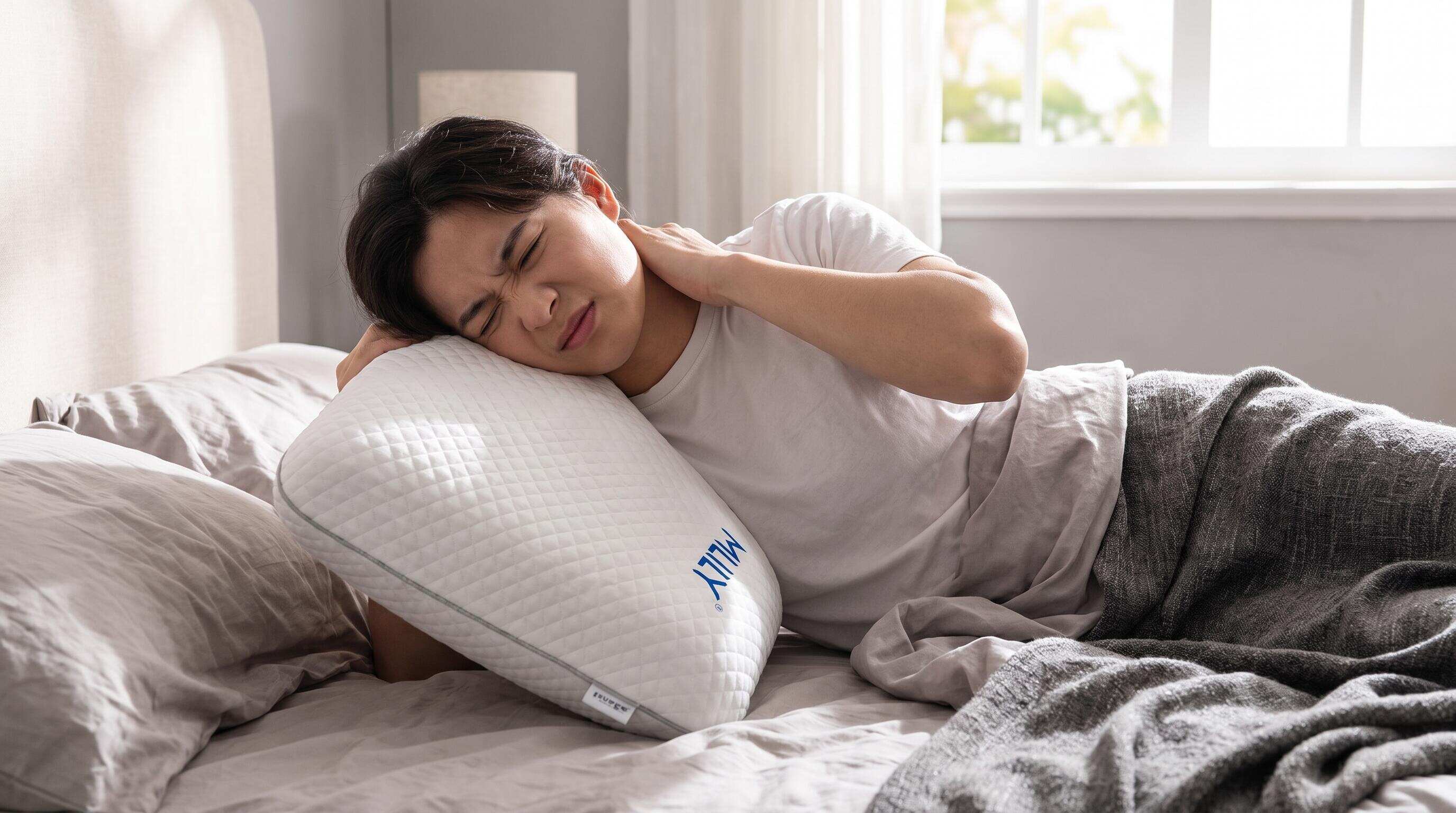
ALT: Person waking up with morning neck pain caused by wrong pillow support and alignment
Is Your Pillow Actually the Reason You Wake Up with a Stiff Neck?
Key Conclusion: Your pillow is one of the most overlooked contributors to morning neck pain. By evaluating your pillow's loft, fill material, and firmness against your sleep position and body proportions, you can identify whether it is working against your cervical spine overnight — and make a targeted change that transforms how you feel each morning. This guide walks you through exactly how to do that assessment, step by step.
Waking up with a stiff, aching neck is one of those problems that people tend to normalize far too quickly. "I must have slept funny" is the usual explanation — and then nothing changes. A pattern we consistently see at SleepBetterMD is that when shoppers finally describe their morning symptoms in detail, the culprit turns out to be the pillow they have been using for years without a second thought. This guide is written for anyone who suspects their pillow might be the problem but is not sure how to confirm it or what to do next.
Before You Start: What You Need to Know Before Diagnosing Your Pillow
Identifying whether your pillow is causing your neck pain is a methodical process, not a guessing game. Before you begin, it helps to understand what a pillow is actually supposed to do: a sleep pillow is a support device designed to keep the cervical spine — the seven vertebrae of the neck — in neutral alignment throughout the night. When that alignment is compromised, muscles, ligaments, and joints are held under low-level strain for hours at a time, and morning stiffness or pain is the predictable result, according to Harvard Health Publishing.
To carry out this self-assessment effectively, you will need the following:
- Your current pillow, undressed (remove the pillowcase so you can handle and inspect the fill directly)
- A flat, firm surface such as a bed or the floor where you can lay the pillow in its actual sleeping position
- A basic understanding of your primary sleep position (back sleeper, side sleeper, or stomach sleeper)
- A few undisturbed minutes of honest observation — this is not complicated, but it does require attention to detail
- A willingness to consider that the problem may not be your mattress, your posture, or your stress levels — even if those are contributing factors
It is also worth noting what this guide does not replace. If your neck pain is severe, radiates down your arm, is accompanied by numbness or tingling, or has been present for more than a few weeks regardless of what you sleep on, a qualified health professional should evaluate you. The assessment below is appropriate for the far more common experience of recurring morning stiffness that tends to ease up as the day progresses.
The entire assessment can be completed in a single morning, ideally right after you wake up when the physical sensations are still fresh and your pillow still holds the impressions of the night's use. Set aside time when you are not rushed, because the quality of your observations is everything here.
Checklist before starting:
- Pillow is removed from its case and placed on your sleeping surface
- You know your dominant sleep position
- You have noted where on your neck or shoulders the pain or stiffness is located this morning
- You have not yet fluffed, repositioned, or otherwise disturbed the pillow from how it sat when you woke up
Step-by-Step: How to Tell If Your Pillow Is Causing Your Morning Neck Pain
Step 1: Note Your Symptoms the Moment You Wake Up
The first and most time-sensitive step is to catalog your symptoms before you start moving around. Morning neck pain caused by poor pillow support tends to be most pronounced immediately upon waking and improves gradually over the first hour as you move, stretch, and warm up. Pain or stiffness that follows this pattern — present at waking, resolving with movement — is a strong indicator that your sleep surface, not an underlying condition, is responsible.
Note specifically where the discomfort lives: is it centered at the base of the skull, along the side of the neck, across the upper trapezius, or between the shoulder blades? The location offers early clues about the type of misalignment that occurred overnight.
Tip: Keep a simple log for three to five mornings. A consistent pattern of pain that eases by mid-morning is one of the clearest signals that your pillow is contributing to the problem.
Step 2: Inspect the Pillow's Current Shape Without Disturbing It
Before you fluff, fold, or reposition your pillow, look at it exactly as it was when your head lifted off. A pillow that is doing its job maintains a consistent loft — roughly the height needed to bridge the gap between the mattress and the side of your head — and recovers its shape reasonably well. A pillow that has compressed flat, formed a canyon-shaped depression in the center, or lumped its fill to one side has been failing you all night.
For side sleepers, a pillow that has compressed below the width of one shoulder means the neck has been angled downward for hours. For back sleepers, a pillow that has either gone completely flat or pushed too high means the chin has either dropped toward the chest or been forced upward — neither is neutral. According to Healthline, improper cervical alignment during sleep is one of the most documented causes of waking neck pain.
Tip: Press the center of the pillow firmly with your palm and count how long it takes to recover. A memory foam pillow that rebounds slowly is working as designed; a down or polyester pillow that takes more than a few seconds to recover, or does not recover at all, has lost its resilience.
Step 3: Match Pillow Loft to Your Sleep Position
Pillow loft — the height or thickness of the pillow under your head — is arguably the single most important specification for cervical alignment, and the right loft is not the same for everyone. The goal is always neutral spine: your neck should continue the natural curve of your upper spine without bending up or down.
- Side sleepers generally need the highest loft because the distance between the mattress and the ear is substantial — roughly equal to the width of the shoulder. A pillow that is too flat will cause the neck to drop; one that is too high will push the neck into lateral flexion in the opposite direction. In our experience working with side-sleeping customers, this mismatch is the most common single source of pillow-related neck pain.
- Back sleepers need moderate loft — enough to support the natural cervical curve without elevating the head so much that the chin is pressed toward the chest. A pillow that is too thick for a back sleeper is a frequent culprit for upper neck and base-of-skull tension.
- Stomach sleepers ideally use the thinnest possible pillow, or no pillow at all under the head, because any loft in this position forces the neck into sustained rotation and extension. If you are a stomach sleeper with regular neck pain, the position itself warrants reconsideration alongside any pillow change.
Tip: If you are unsure of your sleep position, a light dusting of talcum powder on the pillowcase — or simply asking a household member — can confirm whether you start on your back and migrate to your side by morning.
Step 4: Evaluate Pillow Fill Against Your Needs
Not all pillow materials perform the same way, and the fill type directly affects whether the pillow maintains support through the night. At SleepBetterMD, we source pillows from more than 20 Asian manufacturers and make material composition fully transparent — because in our experience, fill type is where most shoppers are working with incomplete information.
Here is how the most common fill types behave:
- Latex pillows hold their shape consistently throughout the night and do not compress under sustained pressure the way many synthetic fills do. Natural latex is particularly valued for its resilience — it pushes back against the head to maintain loft rather than simply conforming and collapsing.
- Memory foam pillows conform closely to the head and neck, which can be excellent for pressure relief, but slow-response foams may not reposition quickly when you shift positions during the night. Shredded memory foam is more adjustable and generally more responsive than a single solid core.
- Down and down-alternative fills are soft and comfortable but tend to redistribute to the edges of the pillow under the weight of the head, reducing effective loft in the center. This is the fill type most likely to produce that flattened-valley shape described in Step 2.
- Buckwheat and other natural fills hold loft well and can be adjusted by adding or removing fill, but they are firmer and heavier than most Western sleepers are accustomed to — though they are widely used and highly regarded across much of Asia.
Tip: If your pillow is more than a couple of years old and uses a compressible fill like polyester fiber or down, age-related compression alone may be the cause of your neck pain, regardless of the original quality of the pillow.
Step 5: Check for Alignment Using a Simple Position Test
This step requires a partner or a mirror positioned at the foot of the bed, but it is the most direct confirmation you can get short of clinical measurement. Lie down on your pillow in your normal sleep position and have someone observe — or photograph — the alignment of your neck and spine from behind (for side sleeping) or from the side (for back sleeping).
For a side sleeper, a straight horizontal line from the top of the head through the neck and along the spine indicates neutral alignment. Any upward or downward deviation at the neck is a measurable problem. For a back sleeper, the natural cervical curve should be gently supported, not flattened or exaggerated.
According to the guidance compiled by chiropractors and sleep health professionals, the pillow's purpose is to fill the space between the head and the mattress without creating any angular stress on the cervical vertebrae — a principle consistently cited in sleep posture literature.
Tip: Even a five-degree deviation in cervical angle, sustained over seven or eight hours, translates into meaningful muscular strain. What looks like a minor misalignment in a photograph can explain significant morning discomfort.
Step 6: Correlate Pain Pattern with Pillow Type and Position
At this stage, you have enough information to draw meaningful conclusions. Map what you know across three variables: your sleep position, your pillow's current loft and condition, and the location of your morning pain.
Common correlations that signal a pillow problem include:
- Side sleeper + flat or low-loft pillow = pain on the lower side of the neck (the side toward the mattress)
- Side sleeper + excessively thick pillow = pain on the upper side of the neck (the side toward the ceiling)
- Back sleeper + over-thick pillow = tension at the base of the skull and upper neck
- Back sleeper + flat pillow = lower neck and upper back stiffness from loss of cervical curve
- Any position + old, lumpy, or unevenly filled pillow = diffuse neck and shoulder discomfort without a clear directional pattern
If your symptoms align with one of these patterns, that is a strong practical indicator that your pillow's loft, fill, or condition is the primary cause. This does not rule out other contributors, but it identifies a clear, actionable first step.
Tip: Try one night on a folded blanket or a different household pillow that more closely matches the correct loft for your sleep position. If symptoms improve noticeably the next morning, you have strong evidence that pillow selection — not an underlying condition — is the driver.
Step 7: Make a Targeted, Informed Replacement Decision
Once you have identified the problem — whether it is inadequate loft, a collapsed fill, the wrong material for your sleep style, or a mismatch between pillow height and body proportions — you are positioned to make a specific, evidence-based replacement choice rather than a random one.
This is precisely where a problem-first shopping approach pays off. Rather than browsing by brand or price, start with the documented profile: sleep position, shoulder width (for side sleepers), preferred firmness feel, and any sensitivities to materials. At SleepBetterMD, the entire product navigation is built around this principle — every pillow in the range comes with transparent fill disclosure and positioning guidance, so the decision is driven by fit rather than packaging.
Tip: Avoid the common trap of replacing a failed soft pillow with the firmest option available. Firmness and loft are separate variables. A pillow can be firm yet still the wrong height for your shoulder width — and the result will be a different kind of misalignment, not a solution.
Common Pillow Problems and How to Fix Them
| Symptom | Likely Cause | How to Fix |
|---|---|---|
| Neck pain on the lower side of the neck (side sleeper) | Pillow loft is too low; neck angling downward toward the mattress | Switch to a higher-loft pillow matched to your shoulder width; consider latex or dense foam for consistent support |
| Tension at the base of the skull (back sleeper) | Pillow is too thick, forcing chin toward chest and straining posterior neck structures | Choose a medium-loft pillow or one with a contoured cervical profile designed for back sleepers |
| Diffuse, non-directional neck and shoulder stiffness | Pillow fill has redistributed or compressed unevenly over time; fill has exceeded its useful life | Replace the pillow; look for a fill type with higher resilience such as latex or high-density shredded foam |
| Pain that shifts with position (back and side sleeper) | Pillow does not adapt when you change position during the night | Consider an adjustable-fill pillow (such as shredded latex or buckwheat) that allows you to dial in loft |
| Upper trapezius and shoulder tightness in addition to neck stiffness | Pillow is too high for back sleeping or too low for side sleeping, causing compensatory shoulder tension | Reassess loft against sleep position using the alignment test in Step 5 before selecting a replacement |
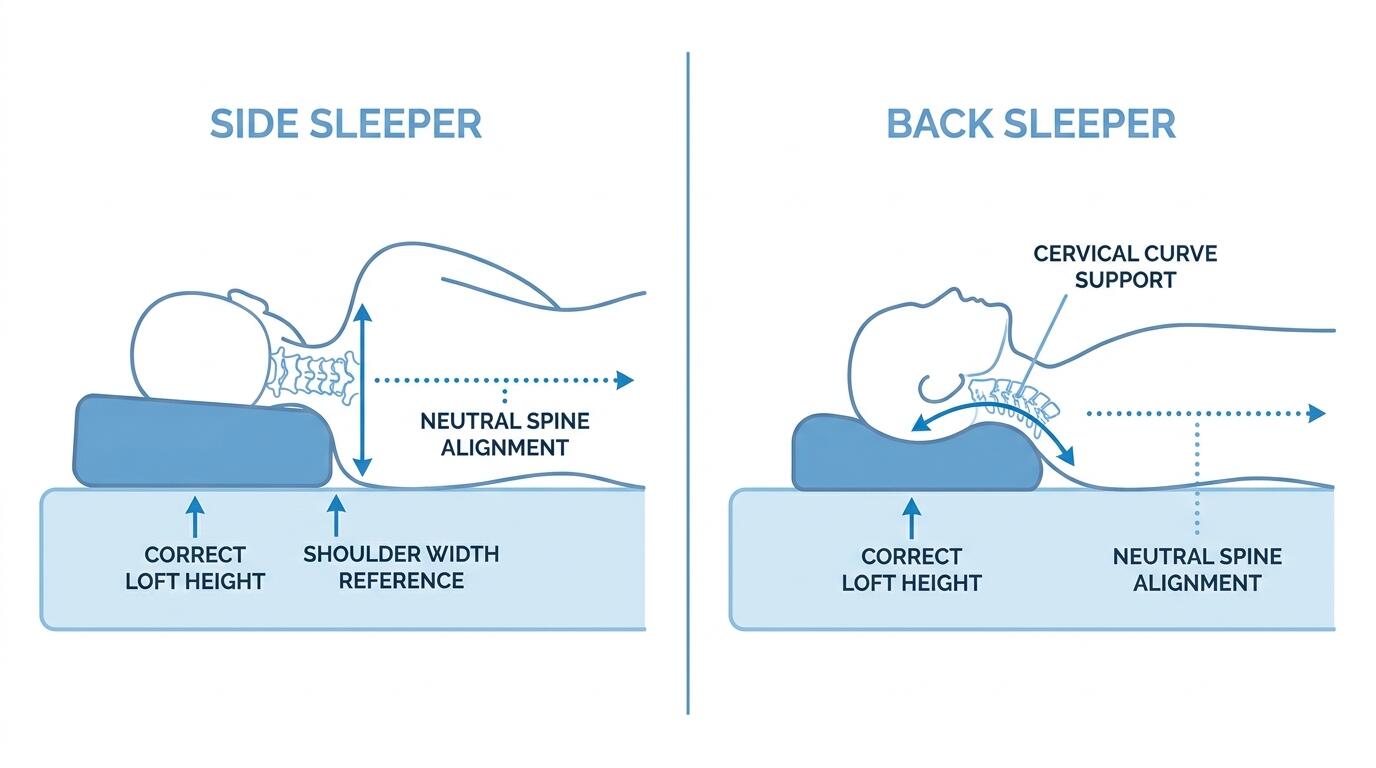
ALT: Diagram comparing correct pillow loft for side sleeper versus back sleeper to prevent morning neck pain and maintain cervical spine alignment
Pro Tips for Better Results When Addressing Pillow-Related Neck Pain
Reassess your pillow every year, not just when it fails visibly. Most fill materials — even higher-quality options — experience gradual compression that is not obvious to the eye but measurable in terms of overnight support. A pillow that still looks full may have lost a meaningful portion of its effective loft. A practical test: fold a synthetic or down pillow in half and release it. If it does not spring back on its own, it has lost the resilience needed to support your neck properly.
Your mattress and pillow form a system. A common misconception is that pillow choice can be evaluated entirely independently of the mattress. A softer mattress allows the shoulder of a side sleeper to sink in, which effectively reduces the gap between mattress and head — meaning the correct pillow loft on a firm mattress is higher than the correct loft on a plush surface. If you have recently changed your mattress and neck pain has followed, revisit your pillow selection before concluding the mattress is the problem.
Pillow protectors affect feel and function. A thick, quilted pillow protector can meaningfully change a pillow's effective loft and surface feel. If you use one, assess your pillow with the protector in place, not without it. Likewise, a quality protector that holds its loft neutrally (rather than adding bulk) is worth the investment for both hygiene and consistent support.
Do not conflate softness with comfort. In our work with customers transitioning from chronic neck pain to genuinely restorative sleep, one of the most common recalibrations is the understanding that "soft" and "comfortable" are not synonyms in pillow selection. A pillow that feels luxuriously soft in-store often fails to support the weight of the head over the course of a full night, particularly for side sleepers. The goal is not maximum softness; it is appropriate support delivered with a comfortable surface texture.
Account for positional variation. Very few people sleep in one fixed position through the entire night. If you start as a back sleeper and migrate to your side, or vice versa, a single-loft pillow may serve one position well and underserve the other. Adjustable-fill pillows — where you can add or remove material to tune the height — are specifically designed for this scenario and are worth considering if your pain pattern does not align neatly with a single position.
Questions & Answers
Q1: How do I know if neck pain is from my pillow or from something else?
Pillow-caused neck pain typically presents as stiffness or soreness that is worst immediately upon waking and improves progressively over the first hour of the day as you move around. If your pain follows this "worst at waking, better by mid-morning" pattern and correlates with a pillow that is flat, old, or mismatched to your sleep position, the pillow is very likely the primary driver. Pain that is constant throughout the day, worsening with movement, or accompanied by neurological symptoms such as tingling or arm weakness warrants professional evaluation beyond a pillow change.
Q2: Is a firm pillow always better for neck pain than a soft one?
Firmness is not the most important variable — loft and fill resilience are. A firm pillow at the wrong height is just as problematic as a soft one that has collapsed, because both result in cervical misalignment. The ideal pillow provides enough structural resistance to maintain consistent loft through the night without creating pressure points. For many side sleepers, a medium-firm latex or high-density foam pillow offers the best balance; for back sleepers, a softer medium-loft option may be appropriate. The key is correct height for your sleep position, supported by a fill that holds that height reliably.
Q3: How long does it typically take to feel improvement after switching pillows?
Most people notice a meaningful difference within the first three to five nights of sleeping on a well-matched replacement pillow, though the full benefit — particularly if supporting muscles and soft tissues have been under chronic strain — may take one to two weeks to become fully apparent. If you notice no improvement after two weeks on a pillow that appears correctly matched to your position and proportions, it is worth considering other contributing factors such as mattress support, sleeping position habits, or daytime posture, and consulting a health professional if the pain persists.
Final Thoughts
Morning neck pain is not something you simply have to accept, and in the majority of cases where the pain eases through the day, a poorly matched pillow is a primary — and very solvable — contributor.
Key Takeaways:
- Morning neck pain that improves as the day progresses is a strong signal that your sleep surface, not an underlying condition, is responsible.
- Pillow loft — height relative to your sleep position and shoulder width — is the single most important variable to evaluate first.
- Fill material determines whether a pillow maintains its loft all night; older, compressible fills are frequent culprits even when they still look intact.
- The location of your pain (lower neck, base of skull, upper trapezius) provides directional clues about the specific type of misalignment occurring overnight.
- Replacing a pillow without understanding the specific mismatch that caused the problem is likely to result in a different problem, not a solution.
The most effective next step is to work through the position and alignment assessment above, identify your specific mismatch profile, and then shop for a replacement with that profile in mind rather than by instinct or price alone.
Ready to finally sleep the way you deserve? SleepBetterMD takes the guesswork out of building your ideal sleep setup — every pillow, sheet, and sleep accessory is hand-picked from 20+ trusted Asian manufacturers and presented with full material transparency, so you know exactly what you are resting on. Start with your biggest sleep problem and let the products come to you at the SleepBetterMD website.
Sources
- Harvard Health Publishing. "Say 'good night' to neck pain."
https://www.health.harvard.edu/pain/say-good-night-to-neck-pain - Healthline. "What Causes Neck Pain After Waking Up and How to Treat It."
https://www.healthline.com/health/neck-pain/waking-up-with-neck-pain - Pinnacle Chiropractic. "Pillow Talk — Preventing Neck Pain Caused By Pillows."
https://www.pinnaclechiropractic.net/prevent-neck-pain-caused-by-pillows/ - American Academy of Sleep Medicine.
https://aasm.org/ - National Institutes of Health — National Institute of Neurological Disorders and Stroke.
https://www.ninds.nih.gov/
Note: Standards and clinical guidance may be updated; please check the latest official documents or consult qualified professional advisors for personal health concerns.