

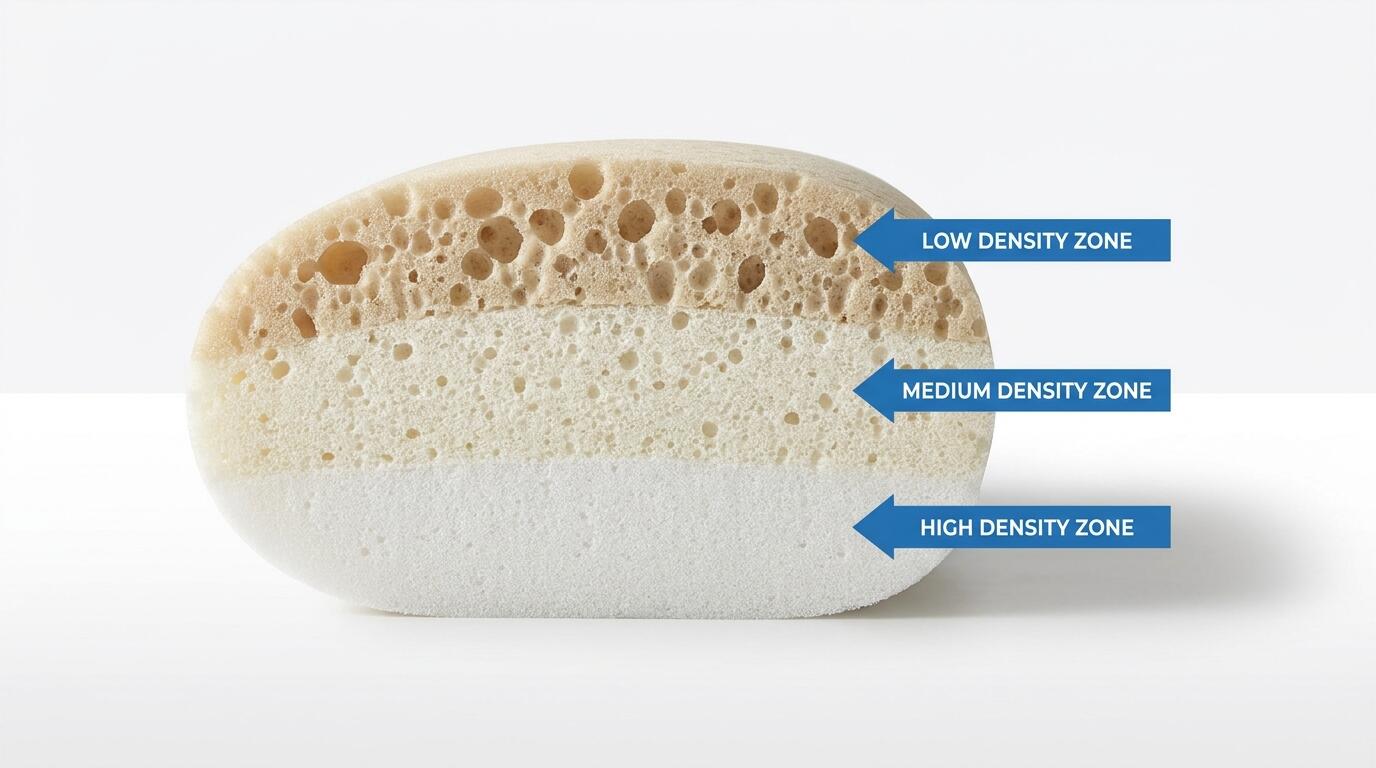
ALT: Close-up of foam pillow cross-section showing density layers for informed pillow buying decisions
What Foam Density Ratings Actually Tell You — And Why It Changes How You Buy a Pillow
What does that number on a foam pillow's label actually mean for the quality of your sleep? Foam density ratings are one of the most misunderstood specs in the entire sleep products world — and getting them wrong can mean spending good money on a pillow that bottoms out in three months, traps heat all night, or simply feels nothing like you expected. This guide is for anyone who has stared at a product listing full of technical jargon and given up, defaulting to whatever looked nice or had the most reviews. By the time you finish reading, you'll know exactly how to read a foam density rating, what it predicts about a pillow's feel and lifespan, and — just as importantly — what it doesn't tell you.
Before You Start: What to Know and Gather Before Comparing Foam Pillows
Foam density is a measurable physical property. In the context of foam pillows, density refers to the mass of foam material per unit of volume — expressed in kilograms per cubic meter (kg/m³) in metric systems, or pounds per cubic foot (PCF/lbs/ft³) in imperial systems. Before you can meaningfully compare pillows, it helps to understand a few groundwork concepts so that the numbers you encounter map to something real.
First, it's worth separating two terms that are constantly conflated in marketing copy: density and firmness. Density measures how much material is packed into the foam. Firmness (often called ILD — Indentation Load Deflection) measures how much force is required to compress the foam. These two properties are related but not the same. A high-density foam can be made in a soft firmness. A low-density foam can be made temporarily firm. Conflating them leads to mismatched expectations and poor purchases.
Second, know that not all foam is the same type. Memory foam (viscoelastic foam), latex foam, and conventional polyurethane foam each behave differently at the same density rating, and they serve different sleep needs. Density ratings are most consistently useful when comparing within the same foam category.
Third, understand why this matters in pillows specifically. Unlike a mattress, where you're distributing weight across a large surface, a pillow is doing precision work — cradling your head and neck for six to eight hours of unconscious posture. A pillow that loses its structure because the foam density is too low will collapse under your head's weight, causing neck tension and disrupted sleep. The density number on a pillow isn't just a spec — it's a predictor of how long the pillow will actually support you.
Preparation checklist before comparing foam pillow options:
- Know your sleep position (side, back, or stomach) — it affects which density range is relevant for your needs
- Know your general head and neck sensitivity (do you wake with neck pain or stiffness?)
- Have the product listing, packaging, or manufacturer spec sheet in front of you
- Understand which foam type you're comparing: memory foam, latex, or polyurethane
- Clarify your budget range so you can cross-reference value against density
How to Decode Foam Density Ratings Step by Step
Step 1: Locate the Density Specification on the Product Listing
The first step is finding the actual number — which is harder than it sounds. Many pillow brands bury density information in fine print, omit it entirely, or express it vaguely as "high-density" without any supporting figure. In our work reviewing products from over 20 Asian manufacturers, we consistently see a pattern: brands that are genuinely confident in their foam quality tend to publish the density spec clearly. Brands that don't often have a reason to obscure it.
Look in the product's technical specifications section, not just the headline description. On e-commerce listings, scroll past the marketing text to where materials and dimensions are listed. If the density isn't published, that itself is useful information — you're dealing with a brand that hasn't committed to transparency, and you should factor that into your decision.
Tip: If a listing uses phrases like "premium density" or "ultra-supportive" without a number, treat these as marketing language, not specifications. Contact the brand directly and ask for the kg/m³ or PCF rating before purchasing.
Step 2: Identify the Unit System and Normalize the Numbers
Density figures appear in two unit systems depending on the market. Most Asian manufacturers and European brands use kg/m³ (kilograms per cubic meter). North American brands typically use PCF (pounds per cubic foot). To compare across markets, you need to normalize. One PCF is approximately equal to 16 kg/m³.
A memory foam pillow listed at 50 kg/m³ and one listed at 3.1 PCF are describing essentially the same density — but if you don't know the conversion, you might assume they're wildly different products. This confusion is especially common when shopping across international brands, which is exactly the kind of scenario our customers encounter at SleepBetterMD when comparing products from multiple Asian manufacturers.
Tip: Bookmark a simple unit conversion reference so you can normalize figures on the fly. The calculation is straightforward: divide the kg/m³ figure by 16.02 to get PCF, or multiply PCF by 16.02 to get kg/m³.
Step 3: Understand What Density Ranges Actually Mean for Pillows
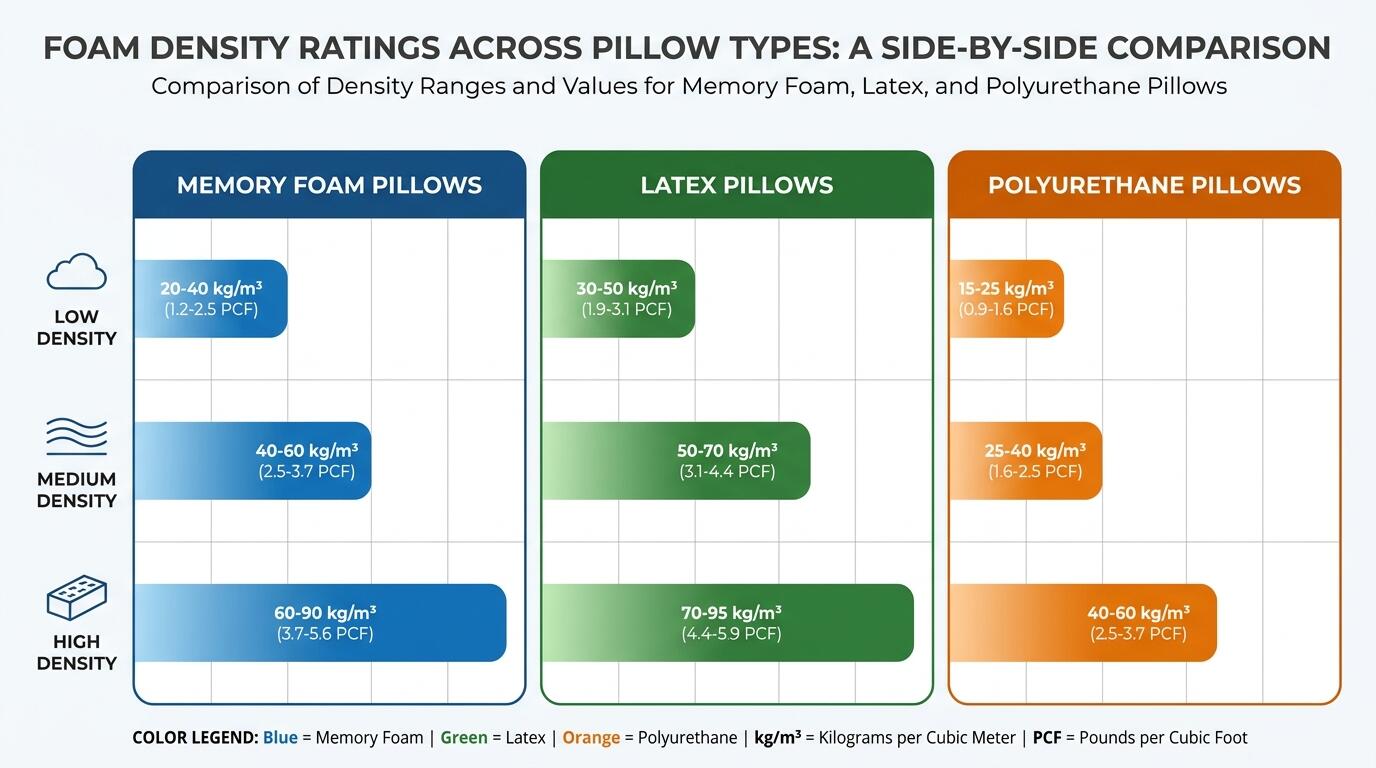
Once you have a normalized number, you need to interpret it. As a general reference — based on industry-standard foam classifications and manufacturer documentation — foam density for pillows typically falls into three broad ranges. These aren't absolute rules, and they apply most consistently to memory foam and polyurethane foam:
Lower density (roughly under 40 kg/m³ / under 2.5 PCF): Lighter foam that compresses quickly and rebounds fast. This can feel initially soft and responsive, but lower-density foam tends to degrade faster with regular use. You may notice visible indentations or reduced loft within months. For pillows, this range is generally better suited to temporary use or budget-tier products.
Medium density (roughly 40–60 kg/m³ / 2.5–3.7 PCF): This is the sweet spot for most foam pillows. Medium-density foam offers a balance of contouring support and durability. It holds its shape over a reasonable lifespan, provides meaningful neck support without feeling rigid, and is typically the range where quality memory foam pillows are made. According to foam industry guides, including resources like those published by foam furniture specialists, this density range represents the most versatile performance tier for everyday use.
Higher density (roughly 60 kg/m³ and above / 3.8 PCF and above): Denser foam that is more durable and generally more supportive, but also heavier and potentially warmer. High-density foam pillows are less common than high-density mattress foam because the additional weight can feel cumbersome, and the reduced airflow can trap heat — a real concern for hot sleepers. That said, for side sleepers who need robust, lasting neck support, a higher-density foam pillow can be a meaningful upgrade.
Tip: Don't automatically assume higher density equals better sleep quality. For lighter sleepers or those who prefer a softer feel, a very high-density pillow may feel unpleasantly rigid.
Step 4: Cross-Reference Density with Foam Type
Density means different things depending on the foam category you're looking at — and this is where many shoppers go wrong.
For memory foam, density is closely correlated with how slowly the foam responds to pressure and heat, how well it contours, and how durable it remains over time. A higher-density memory foam will typically cradle your head more precisely and hold its shape longer. Medium to high density is generally recommended for memory foam pillows.
For latex foam, the density scale reads differently. Latex is naturally denser than polyurethane foam at comparable firmness levels, and it behaves differently under compression. A latex pillow with a density that would be considered "high" in memory foam terms might feel completely different because of latex's inherent springiness and temperature-neutral properties. If you're comparing a memory foam pillow to a latex pillow using density alone, you'll draw incorrect conclusions.
For polyurethane (conventional) foam, density is a strong predictor of longevity. Low-density polyurethane foam is cheap to produce and widely used in budget pillows, but it degrades noticeably faster than higher-density alternatives. Per foam manufacturing guides from established industry sources, even modest increases in density within this foam type can significantly extend usable lifespan.
Understanding what type of pillow is best for your sleep style before comparing density figures will save you from optimizing the wrong spec entirely.
Tip: Always confirm the foam type before interpreting the density figure. The number only tells the full story in context.
ALT: Comparison chart showing foam density ratings across memory foam, latex, and polyurethane pillow types for informed buying decisions
Step 5: Factor in Density's Relationship to Durability and Long-Term Value
Foam density is, at its core, a durability indicator. More material packed into the same space means more cellular structure to resist compression fatigue over time. A pillow that loses its loft and support faster than expected is almost always a density problem.
In practice, this is one of the most consistent patterns we observe when customers come to us after a disappointing purchase: they chose a pillow based on initial softness or price, without realizing the foam density was too low to sustain that performance beyond the first few weeks of use. The pillow felt great in the store or on first use, then gradually became flat and unsupportive.
For a practical framework, consider how long you expect the pillow to last. If you're investing in a quality sleep setup, a medium-to-high density foam pillow is more likely to hold its shape and maintain its support properties for an extended period. If you're buying a guest room pillow or a short-term solution, lower-density options may be entirely appropriate.
This is also where comparing sleep products by material, function, and long-term value becomes especially useful — density is one of several material factors that determine whether a product is genuinely worth its price over its intended lifespan.
Tip: Ask brands directly how their foam density is tested and what lifespan they expect the pillow to maintain its loft. A brand confident in their sourcing will answer clearly.
Step 6: Account for Heat Retention and Airflow
Density and breathability are in tension with each other. As foam density increases, airflow through the foam structure generally decreases — meaning higher-density foam pillows can sleep warmer. This matters enormously for hot sleepers, and it's one of the most underappreciated tradeoffs in foam pillow buying.
Manufacturers address this in different ways: open-cell foam structures, ventilation channels cut into the foam, or gel infusions. These modifications can partially offset the heat retention that comes with higher density. When evaluating a high-density foam pillow, always check whether the manufacturer has incorporated any heat-management features, and verify whether those features are structural (built into the foam) or merely surface-level.
Foam type also plays a role here. Latex foam, even at higher densities, tends to be more breathable than memory foam because of its natural cellular structure. If you're a hot sleeper who also needs robust support, a high-density latex pillow may serve you better than a high-density memory foam option.
Tip: For hot sleepers, density should always be evaluated alongside ventilation design. A pillow's density rating alone won't tell you how warm it will sleep.
Step 7: Verify Material Transparency Before Committing
The final step is one that goes beyond the density number itself. Foam is a processed material, and the composition of that foam — the base chemicals, any added treatments, and manufacturing standards — varies widely across manufacturers. Density tells you about physical structure; it doesn't tell you about chemical safety or material quality.
At SleepBetterMD, radical material transparency is a core part of how we vet the products we carry. We ask manufacturers for full material disclosure because a high-density foam made from lower-grade inputs is not the same product as a high-density foam made from high-quality, well-documented inputs — even if the density figures match exactly.
When evaluating any foam pillow, look for third-party certifications or testing documentation. Standards bodies such as OEKO-TEX and CertiPUR-US exist to evaluate the chemical safety and emissions of foam materials. A foam pillow that carries credible third-party certification alongside a clearly published density rating is offering you two layers of meaningful information. Neither alone is sufficient; together, they tell a much more complete story. You can read more about what material transparency really means when buying sleep products to understand why this layer of vetting matters so much.
Tip: A density figure without material sourcing information is only half the picture. Prioritize brands that publish both.
Common Mistakes and How to Fix Them
| Symptom | Likely Cause | How to Fix |
|---|---|---|
| Pillow loses shape within a few months | Foam density was too low for the pillow's intended use; insufficient cellular structure to resist compression fatigue | Check density spec before purchasing; for daily use pillows, prioritize medium to high density ranges |
| Pillow feels uncomfortably hard despite "soft" label | High density was mistaken for high firmness; buyer expected softness from a spec that predicts structure, not feel | Learn to separate density (ILD) from firmness; request or look for ILD ratings alongside density |
| Hot sleeper experiences heat buildup with a new foam pillow | High-density foam selected without checking for ventilation features or breathable foam type | Cross-reference density with foam type and heat management design; consider open-cell or latex options |
| Identical density figures from two brands produce very different pillows | Density was compared across different foam types (e.g., memory foam vs. polyurethane) without accounting for categorical differences | Always confirm foam type before comparing density numbers; normalize within category first |
| Brand claims "high density" but no number is provided | Marketing language used instead of specification; actual density may be undisclosed for commercial reasons | Contact brand for the actual kg/m³ or PCF figure; treat unlisted specs as a transparency red flag |
| Pillow performs well initially but feels unresponsive in cold weather | Memory foam at higher density becomes stiffer in cooler temperatures — a property of viscoelastic foam | Factor ambient temperature into foam type selection; latex foam is less temperature-sensitive |
Pro Tips for Better Results When Evaluating Foam Density
Look at density alongside ILD, not instead of it. Density and ILD (Indentation Load Deflection, the measure of firmness) are both necessary to predict how a foam pillow will actually feel and perform. A full spec sheet includes both. If a brand only provides one figure, ask for the other.
Weight the pillow in your hands if you can. Higher-density foam is, by definition, heavier. If you have the opportunity to handle a foam pillow before buying — at a physical store or during a trial period — a noticeably light pillow is a signal of lower density. This isn't a definitive test, but it's a practical first filter.
Think in terms of sleep position requirements. Side sleepers generally need more sustained loft and support to maintain spinal alignment, which makes durability — and thus density — more important for them than for stomach sleepers, who typically benefit from lower-profile, softer options. Back sleepers fall somewhere in the middle. Density requirements are not one-size-fits-all, and knowing your position changes the calculation meaningfully.
Be skeptical of extreme density claims without certification. Very high density claims without any supporting documentation or third-party testing are sometimes used as marketing hooks. Foam that is genuinely high-density will have verifiable specs and, ideally, certification from a recognized testing body. Per information from foam industry educational resources, the difference between a legitimately high-density foam and a marketing exaggeration often comes down to the presence or absence of independently verified documentation.
A common misconception to clear up: Many shoppers assume that a denser foam pillow will always feel firmer. This is not accurate. Density describes the amount of material in the foam; firmness describes resistance to compression. Manufacturers can produce high-density, soft-feeling foam by adjusting the foam's chemical formulation and cell structure. This means you can have a pillow that is both highly durable (high density) and genuinely soft to sleep on — these qualities are not mutually exclusive, though finding them well-executed requires buying from transparent, quality-focused manufacturers.
Common Questions
Q1: How do I convert foam density units when comparing pillows from different markets?
Foam density is expressed in either kg/m³ (kilograms per cubic meter) or PCF (pounds per cubic foot), depending on the manufacturer's market. To convert, divide the kg/m³ figure by approximately 16 to get PCF, or multiply PCF by 16 to get kg/m³. For example, a pillow listed at 48 kg/m³ is approximately 3.0 PCF. Always confirm which unit system the brand is using before comparing figures across listings, especially when shopping across different international markets.
Q2: Is a higher foam density rating always better for pillow quality?
Higher foam density is not automatically better — it depends on your sleep position, body weight, temperature preferences, and how long you want the pillow to last. Higher density generally means greater durability and more sustained support, but it also typically means a heavier pillow and potentially warmer sleep. For hot sleepers or those who prefer a softer feel, a very high-density foam pillow may not be the right match, even if its durability specs are impressive. Match density to your actual sleep needs rather than treating it as a universal quality indicator.
Q3: How long should a foam pillow maintain its shape based on density?
Longevity varies by foam type and use conditions, but density is a reliable predictor of durability. Medium-density foam pillows used nightly typically retain meaningful support for a longer period than low-density alternatives, which may show compression fatigue noticeably sooner. High-density foam generally extends that lifespan further. That said, density alone doesn't guarantee quality — the foam's base composition, manufacturing standards, and care (regular airing, use of a protective cover) all play a role in how well a pillow holds up over time.
Summary
Decoding foam density ratings is one of the most practical skills you can develop as a sleep product shopper — and one of the most consistently overlooked.
Key takeaways from this guide:
- Foam density (kg/m³ or PCF) measures how much material is packed into the foam, which predicts durability and support quality — it is not the same as firmness
- Always identify the unit system and convert before comparing figures across brands or markets
- Medium to high density is generally appropriate for foam pillows intended for regular nightly use; lower-density options degrade faster
- Density must be interpreted alongside foam type — memory foam, latex, and polyurethane behave differently at the same density figure
- Higher density often means warmer sleep; hot sleepers should cross-reference density with ventilation design and foam type
- Density data alone is incomplete — material transparency, third-party certification, and clear ILD specs are equally important to a well-informed purchase
The next practical step is to apply this framework to your current pillow shortlist: pull the density figures, normalize the units, confirm the foam type, and ask the brand directly if the spec sheet is incomplete. Choosing a pillow with eyes open to these details dramatically reduces the chance of a disappointing purchase.
Ready to put this into practice with products that already come fully vetted? Visit SleepBetterMD — every pillow and sleep product in our curated range is hand-picked from trusted Asian manufacturers and presented with full material transparency, so you can compare honestly and shop with confidence.
References
- Morfurniture. "Understanding Foam Density for Seats".
https://www.morfurniture.com/blogs/buying-guides/understanding-foam-density-what-every-shopper-should-know - Diesel World Magazine. "The Ultimate Beginner's Guide to Foam Grades That Will Save Your Furniture and Your Back".
https://www.dieselworldmag.com/diesel-news/never-buy-the-wrong-foam-again-the-ultimate-beginners-guide-to-foam-grades-that-will-save-your-furniture-and-your-back/ - YouTube. "Understanding Foam Types: Density, Firmness, and Best Uses".
https://www.youtube.com/watch?v=XVJPp8FpESY - OEKO-TEX Association. OEKO-TEX Standards and Testing.
https://www.oeko-tex.com/
Note: Standards and certifications may be updated; please check the latest official documents or consult professional advisors.