

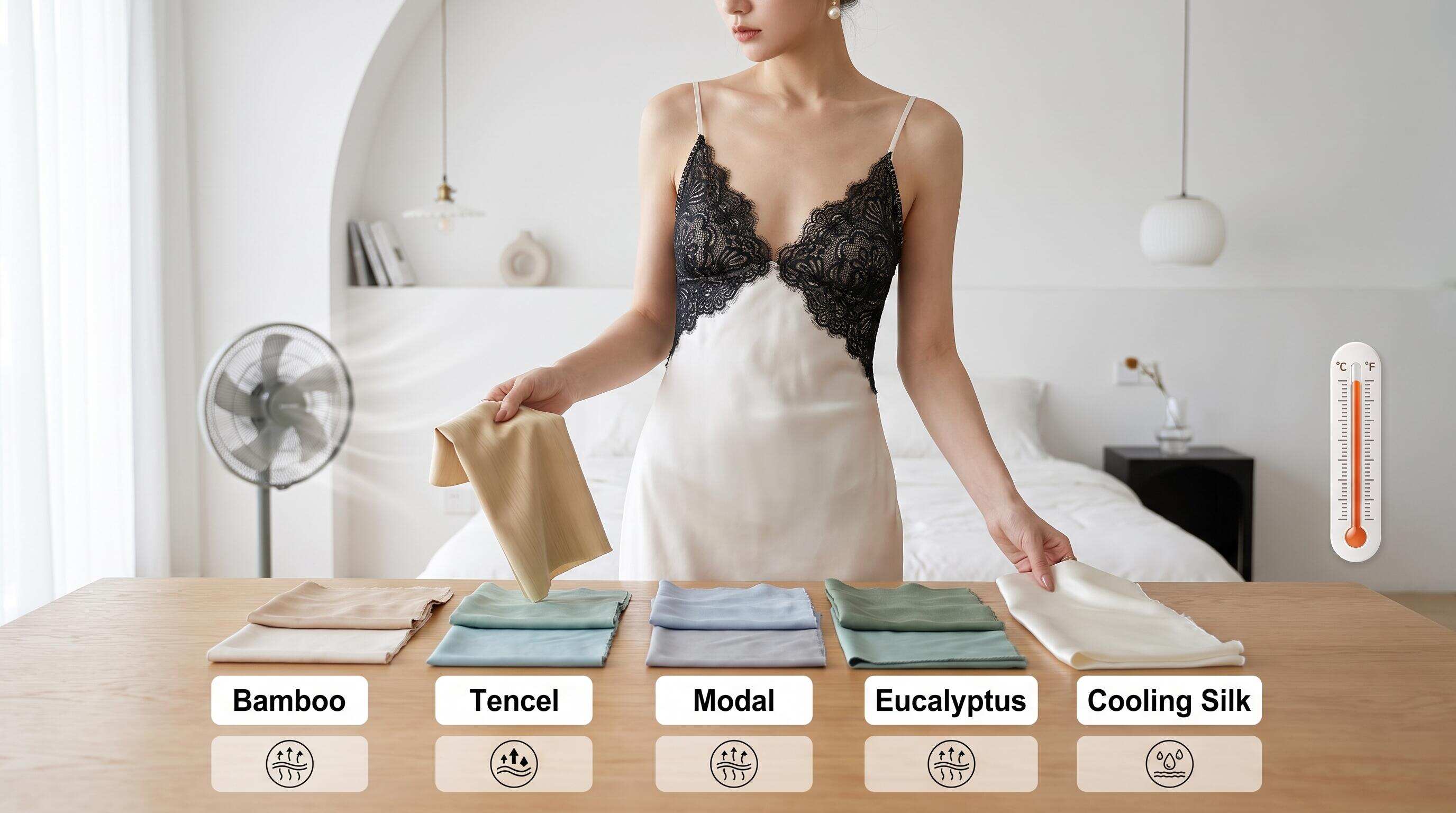
ALT: Hot sleeper comparing cooling pajama fabrics for better summer night sleep comfort
What You'll Learn: How to Find the Best Cooling Pajamas for Hot Sleepers This Summer
Choosing the right cooling pajamas for hot sleepers is simpler than most product listings make it seem — the key is understanding three things: the fiber you're sleeping in, the fabric construction, and how well the garment fits your body's specific heat pattern. This guide cuts through the marketing noise and gives you a practical, step-by-step framework for making a genuinely informed choice before summer's worst nights arrive.
If you've ever woken up drenched at 3 a.m. despite paying good money for "breathable" sleepwear, you're not alone — and the problem is almost never about thread count or brand prestige. In our work curating sleepwear at SleepBetterMD, a Hong Kong-based DTC retailer sourcing from 20-plus Asian manufacturers, a pattern we consistently see is that frustrated hot sleepers have been let down not by bad products but by incomplete information. Fabric labels that say "moisture-wicking" without explaining the mechanism, or "natural fiber" without specifying weave weight, leave shoppers guessing. This guide is for anyone aged 25–45 who wants to sleep cooler this summer and is done settling for vague promises.
Before You Start: What You Need to Know Before Buying Cooling Sleepwear
Finding genuinely effective cooling pajamas requires a small amount of self-knowledge and preparation. Before you browse a single product page, it's worth pausing to build a clear picture of your own sleep heat profile. This preparation stage takes no more than an evening of honest self-reflection — and it will save you from returns and disappointment.
Understand your heat pattern first. Hot sleepers are not a monolith. Some people overheat primarily during the first half of the night, driven by a core body temperature that hasn't fully descended. Others experience night sweats in the second half, often linked to hormonal fluctuation or ambient room temperature rising before dawn. Some run hot throughout. The type of cooling fabric that works best differs depending on when and how you heat up.
Know your climate context. A Hong Kong August, a Sydney January, and a London heatwave are all "summer," but they differ in humidity. High-humidity environments demand moisture-wicking performance above all else — trapped sweat in a still-humid room is the primary discomfort driver. Dry-heat climates benefit more from fabrics with passive breathability and thermal mass.
Identify any skin sensitivities. Certain synthetic performance fabrics that excel at moisture management can feel rough or cause irritation on sensitive skin. If you have reactive skin, sensory sensitivity, or conditions like eczema, your fiber shortlist will look different from someone whose only concern is temperature.
Have your current sleepwear ready for comparison. Pull out what you're already sleeping in. Check the label. Is it polyester-dominant? A heavy cotton jersey? Knowing what isn't working gives you a concrete reference point.
Checklist before starting:
- Identify whether your primary issue is sweating, ambient heat, or both
- Note your sleeping climate's typical summer humidity level
- Flag any known skin sensitivities or tactile preferences
- Check the fiber composition of your current pajamas (the label or a quick search)
- Set a realistic budget — quality cooling sleepwear is an investment, but a targeted one
Step-by-Step Guide to Choosing Cooling Pajamas for Hot Sleepers
Step 1: Understand What "Cooling" Actually Means in a Fabric
Cooling pajamas work through one or more of three distinct mechanisms: passive breathability (allowing air to circulate freely), active moisture management (wicking sweat away from skin and promoting evaporation), and thermal conductivity (the fabric's ability to draw heat away from the body on contact). Most marketing copy conflates these, calling anything "cooling" — but they solve different problems.
Passive breathability is primarily a function of weave openness and fiber fineness. A loose, open weave — think a gauze or a lightweight voile — allows air to move freely between your skin and the environment. Active moisture management is typically a fiber-level property: natural fibers like Tencel (lyocell) and bamboo-derived viscose absorb moisture into the fiber structure, while performance synthetics move moisture along the fiber surface via capillary action. Thermal conductivity tends to be a property of specific natural fibers, particularly linen and certain high-quality silk weaves, which feel cool to the touch on initial contact.
Tip: When a brand claims their pajamas are "cooling," ask yourself which of these three mechanisms they're actually describing. If the answer isn't clear from the product page, that's a red flag.
Step 2: Match Fiber Type to Your Specific Sleep Heat Problem
The single most important variable in cooling pajama performance is fiber composition, and the right fiber depends on the nature of your heat problem. Different fibers excel at different aspects of temperature regulation, and understanding the trade-offs prevents expensive mistakes.
Lyocell (Tencel) is a semi-synthetic fiber derived from wood pulp, processed in a closed-loop solvent system that recovers and reuses the chemical used in production — a process recognized for its low environmental impact. Lyocell has a naturally smooth surface, is highly absorbent, and releases moisture quickly, making it effective for sweaty sleepers in humid climates. It is also exceptionally soft, which matters for sensory-sensitive sleepers.
Bamboo-derived viscose or bamboo rayon is widely marketed for its cooling properties. It does have good moisture absorption and a soft hand-feel, but its thermal performance is closer to regular viscose than to lyocell unless the manufacturing process is tightly controlled. At SleepBetterMD, this is one of the most common gaps we see between marketing claims and material reality — "bamboo" is not a single fiber with predictable performance; the processing route matters enormously.
Linen (flax fiber) is a genuinely high-performing option for hot sleepers in both dry and humid conditions. Linen's hollow fiber structure and high thermal conductivity create a naturally cooling sensation, and it becomes softer with each wash. Its limitation is texture — underprepared linen can feel stiff or rough, especially on sensitive skin.
Cotton requires qualification. A heavy cotton jersey or flannel is genuinely problematic for hot sleepers. But a fine, loosely woven cotton voile, a cotton lawn, or a lightweight cotton gauze can be excellent for moderate heat scenarios. The weave and weight matter as much as the fiber.
Synthetic moisture-wicking fabrics (polyester, nylon blends with moisture-transport finishes) perform well in terms of drying speed and durability, but they trap body odor over time and can feel clammy in high-humidity environments once saturated. According to research discussed by sleep product specialists at publications like Business Insider, hot sleepers testing synthetic performance fabrics often find them effective for light perspirers but less satisfying for heavy sweaters.
Tip: If you sweat heavily and live in a humid climate, prioritize lyocell or fine-weave linen. If you run warm but don't sweat much, a loose-weave cotton voile or bamboo-blend may be sufficient.
Step 3: Evaluate Fabric Weight and Weave Construction
Fiber type alone doesn't determine cooling performance — fabric weight and construction are equally important and often overlooked. A lightweight lyocell in an open, flowing weave will outperform a dense lyocell jersey in terms of airflow, even though both use the same fiber.
Fabric weight is measured in grams per square meter (GSM). Lower GSM fabrics are lighter and typically more breathable. For cooling sleepwear, look for descriptors indicating lightweight construction — terms like "voile," "lawn," "gauze," "seersucker," or "crepe" generally signal an open structure that promotes airflow. "Jersey" and "interlock" constructions tend to be denser and more heat-retentive, regardless of fiber.
Seersucker is particularly worth noting: its puckered surface structure means the fabric touches your skin at only a fraction of its total area, dramatically reducing heat transfer from body to cloth and improving air circulation at the skin surface. It's a structurally clever choice for hot sleepers and one that manufacturers across Asia have refined for generations.
Tip: If a product listing doesn't state the GSM or use construction terminology, look at the photography. A fabric that drapes loosely and appears slightly sheer is a better sign than a stiff, structured fabric.
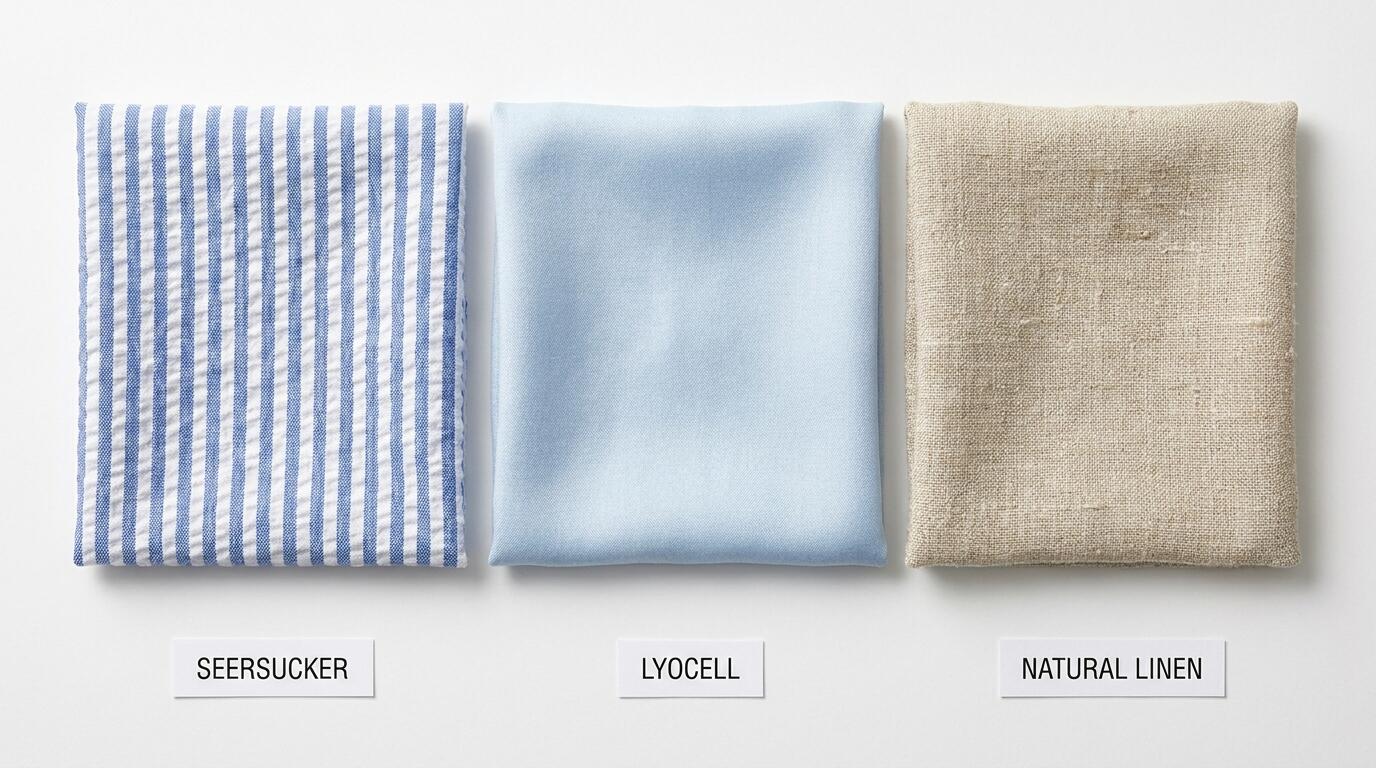
ALT: Close-up comparison of seersucker, lyocell, and linen pajama fabrics for hot summer sleepers evaluating breathability
Step 4: Assess Fit and Garment Design for Airflow
The cut and construction of a pajama set affects thermal performance almost as much as the fabric. A garment can be made from excellent cooling material and still trap heat if the fit is too close to the body.
For hot sleepers, loose or relaxed fits are generally preferable to fitted styles, especially around the torso and legs, where body heat accumulates most. Wide-leg trousers allow air to circulate freely around the thighs and calves — one of the highest heat-generating areas during sleep. Short-sleeve or sleeveless tops reduce fabric contact on the arms, while V-neck or open-collar designs vent heat from the chest and neck area.
Flat seams and minimal embellishment matter for sensory-sensitive sleepers. Raised seams, decorative trim, or elasticated waistbands with thick interfacing can all create friction and localized heat points that disrupt sleep even if the main fabric is excellent.
Tip: When in doubt, size up. A slightly generous fit in a cooling fabric will outperform a fitted version of the same garment for heat management. For combination sleepers who get cold in the second half of the night, a set with a lightweight, long-sleeve layer option gives you flexibility.
Step 5: Verify the Brand's Material Transparency
This step is where most shoppers stop short — and where the most avoidable mistakes happen. Marketing language around cooling sleepwear is notoriously inconsistent. Terms like "moisture-wicking," "breathable," "cooling," and "eco-friendly" are used without standardized definitions in most retail contexts.
A brand that is genuinely transparent about its fabrics will tell you: the specific fiber name and its origin or processing route, the fabric weight or construction type, any finishing treatments applied to the fabric (some cooling finishes are chemical treatments that wash out over time), and whether any certifications apply to the fabric or the manufacturing process.
Look for certifications that indicate third-party verification of both fiber content and safety. The OEKO-TEX Standard 100 certification — administered by the OEKO-TEX Association, an independent testing and certification system for textiles — indicates that a fabric has been tested for a defined list of harmful substances. This doesn't directly verify cooling performance, but it does confirm that what the brand says is in the fabric has been independently verified, which is a meaningful signal of overall transparency.
At SleepBetterMD, material transparency is not a feature — it is the baseline. Every product in our curated range from Asian manufacturers comes with ingredient-level disclosure precisely because we've seen how much hidden detail determines whether a garment actually solves a sleep problem or just looks good on a product page.
Tip: If a brand cannot or will not tell you the specific fiber composition and whether any performance finishes have been applied, treat the cooling claims with proportional skepticism. Genuine performance fabrics don't need to hide behind vague language.
Step 6: Test, Observe, and Iterate
Even with thorough research, sleeping in a fabric is different from reading about it. The way your body chemistry interacts with a specific fiber, how your bedroom's airflow works with a specific weave, and how a garment's fit feels after a few hours of movement in bed — these are things you can only learn by wearing it.
Commit to wearing a new pair of cooling pajamas for at least a week before forming a definitive judgment. Your first night may involve an adjustment period, especially if you're transitioning from a heavy cotton or synthetic fabric to something structurally different like linen or lyocell. Pay attention to whether you wake up feeling damp versus waking up feeling dry-but-warm — these indicate different root causes (moisture management versus thermal regulation) that may point you toward a different fiber or construction next time.
Tip: Keep a brief sleep note for the trial week — not a full sleep diary, just a morning note of how you felt thermally. Patterns across a week are far more reliable than a single night's impression.
Common Mistakes and How to Fix Them
| Symptom | Likely Cause | How to Fix |
|---|---|---|
| Pajamas feel cool initially but become clammy after a few hours | Synthetic moisture-wicking fabric reaching saturation or low vapor permeability | Switch to a natural fiber with high absorbency and release, such as lyocell or lightweight linen |
| New cooling pajamas feel scratchy or stiff | Linen or bamboo fabric that hasn't been pre-washed or is a lower-grade construction | Wash two to three times before judging; look for stonewashed or pre-washed linen options |
| Still sweating despite "moisture-wicking" pajamas | Weave is too dense or fit too close to the body, trapping heat regardless of fiber | Choose a looser construction (voile, gauze, seersucker) and size up for better airflow |
| Cooling pajamas feel cool but you still wake up hot | Room temperature or humidity is the primary driver, not the garment | Combine cooling sleepwear with better room ventilation, a lower-fill duvet, or a cooling mattress pad |
| Fabric feels fine but pills or degrades quickly | Low-grade fiber processing or aggressive wash cycle | Use a gentle or delicate machine cycle, turn garments inside out, and avoid high-heat drying |
| Cooling finish fades after several washes | Performance finish was a chemical treatment rather than a fiber-inherent property | Prioritize fabrics whose cooling properties come from the fiber structure (lyocell, linen) rather than surface treatments |
Pro Tips for Better Results with Cooling Sleepwear
Layer strategically rather than seeking a single perfect garment. The most experienced hot sleepers we work with don't rely on one piece to solve every scenario. A sleeveless lyocell top paired with lightweight linen shorts covers high-heat nights; adding a thin, open-weave long-sleeve layer gives you the option to adjust in the early morning without getting out of bed. Flexibility beats optimization for any one temperature.
Pay attention to care instructions as a proxy for fabric quality. High-quality cooling fabrics — particularly lyocell and fine linen — tend to have specific care requirements that manufacturers are upfront about. A product that claims to be premium but offers no care guidance, or claims to be machine-washable at all temperatures without qualification, is often using lower-grade or chemically-finished versions of the fiber.
Consider the full sleep system, not just the pajamas. According to research covered by specialist sleep brands including Cool-jams, a brand focused on moisture-wicking sleepwear, the interaction between sleepwear, bedding, and mattress surface determines your actual thermal experience — not any one item in isolation. Cooling pajamas in a microfiber duvet on a memory foam mattress will underperform relative to their potential. Address the thermal stack holistically.
The biggest misconception: "natural" always means cooler. Natural fibers are not automatically superior for hot sleepers. A heavy cotton jersey is a natural fiber; it is also one of the worst choices for a night sweater. The relevant variables are fiber structure, fabric weight, and weave construction — not whether the fiber came from a plant or was synthesized. Linen is natural and excellent; heavy cotton is natural and problematic. Keep the analysis at the level of the specific fabric, not the category.
Source from manufacturers with verifiable supply chain transparency. One underappreciated advantage of sourcing sleepwear from Asian manufacturers with verifiable processes is the ability to access tightly controlled fiber grades that don't typically reach Western mass-market retail. At SleepBetterMD, the sourcing relationship with 20-plus manufacturers means that the fiber specifications on a product page reflect actual mill-grade data — not the marketing department's interpretation of what sounds good.
Frequently Asked Questions FAQ
Q1: How do I know if a fabric's cooling properties will last through repeated washing?
Cooling performance that originates in a fiber's inherent structure — such as lyocell's high moisture absorption or linen's hollow fiber construction — is durable and does not degrade with washing. Performance that relies on an applied chemical finish, however, tends to diminish over repeated wash cycles, often within a season of regular use. The reliable way to distinguish these is to ask the brand directly whether the cooling property is fiber-inherent or finish-applied. Brands with genuine material transparency will answer this clearly.
Q2: Are bamboo pajamas actually better than cotton for hot sleepers?
Bamboo-derived viscose pajamas can outperform heavy cotton in moisture management, but the claim requires nuance. The cooling and moisture-wicking properties attributed to "bamboo" depend heavily on how the fiber was processed — bamboo viscose produced through a standard viscose process behaves similarly to regular rayon, while bamboo lyocell (a rarer, closed-loop process) performs closer to Tencel. Meanwhile, fine-weave cotton in a voile or gauze construction can match or exceed bamboo viscose in airflow. The fiber origin matters less than the processing route and fabric construction.
Q3: How long does it typically take to notice a difference when switching to cooling pajamas?
Most hot sleepers notice a meaningful difference within the first two to three nights, particularly if they're switching from a dense synthetic or heavy cotton to a lightweight natural fiber in a loose construction. A full assessment, however, is best made after about a week of consistent wear — body chemistry, room temperature variation, and initial fabric stiffness (particularly with linen) can all affect the first night's experience. Washing new cooling pajamas before the first wear also improves initial comfort and activates the fabric's drape and breathability.
Key Takeaways
Choosing effective cooling pajamas for hot sleepers comes down to three non-negotiable factors: fiber composition and processing route, fabric weight and weave construction, and garment fit. No single variable works in isolation — a premium fiber in the wrong construction, or a great fabric in an ill-fitting cut, will still leave you waking up hot.
The most consistent pattern in our work with customers is that the problem isn't finding cooling sleepwear — there's plenty of it on the market. The problem is finding it paired with honest, specific information about what's actually in the garment and why it will work for your particular heat profile. That gap between claim and reality is exactly what rigorous material transparency is designed to close.
Three points to carry forward: first, match the specific mechanism (breathability, moisture management, or thermal conductivity) to your specific problem. Second, treat fiber origin as a starting point, not a conclusion — the processing route and fabric construction determine real-world performance. Third, approach the purchase as a short experiment with a defined evaluation period, not a permanent commitment based on a product page alone.
Your next step is straightforward: identify which of the three heat mechanisms is your primary challenge, use that to narrow your fiber shortlist, and then look for a brand that can tell you, specifically, why their fabric addresses that mechanism.
Ready to find cooling sleepwear you can actually trust? At SleepBetterMD, every piece of sleepwear is chosen for its material performance and problem-solving ability — and every product page tells you exactly what's in it and why it works. Browse by your sleep challenge at SleepBetterMD and stop guessing.
References & Further Reading
- OEKO-TEX Association. "OEKO-TEX Standard 100 — Testing for Harmful Substances in Textiles."
https://www.oeko-tex.com - National Sleep Foundation. "Sleep and Body Temperature Regulation — What Hot Sleepers Should Know."
https://www.thensf.org - Business Insider. "The Best Cooling Pajamas, Tested by Hot Sleepers."
https://www.businessinsider.com/guides/style/best-cooling-pajamas - Cool-jams. "Moisture Wicking Sleepwear & Cooling Pajamas."
https://www.cool-jams.com - Dagsmejan. "The Best Cooling Pajamas for Women."
https://dagsmejan.com
Note: Standards and certifications may be updated; please check the latest official documents or consult professional advisors before making purchasing decisions based on certification claims.