

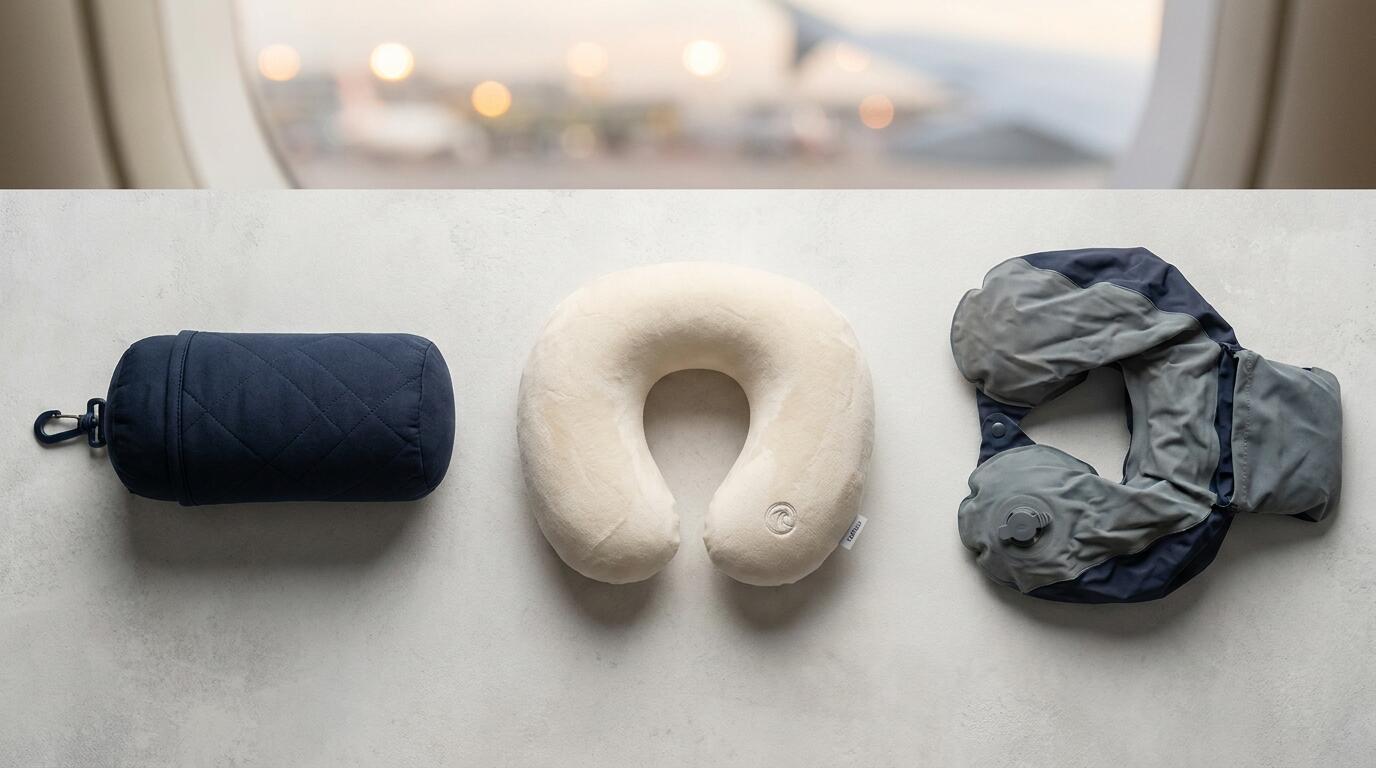
ALT: Clip-on, U-shaped, and inflatable travel neck pillows compared for the best sleep on long flights
Finding the Right Travel Neck Pillow Before Your Next Trip
A travel neck pillow is a portable support device designed to cradle your neck and head while you sleep in an upright or semi-reclined position — most commonly on long-haul flights, trains, or road trips. Choosing the wrong one is a familiar frustration: you land after a ten-hour flight with a stiff neck, a sore jaw, and the vague regret of having trusted a too-thin horseshoe of memory foam. In our experience curating sleep products for travelers across different body types and sleep habits, the single most impactful variable is not brand or price — it is the type of neck pillow you choose relative to how you actually sleep in transit.
This guide breaks down the most common travel neck pillow styles — clip-on, traditional U-shaped, inflatable, full-wrap, side-sleeper, chin-supporting, and memory foam variants — with an honest look at who each one genuinely suits, where it falls short, and what to look for in terms of materials and construction. The items were selected based on functional design principles, recurring patterns in traveler feedback, and the material transparency standards we apply at SleepBetterMD when evaluating any sleep product. Use this as a practical decision framework, not a ranked list — the "best" neck pillow is entirely determined by your travel style.
The Main Travel Neck Pillow Types: A Practical Breakdown
The Classic U-Shaped Neck Pillow
The U-shaped neck pillow is the most widely recognized travel sleep accessory — a curved, horseshoe-style cushion that wraps around the back and sides of the neck. It has been the default airport purchase for decades, and for good reason: it requires zero setup, works in almost any seat, and is immediately intuitive to use.
The appeal is straightforward. A well-filled U-shaped pillow prevents your head from dropping to one side when you drift off, which is one of the most common causes of neck strain in transit. Where many travelers go wrong is choosing one that is too flat or too narrow, which means it provides no real lateral support and essentially functions as decorative neckwear.
The material matters enormously here. Memory foam versions conform to the curve of your neck more precisely than polyester-filled alternatives, reducing pressure points. Shredded foam variants offer some adjustability. What to watch for on the label: look for covers that are removable and washable, since neck pillows accumulate oils and bacteria faster than most people realize. At SleepBetterMD, we apply the same material disclosure standard to travel pillows that we do to standard bed pillows — knowing what's inside the casing is non-negotiable.
Best for: Window seat travelers who lean their head to one side; first-time travel pillow buyers who want something familiar and fuss-free.
Watch out: U-shaped pillows can push the head forward if the fill is too thick at the back, which strains the cervical spine rather than supporting it — check that the back section is thinner than the sides.
The Clip-On Neck Pillow
A clip-on neck pillow is a compact, often cylindrical or rectangular cushion that attaches directly to your seat's headrest via an integrated clip or strap mechanism, positioning support at the sides or back of the head rather than around the neck itself. This design inverts the logic of the traditional U-shape: instead of you resting on the pillow, the pillow is anchored to the seat and comes to meet your head.
This is a meaningful functional difference for a specific type of sleeper. If you tend to fall asleep sitting relatively upright and your head lolls sideways, a clip-on positions cushioning exactly where your head lands — without requiring you to hold a pillow in place with your body weight. The result can feel more natural and less constricting than wearing something around your neck.
The trade-off is compatibility. Clip-on designs assume a headrest with a gap or protrusion to clip onto, which works well on most modern aircraft seats but can be awkward on older train seating, car headrests, or bus seats with flat backrests. They also tend to be less packable than inflatable options.
Best for: Upright sleepers on modern aircraft; travelers who find traditional U-shaped pillows claustrophobic or uncomfortable around the throat.
Watch out: Clip compatibility varies — always check whether the design suits the type of seating you'll encounter on your specific route.
The Inflatable Travel Neck Pillow
An inflatable travel neck pillow is a U-shaped or cylindrical cushion that can be deflated for packing and inflated by mouth or pump when needed, reducing its packed size to a fraction of a foam equivalent. For travelers who prioritize luggage space, this is often the deciding factor.
The honest trade-off is feel. Even the best inflatable neck pillow has a firmness profile that differs from foam — air tends to redistribute under pressure, so you may find yourself reinflating mid-flight or adjusting frequently. Some higher-end inflatables address this with internal baffling or a fabric-wrapped outer surface that prevents the plasticky feel from being the thing you notice most when you're trying to sleep.
According to sleep ergonomics guidance referenced by the American Academy of Sleep Medicine, maintaining neutral cervical alignment during rest — even upright rest — meaningfully reduces muscle tension and the likelihood of waking up with neck pain. An inflatable that you've inflated to the right firmness can achieve this; one that's either over- or under-inflated typically cannot.
Best for: Carry-on-only travelers; frequent flyers who want a pillow that fits in a jacket pocket; budget-conscious buyers who need a functional option without bulk.
Watch out: Valve quality varies significantly — a poor valve means slow air loss overnight, and you'll wake up with less support than you started with. Prioritize designs with double-valve mechanisms.
The Full-Wrap or J-Pillow Style
A full-wrap travel pillow — sometimes called a J-pillow or multi-lobe pillow — is a neck support that extends beyond the traditional horseshoe shape to include a front chin rest or a secondary lobe that supports the jaw and prevents the mouth from falling open. This design addresses one of the most common complaints about traditional U-shaped pillows: the head still drops forward if you fall deeply asleep.
In our work with travelers who do frequent long-haul routes, a pattern we consistently see is that chin-drop is the primary sleep disruptor on overnight flights — and it is something a standard U-pillow simply does not address. The J-style or full-wrap design tackles this by giving the chin somewhere to rest, which keeps the airway more open and the neck in a more neutral position.
The trade-off is bulk and a slight learning curve. These pillows are harder to pack than a simple horseshoe and can feel unfamiliar for the first few uses. Some travelers also find that the chin rest interferes with comfort when they're awake and trying to watch a screen.
Best for: Deep sleepers who consistently wake with forward head slump; mouth breathers; travelers on overnight international routes.
Watch out: The extra lobes add volume — check packing dimensions before buying if you're on a strict carry-on allowance.
The Memory Foam Contour Pillow
A memory foam contour travel pillow is a neck support made from viscoelastic polyurethane foam that responds to body heat and pressure to conform to the exact shape of your neck and jaw. Unlike standard polyester-filled U-pillows, memory foam rebounds slowly, which means it maintains a custom fit throughout the flight rather than compressing immediately under weight.
This is the closest analog to what high-quality bed pillows offer — and for travelers who already sleep on memory foam at home, it can feel like the smallest possible departure from their usual sleep environment. The density and responsiveness of the foam are the critical variables: high-density memory foam holds its shape and support over time, while low-density versions compress quickly and lose their contouring benefit.
If material transparency matters to you — and for allergy-prone travelers, it absolutely should — look for memory foam travel pillows that disclose their foam density, any certifying body information (such as OEKO-TEX certification for chemical safety), and whether the cover fabric has been tested for skin contact safety. This is a standard we apply consistently across the products we evaluate at SleepBetterMD, informed by our broader approach to comparing sleep products by material, function, and long-term value.
Best for: Allergy-prone travelers; those who already use memory foam pillows at home; anyone prioritizing support quality over packability.
Watch out: Memory foam travel pillows are generally the heaviest and bulkiest option. They pack down significantly less than inflatable alternatives.
The Side-Sleeper Travel Pillow
A side-sleeper travel pillow is a neck support specifically engineered for travelers who sleep with their head tilted to one side — often resting against a window, a bulkhead, or a travel pillow positioned laterally. These designs typically feature asymmetrical loft, with taller support on the side the sleeper leans toward and lower fill on the opposite side to prevent the neck from torquing unnaturally.
This is a niche but important category. Most travel pillows are designed with the assumption that you'll sleep with your head roughly upright, but a meaningful proportion of travelers naturally and consistently sleep leaned to one side. A standard U-pillow on a side-sleeper often compresses on the leaning side and rides up on the non-leaning side, creating a lopsided pressure that wakes them up.
Best for: Window seat travelers who use the fuselage as a secondary rest surface; consistent side-sleepers who struggle with every other neck pillow format.
Watch out: The asymmetric design means these pillows work well in one specific orientation — if you switch sides during sleep, they can feel awkward.
The Scarf or Wrap-Style Travel Pillow
A scarf or wrap-style travel pillow is a neck support that doubles as a wearable accessory — typically a soft, tube-shaped cushion filled with microbeads, buckwheat, or a light synthetic fill, designed to be worn loosely around the neck like a scarf. When it's time to sleep, you position it for support; when you're awake, it functions as a regular neck covering, which is particularly useful on cold flights.
The dual-use practicality is the main appeal. Frequent travelers often cite the "dead weight" problem with travel pillows — they take up space and serve exactly one purpose. A scarf-style design eliminates that friction by being wearable throughout the journey, not just during sleep. The support level is generally lower than dedicated foam or inflatable options, but for shorter flights or travelers who doze lightly rather than sleeping deeply, it can be entirely sufficient.
Best for: Light sleepers on medium-haul routes; cold sleepers on temperature-variable flights; travelers who want to minimize single-use accessories.
Watch out: Because these prioritize softness and wearability, they typically offer less structured support than foam or inflatable alternatives — not the right choice for anyone with existing cervical or neck issues.
Quick Comparison at a Glance
The table below summarizes each travel neck pillow type against the factors that matter most in a real travel context: who it suits, its primary strength, and its main limitation. Use it as a starting filter, then read the relevant section above for fuller context.
| Pillow Type | Best For | Key Strength | Limitation |
|---|---|---|---|
| U-Shaped | First-time buyers, window-seat sleepers | Intuitive, widely compatible, no setup | Can push head forward if too thick at back |
| Clip-On | Upright sleepers, modern aircraft | Anchored support, non-constricting | Requires compatible headrest; less packable |
| Inflatable | Carry-on travelers, budget buyers | Extremely compact when deflated | Air redistributes under pressure; valve quality varies |
| Full-Wrap / J-Pillow | Deep sleepers, overnight flights | Prevents chin-drop and forward head slump | Bulky; slight learning curve |
| Memory Foam Contour | Allergy-prone, material-conscious travelers | Conforms to neck shape; durable support | Heaviest and bulkiest option |
| Side-Sleeper | Consistent side-sleepers, window passengers | Optimized for lateral sleeping posture | Awkward if you switch sides mid-flight |
| Scarf / Wrap-Style | Light sleepers, cold flights, minimalists | Wearable anytime; dual-use | Lower support level; not for deep sleepers or neck issues |
How to Choose the Right Travel Neck Pillow for Your Trip
The right travel neck pillow for you depends on three things: how you naturally sleep in transit, how much luggage space you have, and whether you have any specific physical considerations (neck sensitivity, allergies, or temperature preferences).
Start with your sleep position. If you reliably fall asleep leaning against a window, a clip-on or side-sleeper pillow is worth prioritizing. If you tend to sleep relatively upright or you don't have a reliable lean direction, a full-wrap or contour memory foam pillow will give you the most consistent support across positions. If you sleep lightly and just need a little neck cushioning rather than full structural support, a scarf-style or lightly-filled U-pillow is often enough.
Consider your route length. On short flights (under three hours), even a mediocre pillow will do — the stakes are low. On long-haul or overnight routes, cervical alignment matters in a much more concrete way: poor support over many hours can lead to muscle strain that lingers well after landing. For these trips, it is worth investing in a memory foam or full-wrap design rather than reaching for the cheapest inflatable at the departure gate.
A common misconception worth addressing: many travelers assume that firmness equals support. In neck pillows, this is not reliably true. A very firm U-pillow that sits too high can actually torque the neck sideways rather than supporting it in neutral alignment. What you want is a pillow that holds its shape without forcing your head into an unnatural angle — and that requires the right combination of loft, firmness, and shape for your specific neck length and head weight.
If you have allergy concerns or sensitive skin, pay close attention to cover materials. Synthetic covers can trap heat and irritate skin on long flights. Natural fiber covers — cotton, bamboo, or modal — tend to breathe better and are less likely to cause contact reactions. And as a general rule: if a product's material composition is not clearly disclosed, that is worth noting. Transparency about what's inside a sleep product is something we consider foundational at SleepBetterMD, a principle that applies just as much to a travel pillow as it does to a full bedding set.
For travelers who want a broader framework for evaluating sleep accessories based on their specific needs, this guide on navigating overwhelming pillow choices offers a useful decision structure.
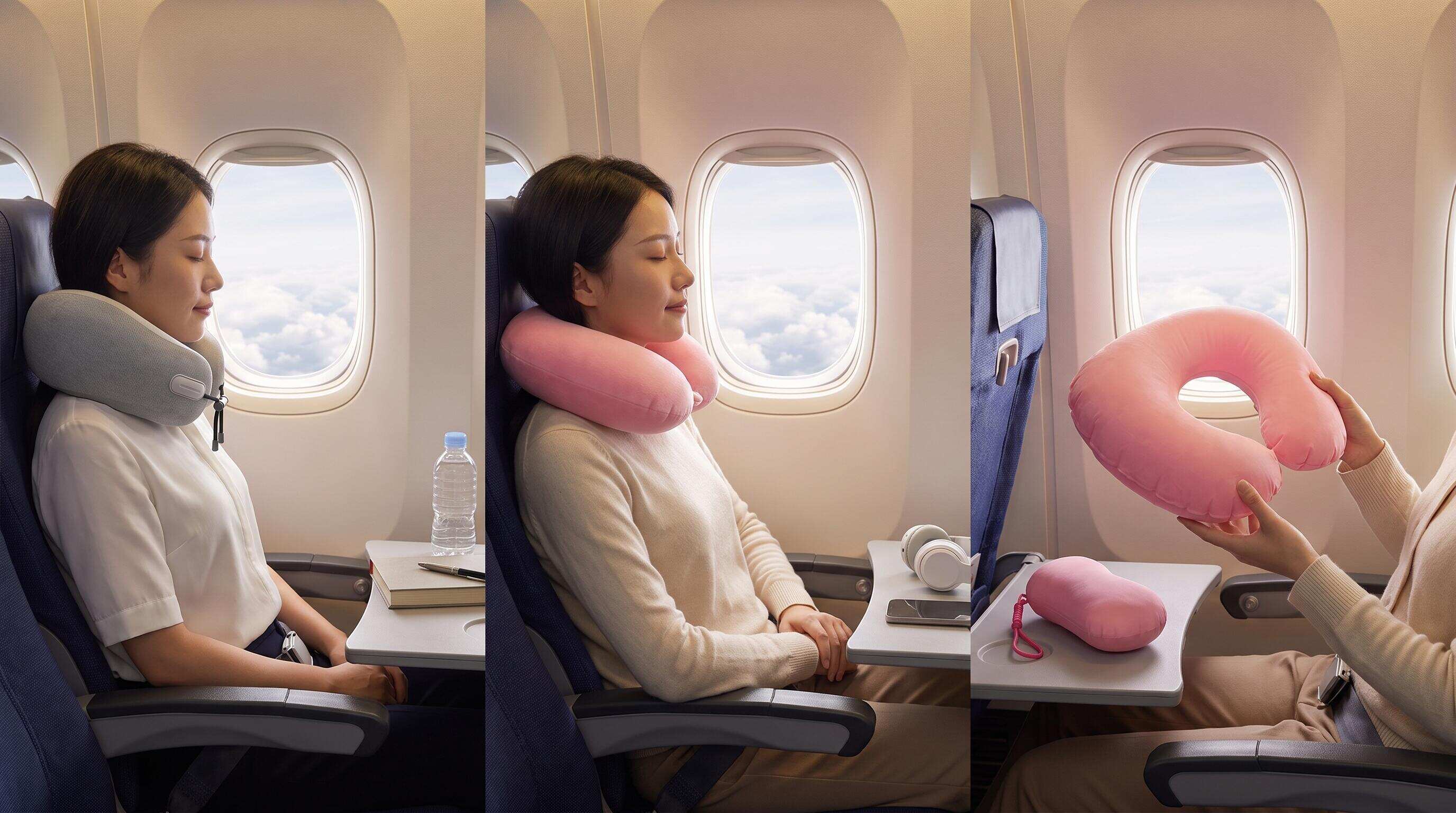
ALT: Traveler using a contour travel neck pillow on a long-haul flight for proper neck and cervical support during sleep
People Also Ask
Q1: How do I know which travel neck pillow will actually support my neck correctly?
The key is matching the pillow's loft and shape to your sleeping position in transit. If your head drops forward, you need a design with chin support (like a J-pillow or full-wrap style). If your head lolls sideways, a clip-on or side-sleeper design is more effective. As a general ergonomic principle, your neck should remain roughly aligned with your spine — not tilted forward or sharply to one side — throughout sleep. When in doubt, contour memory foam tends to be the most forgiving across positions because it adapts to your specific neck shape rather than imposing a fixed shape.
Q2: Are inflatable travel pillows as supportive as foam options?
Inflatable travel pillows can provide adequate support, but they are generally less consistent than foam equivalents. Foam — particularly viscoelastic memory foam — maintains a stable support profile throughout the night without requiring adjustment. Inflatables depend heavily on the firmness you inflate them to and the quality of the valve keeping that air pressure stable. For short flights or light sleepers, inflatables are often sufficient. For overnight routes or anyone with existing neck sensitivity, foam or full-wrap designs tend to perform more reliably over extended periods, per ergonomic sleep guidance from organizations such as the American Academy of Sleep Medicine.
Q3: How long does a quality travel neck pillow typically last, and when should I replace it?
A well-constructed memory foam or high-density filled travel pillow should maintain its support properties through regular use for a meaningful number of years, assuming it is stored properly (not compressed indefinitely) and its cover is washed regularly. Inflatables have a shorter functional lifespan, as valves and seams are subject to wear with repeated use. The clearest sign that any pillow needs replacing is loss of loft — when it no longer springs back to its original shape or feels noticeably flatter than when new, the support is gone regardless of how the exterior looks.
The Bottom Line
Choosing a travel neck pillow comes down to three honest factors: your sleep position in transit, your route length, and the physical properties of the materials you're sleeping against. There is no single best type — but there is almost certainly a best type for you specifically.
The three points worth carrying forward from this guide: first, the shape and loft of a travel pillow determine whether it actually supports your cervical alignment or simply adds a layer of padding with no structural benefit. Second, material quality and transparency matter for both comfort and safety, especially for allergy-prone travelers or anyone spending extended hours in contact with the pillow. Third, packability is a real consideration, but it should not automatically override support quality — a pillow you never want to use because it's uncomfortable is not a space-saving win.
The practical next step is to identify which sleep position category you fall into (upright, lateral, or forward-dropper), then use that as your primary filter before comparing options by material and packed size. If you are replacing a pillow that consistently let you down, it is worth asking honestly whether the type was wrong, not just the brand.
Ready to wake up feeling truly rested? Explore curated sleep solutions matched to your specific needs at SleepBetterMD — every product is hand-picked from trusted Asian manufacturers and presented with full material transparency, so you know exactly what you're sleeping with, whether at home or at 35,000 feet.
Sources
- American Academy of Sleep Medicine. "Sleep Health and Sleep Hygiene Guidance".
https://aasm.org/ - OEKO-TEX Association. "OEKO-TEX Standard 100 — Testing for Harmful Substances in Textiles".
https://www.oeko-tex.com/ - No Sleepless Nights. "The Best Travel Pillows: I Compare 10".
https://www.nosleeplessnights.com/travel-pillow-reviews/ - YouTube / Independent Review. "I compared 5 Popular Travel Pillows (AND one no one knows...".
https://www.youtube.com/watch?v=NIFN7Cz3mrE - Amazon Best Sellers. "Best Travel Pillows — Home & Garden Category".
https://www.amazon.com/Best-Sellers-Travel-Pillows/zgbs/home-garden/3732121
Note: Standards and guidance documents may be updated; please check the latest official publications or consult relevant professional advisors for current recommendations.