

ALT: Compact travel sleep kit with pillow, eye mask, and earplugs fitting neatly inside a carry-on bag
What Goes Into a Travel Sleep Kit — and Why Most Travelers Pack It Wrong
You board a red-eye, tuck your jacket behind your head, and spend the next eight hours hovering in that miserable half-sleep where you're aware of every announcement and every kick from the seat behind you. Most travelers have been there. The difference between arriving rested and arriving wrecked is rarely about the destination — it's about what you packed before you left.
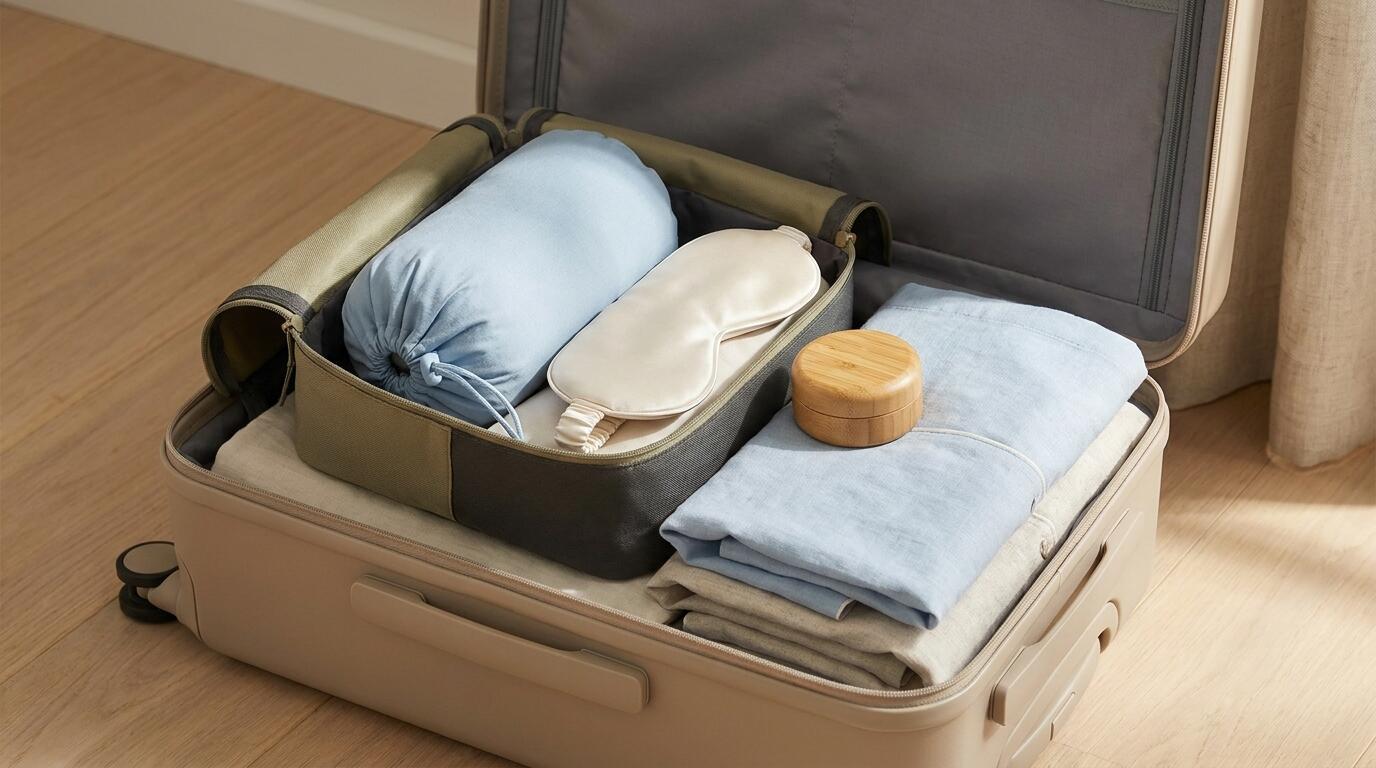
A travel sleep kit is a curated set of compact sleep aids — pillow, eye mask, earplugs, sleepwear, and supporting accessories — chosen specifically to recreate your best-possible sleep environment while away from home, all within carry-on limits. Done well, it fits in a packing cube and adds meaningful comfort on planes, trains, hotel beds, and anywhere your normal sleep setup simply doesn't exist. Done poorly, it's a bulky tote bag full of things you'll abandon by day two.
This guide compares the main options across every category in a travel sleep kit — from the pillow you choose to the sleepwear fabric you select — and gives you a clear framework for building one that actually works for your body, your trip type, and your luggage constraints.
What Makes a Travel Sleep Kit Genuinely Useful: The Evaluation Criteria
The best travel sleep kit balances five practical dimensions. Each one matters in a different way, and understanding the trade-offs between them is what separates a thoughtfully assembled kit from a collection of Amazon impulse purchases.
Packability and weight are the non-negotiables for carry-on travel. Anything that can't compress to roughly the size of a water bottle or fit flat in a packing cube will get left behind after the first trip. Weight adds up faster than travelers expect when you're already managing laptop, shoes, and toiletries.
Material quality and transparency determine how comfortable an item actually feels against your skin — and whether it will cause problems for sensitive sleepers. At SleepBetterMD, a pattern we consistently see is that travelers who've struggled with itchy eye masks or stuffy neck pillows almost always picked products without knowing what the fill or facing fabric actually was. Knowing that an eye mask is made from a specific grade of mulberry silk versus a polyester satin lookalike changes the purchase decision entirely.
Versatility across environments matters because a two-week trip might take you from a cold overnight flight to a hot, humid hotel room with thin pillows. Items that work only in one condition have limited value in a kit that needs to earn its keep across contexts.
Sleep-problem specificity is the criterion most guides ignore. A neck pillow is not the right answer for someone whose primary travel sleep problem is noise sensitivity, just as earplugs alone won't solve the problem for a light sleeper on a bright overnight bus. Matching each kit component to your actual sleep discomforts — rather than packing a generic list — is the highest-value move.
Durability and washability close the loop. Travel sleep items touch your face and skin repeatedly, often in environments where allergens and bacteria accumulate. If an item can't be hand-washed in a hotel sink and dry overnight, it has a hidden maintenance cost that compounds across every trip.
The Contenders: Every Major Category in a Carry-On Sleep Kit
Travel Pillows: Inflatable vs. Compressible Fill vs. Memory Foam
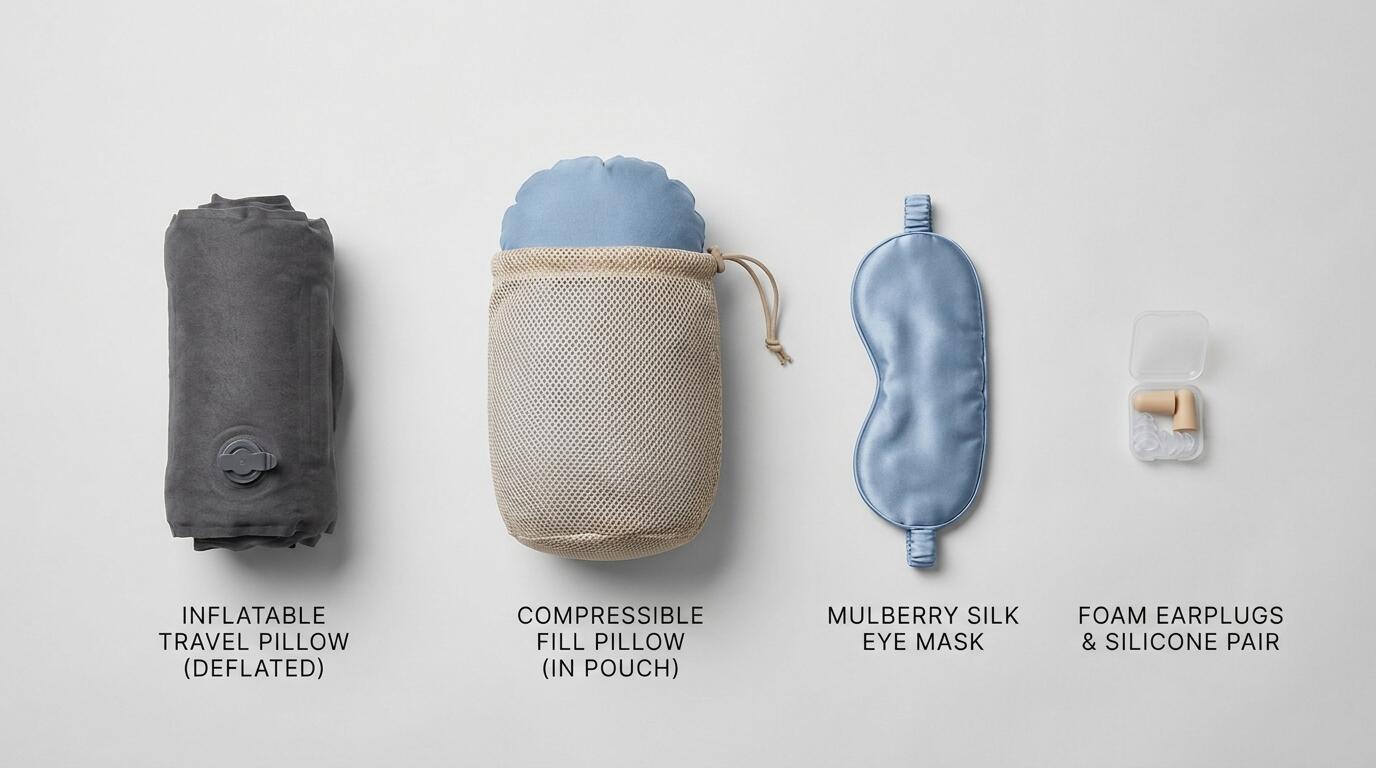
Travel pillows are the anchor of any kit, and the options have diverged significantly. Inflatable travel pillows compress to almost nothing and can be adjusted for firmness by varying the air volume, but they carry a real risk of the valve failing mid-trip and offer no meaningful loft customization. They're best for travelers whose primary concern is pack size over sleep quality.
Compressible fill pillows — using down alternatives, microfiber clusters, or natural fills like buckwheat — offer a much closer approximation to your pillow at home. They compress into a small pouch and expand when unpacked. The quality range is wide: a poorly constructed compressible pillow will clump or go flat within a few uses, while a well-made one from a manufacturer with disclosed fill specifications will hold its loft consistently. For side sleepers especially, getting the fill type right is critical — a subject explored in depth in What Type of Pillow Is Best for Comfortable and Healthy Sleep?
Memory foam travel pillows offer the most consistent support but compress the least. They're best suited for travelers who use a full-size bag or check luggage, or who want reliable cervical support on long-haul flights regardless of pack constraints.
Eye Masks: Silk vs. Foam-Padded Fabric vs. Contoured Hard Shell
Eye masks do one job: block light. The differentiation is in how they block it, what they're made of, and how they sit on your face. Flat fabric masks made from lower-grade synthetics are inexpensive but tend to press against the eyelids, which disrupts REM sleep — a stage in which the eyes move rapidly and need freedom of movement.
Silk masks, particularly those made from mulberry silk, are the gold standard for face comfort. They're thermoregulating, smooth against the skin, and far gentler for anyone who sleeps with contact lenses or has sensitive skin around the eyes. The practical test is simple: if the mask leaves marks on your face or feels warm after twenty minutes, the material isn't working for you.
Contoured hard-shell masks — shaped like a pair of cupped goggles — are the choice for travelers who need complete blackout without any fabric touching their eyes at all. They're bulkier but genuinely effective for light-sensitive sleepers.
Earplugs and Sound Solutions: Foam vs. Silicone vs. White Noise
Disposable foam earplugs remain the most space-efficient noise solution in existence, and they work — but they require proper insertion technique to achieve their rated attenuation, and repeated use requires replacement to prevent hygiene issues. Reusable silicone earplugs offer a cleaner option with a better fit profile for many users and pack small in a hard case.
White noise devices — whether a dedicated travel speaker or a smartphone app — serve a different function: they don't block noise, they mask it. For travelers whose problem is inconsistent noise (snoring partners, thin hotel walls, unpredictable city sounds), white noise is often more effective than trying to achieve full acoustic isolation with earplugs alone. According to sleep researchers at the National Sleep Foundation, creating a consistent audio environment can meaningfully reduce the number of nighttime awakenings.
Travel Sleepwear: Lightweight Fabrics That Regulate Temperature
Sleepwear is underrepresented in most travel sleep kit guides, but it's one of the highest-impact variables — particularly for travelers crossing time zones or moving between air-conditioned planes and warm destinations. The principle here is thermoregulation: fabrics that breathe and wick moisture help your body maintain the temperature drop it needs to enter and sustain deep sleep.
Natural fiber options like lightweight modal, bamboo-derived fabric, or a cotton-linen blend perform well across a range of environments. Synthetic performance fabrics can work for colder conditions but often feel clammy on warmer nights. If you run warm at night or know that hotel HVAC is unpredictable, choosing cooling pajamas with verified breathable materials is a genuinely useful pre-trip decision rather than an afterthought.
Supporting Accessories: Neck Support, Light Therapy, and Melatonin-Adjacent Tools
The supporting layer of a travel sleep kit includes items like portable neck rolls, cooling or warming gel eye masks that pull double duty, compression socks for flight-related leg discomfort, and small-format sleep sprays with lavender or other calming botanicals. None of these are essential for every traveler, but each addresses a specific sleep problem that some travelers face consistently. The key is selecting only the items that correspond to your actual discomforts — not packing everything "just in case."
ALT: Side-by-side comparison of inflatable travel pillow, compressible fill pillow, silk eye mask, and foam earplugs for carry-on sleep kit
Head-to-Head Comparison: How Every Kit Component Stacks Up
| Criterion | Inflatable Travel Pillow | Compressible Fill Pillow | Silk Eye Mask | Foam Contoured Eye Mask | Foam Earplugs | Silicone Earplugs | Lightweight Natural Sleepwear |
|---|---|---|---|---|---|---|---|
| Pack size | Excellent (deflates flat) | Good (compresses to pouch) | Excellent (folds flat) | Fair (rigid shell) | Excellent | Good (hard case needed) | Good (rolls or folds) |
| Sleep quality support | Moderate | High | High | High | High | High | High |
| Skin/material comfort | Moderate | High (fill-dependent) | High (mulberry silk) | Moderate | Low (foam) | High | High (fabric-dependent) |
| Versatility (environments) | Moderate | High | High | Moderate | High | High | High |
| Durability/washability | Low (valve risk) | High | High (hand wash) | Moderate | Low (disposable) | High | High |
| Cost efficiency | High | Moderate | Moderate–High | Low–Moderate | High | Moderate | Moderate–High |
The most striking pattern in this comparison is how consistently the fill pillow and silk eye mask outperform their cheaper alternatives across nearly every dimension that actually affects sleep quality — while their pack-size disadvantage compared to inflatables or flat masks is relatively modest in practice.
The foam earplug scores well on packability and cost but carries two real limitations: the hygiene requirement of regular replacement, and the technique sensitivity of proper insertion. Research published through the National Institutes of Health notes that improper earplug insertion can reduce effective noise attenuation to a fraction of the rated level — which means a traveler who buys high-rated earplugs but doesn't insert them correctly may get no meaningful noise reduction at all.
Lightweight natural sleepwear earns a consistently high rating across criteria but is often excluded from sleep kit comparisons because it's treated as clothing rather than a sleep product. That distinction misses the functional point: what you wear to sleep is part of your sleep environment, and it has a measurable effect on thermoregulation and comfort in unfamiliar climates. As Calm notes in their guide to assembling a sleep travel kit, the best-performing kits treat sleepwear as a core component rather than an optional addition.
Which Should You Choose? Scenario-Based Recommendations for Every Traveler
If you're a frequent long-haul flier who needs reliable cervical support, a compressible fill pillow with disclosed fill specifications is the most durable and sleep-effective choice over repeated flights. Skip the inflatable option — valve failure mid-trip eliminates your pillow entirely, and the loft is too variable for side and combination sleepers.
If your primary travel sleep problem is light sensitivity, invest in a silk eye mask with full blackout coverage rather than a generic padded one. The skin comfort difference over an eight-hour flight is substantial, and a well-made silk mask folds so flat it effectively takes no space.
If you share a hotel room or tend to book budget accommodation, the combination of silicone reusable earplugs plus a white noise app is more versatile than either alone — you can adjust the masking level based on the specific noise environment each night.
If you tend to overheat on planes or in hotels, the single highest-return change you can make is to your sleepwear. Prioritize lightweight, breathable natural fibers over synthetics, and treat this as a kit essential rather than a nice-to-have.
If you're building your first travel sleep kit on a moderate budget, the hierarchy of priorities should be: eye mask first (highest impact, lowest weight), earplugs second (smallest cost, high impact for light sleepers), compressible pillow third (largest investment, but the most versatile across years of travel), and sleepwear last (if you don't already have appropriate lightweight options). For a structured approach to evaluating the trade-offs involved in product selection, comparing sleep products by material, function, and long-term value is a helpful framework to apply.
Pros and cons summary:
Compressible fill pillow: high sleep quality, durable, versatile — takes the most space and costs more than inflatables.
Silk eye mask: premium comfort, thermoregulating, long-lasting — higher upfront cost than synthetic alternatives.
Silicone earplugs: hygienic, reusable, effective — require a hard case to travel safely.
Natural fiber sleepwear: excellent for temperature regulation across environments — requires thoughtful packing to avoid wrinkling.
Frequently Asked Questions FAQ
Q1: How do I keep my travel sleep kit compact enough to fit in a carry-on alongside everything else I'm packing?
The best strategy is to assign everything in your kit a compression limit — each item should pack down to roughly the size of a standard water bottle or smaller. Silk eye masks and foam earplugs have almost no footprint. For pillows, choose compressible fill over memory foam if carry-on space is tight. A single medium packing cube can house a full kit without meaningfully reducing space for clothing, and items like sleepwear count toward both your kit and your clothing allowance simultaneously.
Q2: Is a silk eye mask worth the higher cost compared to a standard fabric one for travel?
Yes, particularly for travelers who sleep on long-haul flights or are sensitive around the eye area. Mulberry silk is naturally thermoregulating, smooth against skin, and doesn't press against the eyelids during REM sleep. Over multiple trips, a high-quality silk mask outlasts several rounds of cheaper alternatives — making the per-use cost comparable. The comfort difference is most noticeable after more than four hours of wear, which is exactly the window that matters most on an overnight flight.
Q3: How much should I expect to spend to build a functional travel sleep kit from scratch?
Building a well-considered kit — compressible fill pillow, silk or padded eye mask, reusable earplugs, and one set of lightweight sleepwear — typically represents a moderate one-time investment that pays dividends across years of travel. The priority items (eye mask and earplugs) can be assembled at relatively low cost, while the pillow and sleepwear carry higher upfront value. Focusing on material transparency when purchasing ensures you're paying for actual performance rather than packaging.
Key Takeaways
- A travel sleep kit is most effective when it's built around your specific sleep problems — noise sensitivity, light sensitivity, temperature dysregulation, or cervical discomfort — rather than a generic checklist.
- The pillow and eye mask categories show the clearest quality differentiation: compressible fill pillows and silk eye masks consistently outperform cheaper alternatives in real sleep conditions.
- Material transparency matters as much in travel sleep products as it does in your home sleep setup — knowing what a product is made of is the fastest way to evaluate whether it will actually work for your body.
- Lightweight natural sleepwear is an underrated kit component with a high impact-to-pack-weight ratio, especially for travelers crossing climate zones.
- The carry-on constraint is a feature, not a limitation — it forces prioritization that actually results in a more useful, lighter kit than travelers who pack everything manage to assemble.
Start with the item that addresses your biggest sleep problem on the road, get the material right, and build from there. A purposefully assembled kit of four or five items will outperform a stuffed bag of a dozen generic ones every time.
Ready to build a travel sleep kit that actually works? Explore SleepBetterMD's curated collection of pillows, sleepwear, bedding, and sleep accessories — hand-picked from 20+ trusted Asian manufacturers with full material transparency, so you know exactly what you're taking on your next trip.
Sources
- Calm. "How to build a sleep travel kit for better sleep while traveling".
https://www.calm.com/blog/whats-in-my-sleep-travel-kit-and-how-to-assemble-your-own - National Sleep Foundation. Sleep health research and sleep hygiene guidance.
https://www.thensf.org/ - National Institutes of Health (NIH). Sleep research and noise attenuation studies.
https://www.nih.gov/ - Amazon. "3-in-1 Airplane Sleep Support System".
https://www.amazon.com/Airplane-Sleep-Support-System-Blanket-Like/dp/B0DPBF69C3
Note: Standards and guidelines may be updated; please check the latest official documents or consult professional advisors.