

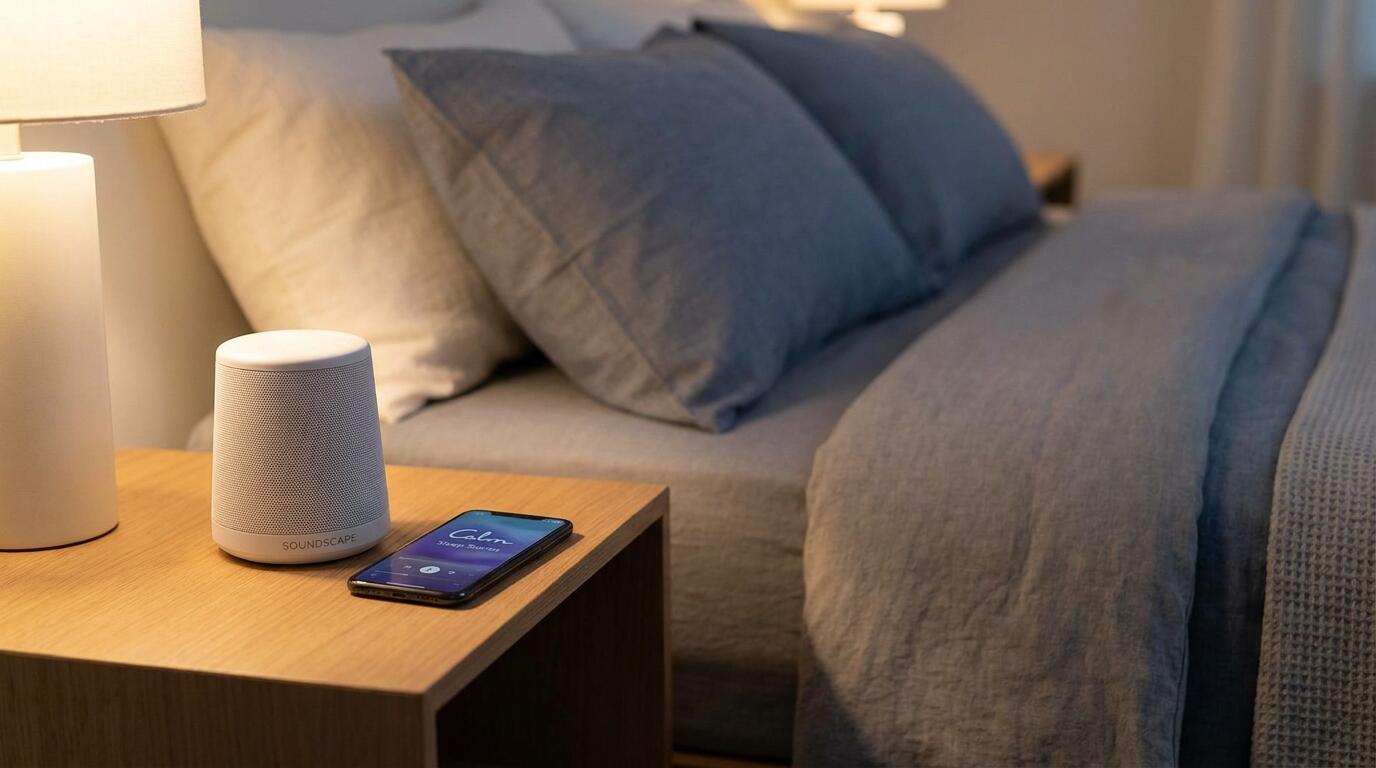
ALT: Comparing the best white noise machines and sleep apps for deep, uninterrupted sleep at night
White Noise Machines vs. Sleep Apps: Which Actually Delivers Deep, Uninterrupted Sleep?
Key Conclusion: Finding the best white noise machine or sleep app for deep, uninterrupted sleep depends on your specific noise environment, lifestyle, and how you like to wind down. This guide cuts through the marketing noise — no pun intended — to compare the most effective options across hardware machines and digital apps, so you can match the right tool to your actual sleep problem. Whether you're a light sleeper in a noisy city apartment, a new parent craving quiet, or a remote worker whose home office bleeds into your bedroom, there's a solution here for you.
The options below were selected based on their effectiveness at masking disruptive sounds, ease of use, sound quality, and how well they fit different lifestyles and budgets. We've drawn on the patterns we consistently see in our work at SleepBetterMD — where we talk daily with people who've tried everything and still wake up at 3 a.m. Use this list as a practical starting point: scan the "Best for" and "Watch out" notes, then trust the comparison table to narrow it down fast.
The Best White Noise Machines and Sleep Apps, Ranked by Real-World Fit
Dedicated White Noise Machines: The Hardware Case
A white noise machine is a standalone electronic device that generates continuous ambient sound — typically fan-based mechanical noise or digitally synthesized audio — to mask environmental disruptions like traffic, neighbors, or snoring partners. Unlike a phone app, it doesn't compete with your other nighttime phone habits, doesn't drain your smartphone battery, and doesn't push you notifications while you're trying to fall asleep.
In our experience, people who struggle most with noise sensitivity and find themselves waking multiple times a night often see the biggest improvement by switching from an app to a dedicated device. That said, hardware comes with its own trade-offs worth knowing upfront.
LectroFan Classic (or its current equivalent from Adaptive Sound Technologies)
The LectroFan Classic is a compact, mains-powered white noise machine that produces non-looping, electronically generated fan sounds and white, pink, and brown noise variants — meaning the audio never repeats in a recognizable pattern, which is a key advantage over lower-cost machines that loop short audio clips.
Non-looping sound is a surprisingly big deal. A pattern we consistently see: people who initially love a budget machine start noticing the loop after a few weeks and find it more distracting than soothing. Non-looping machines eliminate that problem entirely. The LectroFan offers multiple volume levels and sound variations, making it genuinely versatile for different room sizes and sensitivity levels.
According to IntraSleep's comparison of white noise machine features, the ability to produce non-looping, electronically generated audio rather than recorded loops is one of the most meaningfully differentiating features in the white noise machine category — and it's often underemphasized in product marketing.
Best for: Light sleepers, people in urban apartments with consistent ambient noise (traffic, HVAC, street sounds), and anyone who has already tried a looping machine and found it insufficiently immersive.
Watch out: It requires a power outlet, which limits portability. If you travel frequently and want a bedside sound solution, you'll need to either pack it or find a travel-specific alternative.
Marpac Dohm Classic (Mechanical Fan Machine)
The Marpac Dohm Classic is a mechanical white noise machine — meaning it uses a real internal fan to generate sound rather than digital audio. This produces a uniquely natural, airy tone that many users find distinctly more soothing than digital approximations. It's one of the longest-standing products in the sleep sound category, and its longevity is itself a kind of proof of concept.
The mechanical nature means there's genuinely no digital loop, no file playing — just actual moving air creating consistent sound. For people who find digital white noise too "clean" or artificial, the Dohm often feels more natural. The trade-off is less variety: you get one sound, adjustable in tone and volume by rotating the housing, but nothing else.
Best for: People who dislike the slightly synthetic quality of digitally generated noise and prefer something that sounds more like a real appliance running in the room — a kind of ambient familiarity.
Watch out: The motor can develop a slight hum or rattle over time, particularly in older units. It's also louder at lower frequencies than some digital machines, which may not suit very sensitive sleepers or light-sleeping partners.
Hatch Restore (Smart Sleep Machine with Alarm)
The Hatch Restore is a smart bedside device that combines white noise and sleep sounds with a sunrise alarm light and a guided sleep routine — essentially a sleep coaching tool built into a single device. It connects to an app but functions primarily as a hardware unit on your nightstand.
What distinguishes it is the integration of a full wind-down routine: you can program it to dim a warm reading light, transition into sleep sounds, and then wake you gradually with increasing light rather than a jarring alarm. A pattern we see consistently in our work is that people focus almost entirely on falling asleep, overlooking how dramatically their morning alarm affects their overall sleep quality. The Hatch addresses both ends.
Best for: People who want more than just sound — particularly those working on building consistent sleep and wake routines, or anyone who wakes abruptly to a harsh alarm and feels groggy throughout the morning.
Watch out: It requires a subscription for full access to its sound and meditation library. The device itself is an investment, and without the subscription, functionality is noticeably limited. Evaluate the ongoing cost honestly before committing.
Calm App (Sleep Stories and Ambient Sound)
Calm is a sleep and meditation app — available on iOS and Android — that offers guided sleep stories narrated in deliberately low, steady voices, alongside a library of ambient sounds, nature soundscapes, and relaxation music. It's less about pure noise masking and more about redirecting a racing mind toward something calm and undemanding enough to ease you into sleep.
Sleep stories are particularly effective for people whose sleep problem is primarily cognitive — the mind that simply won't stop replaying the day or anticipating tomorrow. Pure white noise does nothing for that pattern; something that holds just enough of your attention to stop the internal monologue, without being interesting enough to keep you awake, is the smarter tool.
Best for: Professionals and people with anxiety-adjacent sleep disruption — those who lie awake thinking rather than those whose sleep is interrupted by external sounds.
Watch out: Calm requires an annual subscription, and its effectiveness depends heavily on personal preference for voice and storytelling style. If you find the narrators grating or the stories unengaging, the whole premise falls apart. Use a free trial to test it with your own sleep environment before committing.
BetterSleep App (Layered Sound Mixing)
BetterSleep is a sleep app — available on the App Store — that allows users to layer multiple ambient sounds simultaneously, mixing, say, rain on a window with distant thunder and soft brown noise to create a personalized soundscape. This level of customization sets it apart from apps that simply offer a library of presets.
The layering function is more useful than it might initially sound. Different sleep problems respond to different sonic frequencies and textures. Brown noise, for instance, has a deeper, lower rumble than white noise and is often preferred for people who find white noise too sharp or bright. The ability to blend sounds means you can tune your environment to your specific sensitivity rather than accepting a one-size preset. Per the BetterSleep app's own description of its feature set, the customization is designed to let users build a sound environment tailored to their individual preferences rather than choosing from a fixed menu.
Best for: Experimenters and people who've tried standard white noise and found it flat — those who want to actively build their ideal sleep sound environment rather than passively accept a default.
Watch out: Using your phone as your primary sleep sound device means it's on, lit, and nearby all night. Even with screen off and notifications silenced, the temptation and blue light exposure are real. A dedicated Bluetooth speaker paired with your phone mitigates this somewhat.
Spotify and YouTube (Free Ambient Playlists)
Spotify and YouTube both host extensive libraries of ambient sleep sounds — white noise, brown noise, rain, ocean waves, lo-fi sleep music — available free or at existing subscription cost. For many people, this is genuinely sufficient, particularly if you already pay for Spotify and have a smart speaker or Bluetooth device in your bedroom.
The honest reality is that the underlying sound physics of white noise work regardless of the platform delivering them. If a ten-hour brown noise track on YouTube does the job for you, that's a completely valid sleep solution. We'd never push someone toward a paid product when a free one genuinely works.
Best for: Budget-conscious sleepers who want to test whether ambient sound helps their sleep before investing in dedicated hardware or a paid app subscription.
Watch out: Ads interrupt free-tier playback on both platforms, which is a genuine problem at 2 a.m. Spotify Free and YouTube without Premium will interrupt your soundscape. This is a real limitation worth solving before you commit to using either as your primary sleep sound source.
Oura Ring (Sleep Tracking to Inform Sound Choices)
The Oura Ring is a wearable health tracking device worn on the finger that monitors sleep stages, heart rate variability, and body temperature throughout the night — giving you data-informed insight into whether your current sleep environment is actually working. It doesn't produce sound, but it belongs in this list because it changes how intelligently you can use every other tool here.
A limitation we see consistently: people try a white noise machine or app for a week, feel slightly better, and assume it's working — without any objective measure of whether their deep sleep and REM cycles actually improved. The Oura Ring closes that gap. It lets you compare sleep quality across different sound environments and make evidence-based adjustments rather than relying purely on subjective morning feel.
Best for: Analytically minded sleepers, wellness enthusiasts who already track other health metrics, and anyone who wants to move from guessing to knowing when optimizing their sleep setup.
Watch out: Sleep tracking devices, including the Oura Ring, measure movement and physiological signals as proxies for sleep stages — they do not directly measure brain activity. Treat the data as directional rather than clinical. The ring is also a meaningful upfront investment.
Your Sleep Environment Itself (Bedding, Temperature, Pillow Support)
Sound is only one variable in your sleep environment, and often not the most powerful one. A pattern we see constantly in our work at SleepBetterMD is that people invest in audio solutions while sleeping on an ill-fitting pillow, in bedding that runs hot, or in a room that doesn't support the body temperature drop that quality sleep requires.
No white noise machine — however sophisticated — will fully compensate for a sleep environment that's working against your body. At SleepBetterMD, we approach sleep improvement from a problem-first lens: start with what's actually waking you up, then address the right variable. Sound masking is powerful when noise is the problem. But if you're waking up hot, stiff, or restless, the answer lives in your bedding and support layers — and that's where material transparency really matters.
Best for: Anyone who has tried multiple sound solutions without satisfying results and suspects the root cause may lie elsewhere in their sleep environment.
Watch out: This isn't a reason to skip sound optimization — it's a reason to stack it with the right physical environment. The best outcomes we see come from people who address both.
Quick Comparison at a Glance
Summarizing the above options to help you identify your best fit at a glance.
| Item | Best For | Key Strength | Limitation |
|---|---|---|---|
| LectroFan Classic | Urban light sleepers, consistent noise environments | Non-looping electronic audio, wide sound variety | Requires power outlet; less portable |
| Marpac Dohm Classic | Those who prefer natural, mechanical sound | Authentic fan-generated tone, no digital loop | Limited sound options; motor can degrade |
| Hatch Restore | Routine-builders, people with harsh wake-ups | Full sleep/wake routine in one device | Subscription required for full library |
| Calm App | Cognitive over-thinkers, anxiety-adjacent insomnia | Sleep stories that redirect a racing mind | Subscription cost; voice/story preference dependent |
| BetterSleep App | Sound experimenters, custom soundscape builders | Layered, mixable ambient sounds | Phone stays active; blue light risk |
| Spotify / YouTube | Budget-conscious testers | Free access to vast ambient sound libraries | Ads interrupt free tiers at night |
| Oura Ring | Data-driven sleep optimizers | Objective sleep quality feedback loop | Upfront cost; data is proxy-based, not clinical |
| Sleep Environment (bedding, pillow, temperature) | Those whose problem isn't primarily noise | Addresses root physical causes of poor sleep | Requires a separate product evaluation process |
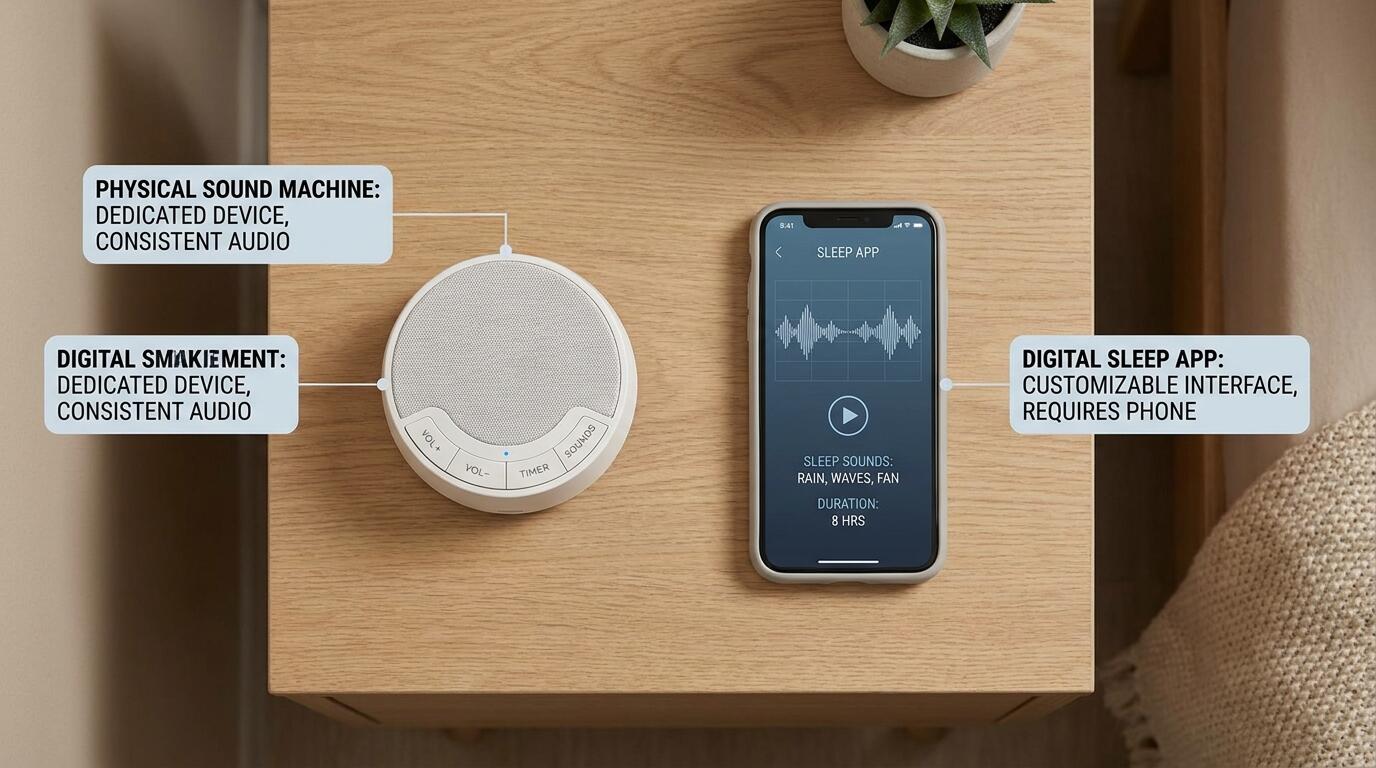
ALT: Side-by-side comparison of white noise machine and sleep app on nightstand for choosing the right deep sleep solution
How to Choose the Right White Noise Machine or Sleep App for Your Sleep Problem
The right choice comes down to one question first: what is actually disrupting your sleep?
If external noise — traffic, a snoring partner, upstairs neighbors — is the primary culprit, a dedicated white noise machine like the LectroFan Classic or Marpac Dohm will generally outperform an app. Hardware devices produce consistent, reliable sound without requiring your phone to stay active, and their audio quality is optimized for one specific purpose.
If your sleep disruption is more internal — a mind that races, difficulty switching off after a stressful day — an app like Calm that offers sleep stories or guided relaxation is likely to serve you better than pure noise masking. White noise does nothing for cognitive arousal; it needs a partner tool.
If you're genuinely unsure what's disrupting your sleep, start with a free option (a brown noise playlist on Spotify or YouTube) to test whether ambient sound helps at all. If it does, you'll know audio is a meaningful variable and can invest in hardware or a premium app accordingly. If it doesn't, look at your physical sleep environment — your pillow, your bedding temperature, your room temperature — before spending more.
One common misconception worth clearing up: many people assume "white noise" means one thing. In practice, white noise (equal energy across all frequencies), pink noise (louder at lower frequencies), and brown noise (even more bass-heavy) produce meaningfully different sensations and work better for different people. Most quality hardware machines and apps offer all three. Start with brown noise if you find white noise too harsh or fatiguing — a large number of people who "don't like white noise" simply haven't tried the right frequency variant.
According to research published by the National Institutes of Health, consistent ambient sound can help reduce the contrast between background noise and disruptive sounds, reducing arousal responses during sleep — though individual responses vary considerably.
Common Questions
Q1: How loud should a white noise machine or sleep app be set for safe, effective sleep?
The general guidance from sleep and hearing health professionals is to keep ambient sleep sound below 65 decibels at the point of listening — roughly the volume of a normal conversation. For most people, a comfortable, mask-effective level is well below this. Set your machine or app loud enough that you stop noticing disruptive sounds, then reduce it slightly. Louder is not meaningfully more effective once masking is achieved, and sustained high-volume exposure overnight is worth avoiding, particularly for infants and young children.
Q2: Are white noise machines or sleep apps safe to use every night long-term?
For most healthy adults, using ambient sound nightly is considered safe and does not appear to cause dependency in a harmful sense. Some people do find it harder to sleep without their usual sound environment after extended use — a pattern of contextual association rather than physiological addiction. If this concerns you, gradually vary the sound type or volume over time rather than relying on a single fixed setting every night. Consult a sleep specialist if you have specific concerns about hearing health or sleep disorders.
Q3: How long does it take to see a difference when starting a white noise machine or sleep app?
Most people notice a difference in time to fall asleep within the first few nights, though adapting to a new sleep sound environment can take up to two weeks to feel fully natural. Per a pattern we consistently observe, the initial novelty of a new sound can briefly disrupt sleep before it becomes background. Give any new approach at least ten to fourteen nights of consistent use before evaluating whether it's genuinely working — one or two difficult nights early on aren't a fair verdict.
Summary
Choosing the best white noise machine or sleep app comes down to correctly identifying what's actually breaking your sleep — external noise, an overactive mind, a disrupted routine, or a physical environment that's fighting your body's needs.
Key Takeaways:
- Dedicated white noise machines outperform phone apps for consistent external noise masking, particularly when non-looping audio is a feature.
- Sleep apps like Calm are better suited for cognitive sleep disruption — racing thoughts, stress, and anxiety — than for pure noise masking.
- Brown noise is often better tolerated than white noise for people who find standard white noise too sharp or bright.
- Tracking sleep quality objectively (with a device like the Oura Ring) is the fastest way to know whether any intervention is actually working, rather than relying on morning guesswork.
- Sound is one variable. If you've optimized it without satisfying results, your pillow, bedding material, and room temperature are the next places to look.
The most effective sleep setups we see aren't built around a single product — they're layered, deliberate environments where sound, support, and temperature all work together. Start with the variable most likely to be your problem, fix it properly, and build from there.
Ready to wake up feeling like a different person? Visit SleepBetterMD to find your perfect sleep match today — every pillow, sheet, and sleep accessory is handpicked from trusted Asian manufacturers, with full material transparency, so you can shop by your actual sleep problem, not just a pretty label.
Sources & Further Reading
- National Institutes of Health (NIH). "Sleep and Ambient Sound Research".
https://www.nih.gov/ - IntraSleep. "White Noise Machines Compared: Features That Elevate Your Sleep".
https://intrasleep.com/blog/article/white-noise-machines-compared-features-that-elevate-your-sleep - BetterSleep: Relax and Sleep — App Store Listing.
https://apps.apple.com/ro/app/bettersleep-relax-and-sleep/id314498713 - Le Stallion. "7 Best White Noise Sound Machines for Sleep at Office Desk".
https://lestallion.com/blogs/product-reviews/best-white-noise-sound-machines-for-sleep-at-office-desk?srsltid=AU7gw4VUccSFj2Chg3o0nDiMnCVnympLIPeMXTEPQFqdC3qRQom4vQ6b
Note: Standards and research may be updated; please check the latest official documents or consult professional advisors for current guidance.